Contents
- Overview and origin
- Purpose and main structure
- 2.1. Two versions and two types of indicators
- 2.2. The 8-part structure of the medium & large version
- 2.3. Full list of the 166 indicators (medium & large version)
- Part V – Performance indicators over three years, 2023–2025 (Index I, 35 indicators)
- Part VI – Corporate governance indicators (Index G, 25 indicators)
- Part VII – Environmental indicators (Index E, 31 indicators)
- Part VIII – Labour and social indicators (Index L&S, 75 indicators)
- Who uses it and how
- Practical example
- Notes for use in Vietnam
Overview and origin
| Item | Details |
|---|---|
| Vietnamese name | Bộ chỉ số Doanh nghiệp bền vững (Bộ chỉ số CSI) |
| English name | Corporate Sustainability Index (CSI) |
| Issuer / administrator | Vietnam Chamber of Commerce and Industry (VCCI), with the Vietnam Business Council for Sustainable Development (VBCSD) at its core. The 2026 Programme Steering Committee includes the Central Policy and Strategy Commission, the Ministry of Agriculture and Environment, the Ministry of Home Affairs, the Ministry of Finance and the Vietnam General Confederation of Labour. |
| Nature | A voluntary index that serves both as an internal self-assessment/management tool and as the scoring and ranking yardstick of the Programme for Evaluating and Announcing Sustainable Companies in Vietnam (the CSI Programme). It is not a certification and not a legal requirement. |
| Reference scope | Four pillars – Economic, Environmental, Social, Governance; references GRI, ISSB, TCFD, the UN Guiding Principles on Business and Human Rights (UNGPs) and Vietnamese law (Enterprise Law, Law on Environmental Protection 2020, Labour Code 2019, Law on Occupational Safety and Hygiene, etc.). |
VCCI first introduced CSI in 2016; it is Vietnam's first index for assessing corporate sustainability. 2026 marks the Programme's 11th consecutive edition. After 10 editions, more than 4,500 company entries had taken part directly and over 10,000 had used CSI as an internal self-assessment tool.
Crucially, CSI is updated every year: the number of indicators, parts and content change with the law and international trends (130 indicators/7 parts in 2023; 153/6 in 2024; 145/7 in 2025; 166/8 in 2026). Companies must always use the version for the assessment year.
Purpose and main structure
CSI has three purposes: (1) help companies look honestly at their compliance and sustainability management capacity; (2) provide a clear improvement path from “must do” to “should do”; and (3) create a basis to recognise and announce leading companies, spreading good practice. The CSI 2026 message is to shift management thinking from “compliance” to “long-term value creation”.
2.1. Two versions and two types of indicators
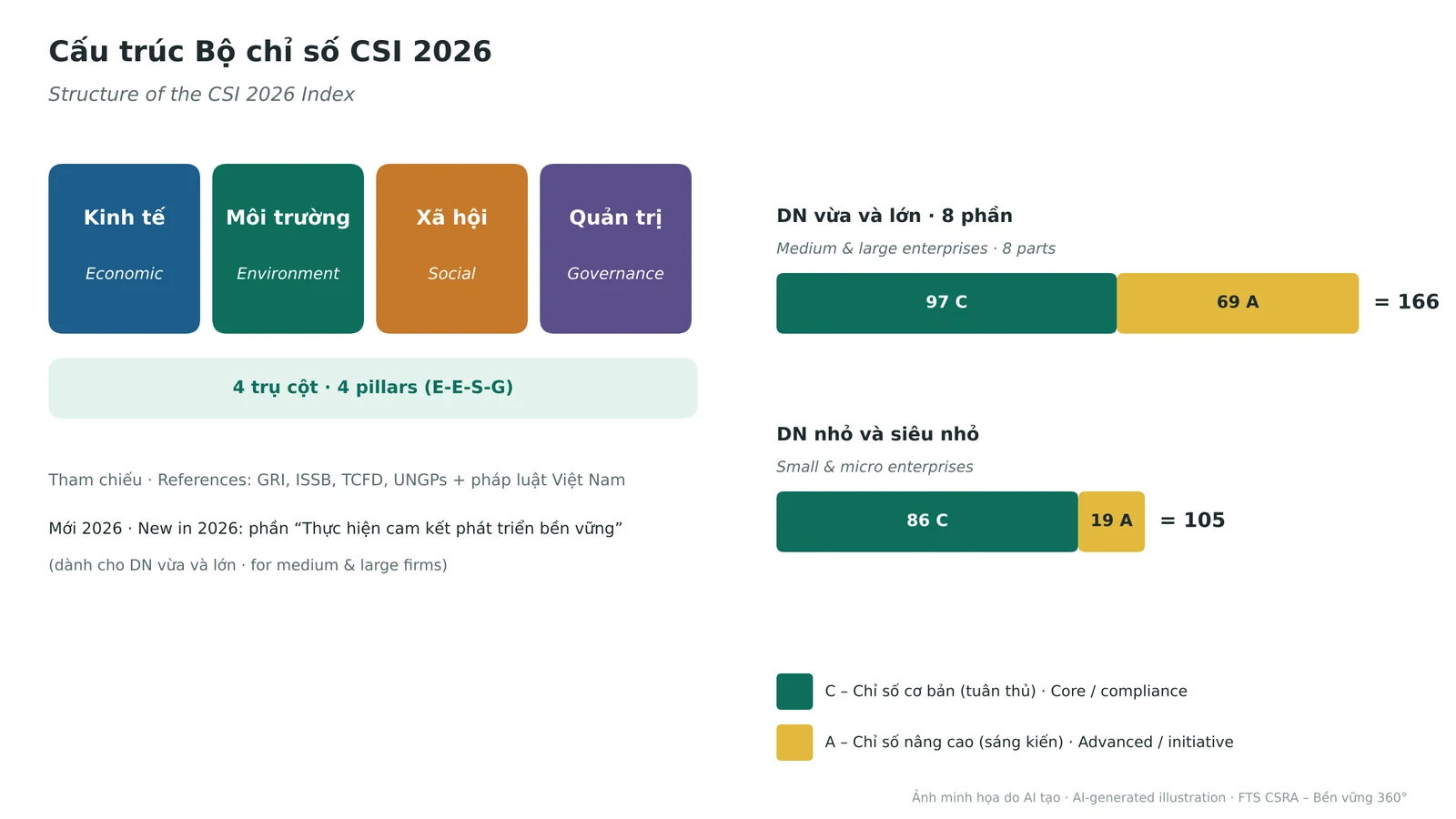
| CSI 2026 version | Total indicators | Core indicators (C) | Advanced indicators (A) |
|---|---|---|---|
| Medium & large enterprises (8 parts) | 166 | 97 (≈58%) | 69 (≈42%) |
| Small & micro enterprises | 105 | 86 (≈82%) | 19 (≈18%) |
- Core indicators (C – Compliance): reflect compliance with the law. They are the “necessary condition” – without them a company can hardly be rated sustainable.
- Advanced indicators (A – Advanced): reflect initiatives and practices beyond compliance (e.g., emission-reduction targets, circular economy, benefits above statutory levels).
- New in 2026: a new part, “Delivering on sustainability commitments”, for medium and large firms, requiring them to set out their commitments, actions and results against their sustainability goals.
2.2. The 8-part structure of the medium & large version
The CSI 2026 Index for medium and large enterprises has two blocks. Block A – Corporate overview (Parts I–IV) consists of disclosure forms scored on completeness. Block B – Rating indicators and grading scale (Parts V–VIII) contains 166 coded indicators, each labelled C (core) or A (advanced).
| Part | Content | Points/Indicators |
|---|---|---|
| I | Corporate information | 40 points (disclosure) |
| II | Organisational structure, model and key personnel | 20 points (disclosure) |
| III | Materiality analysis matrix | 15 points (disclosure) |
| IV | Delivering on sustainability commitments (new in 2026) – economic, governance, environmental, labour-social | 20 points (disclosure) |
| V | Performance indicators over three years, 2023–2025 (code I) | 35 indicators |
| VI | Corporate governance indicators (code G) | 25 indicators |
| VII | Environmental indicators (code E) | 31 indicators |
| VIII | Labour and social indicators (codes L and S) | 75 indicators |
2.3. Full list of the 166 indicators (medium & large version)
The indicator titles below are condensed by FTS CSRA from the CSI 2026 Index published by VBCSD. When submitting, companies must use the exact wording, sub-items and scoring in the official Index and Scoring Sheet.
Part V – Performance indicators over three years, 2023–2025 (Index I, 35 indicators)
| Code | Indicator | Type |
|---|---|---|
| Economy | ||
| I1 | Gross revenue | C |
| I2 | Net revenue from sectors with significant environmental and climate impacts | A |
| I3 | Profit before tax | C |
| I4 | Return on equity (ROE) | C |
| I5 | Return on assets (ROA) | C |
| I6 | Return on sales (ROS) | C |
| I7 | Total contributions to the State Budget | C |
| I8 | Budget for community and social support programmes | A |
| I9 | Operating expenditure on sustainability activities | A |
| I10 | Capital expenditure on sustainability plans | A |
| I11 | Expected cost reduction from climate mitigation and adaptation | A |
| Society | ||
| I12 | Female mid-level managers | C |
| I13 | Female leaders on the Board of Management and Board of Directors | C |
| I14 | Average monthly income per employee | C |
| I15 | Average monthly income by gender | C |
| I16 | Share of eligible employees covered by mandatory insurance | C |
| I17 | Annual training hours per employee requiring training | C |
| I18 | Annual training hours for members of the highest governance body | C |
| I19 | Number of workplace accidents and incidents | C |
| Environment – Climate change | ||
| I20 | Share of purchased inputs certified as recycled or reused | A |
| I21 | Share of solid waste, scrap, by-products and packaging recycled or reused | A |
| I22 | Plastic waste reduction activities | A |
| I23 | Volume of solid waste sorted, collected and treated | C |
| I24 | Direct costs of solid waste management | C |
| I25 | Energy intensity per unit of product or service | C |
| I26 | Share of clean and renewable energy in consumption | A |
| I27 | Share of energy saved through efficiency measures | A |
| I28 | Share of waste heat recovered and reused | A |
| I29 | GHG emissions intensity | A |
| I30 | GHG emissions reduced versus the baseline year | A |
| I31 | Water consumption intensity per unit of product or service | C |
| I32 | Share of water saved through conservation measures | C |
| I33 | Share of wastewater treated to required standards before discharge | C |
| I34 | Share of wastewater recycled into production | A |
| I35 | Water replenishment and restoration activities | A |
Part VI – Corporate governance indicators (Index G, 25 indicators)
| Code | Indicator | Type |
|---|---|---|
| Sustainability commitments | ||
| G1 | Business plan includes environmental and social targets aligned with sustainability programmes | C |
| G2 | Assigned leaders and officers overseeing sustainability | C |
| G3 | Top leadership prepares monitoring reports on economic, environmental and social impacts | A |
| Risk management | ||
| G4 | Disclosure of risk profile and controls, incl. climate, geopolitical and water risks | A |
| G5 | Risk management policies, processes and structure | C |
| G6 | Business continuity plans for force majeure, disasters and epidemics | A |
| G7 | Risk awareness programmes for employees | A |
| Supply and market diversification; procurement and supplier management | ||
| G8 | Procurement policies with environmental and labour-social supplier criteria | C |
| G9 | Sustainable supply chain management process | A |
| G10 | Diversified input supply sources | A |
| G11 | New customer and market development | A |
| Customer satisfaction | ||
| G12 | Feedback, survey and customer satisfaction processes | C |
| G13 | Grievance procedures for customers and stakeholders | C |
| Specific policies | ||
| G14 | Succession planning and capacity building for board members, preserving diversity | C |
| G15 | Diversity policies for the board and executive board | A |
| G16 | Flexible working arrangements | A |
| G17 | Anti-sexual harassment policies | C |
| G18 | Anti-corruption code of conduct | A |
| G19 | Policies against wildlife trafficking and consumption | C |
| Communication | ||
| G20 | Stakeholder communication approaches and feedback channels | C |
| G21 | Sustainability or integrated reports with non-financial information | A |
| R&D, innovation and technology application | ||
| G22 | R&D and innovation to improve governance processes and products | A |
| G23 | Commercially viable R&D products contributing to sustainability | A |
| Improvement programme | ||
| G24 | Annual performance assessment for mid-level managers and above | A |
| G25 | Governance improvements based on feedback | A |
Part VII – Environmental indicators (Index E, 31 indicators)
| Code | Indicator | Type |
|---|---|---|
| Compliance with environmental protection law | ||
| E1 | Valid environmental permits, registrations and water extraction registrations | C |
| E2 | Timely payment of environmental taxes, fees and deposits | C |
| E3 | Timely environmental, water, chemical and packaging-recycling reports | C |
| Waste management, pollution prevention and incident response | ||
| E4 | Handling of non-hazardous industrial and municipal solid waste | C |
| E5 | Handling of hazardous industrial waste | C |
| E6 | Rules on importing, exporting and transiting used goods and scrap | C |
| E7 | Extended producer responsibility (EPR) compliance | C |
| E8 | Economical and safe use of chemicals, equipment and tools | C |
| E9 | Equipment to prevent and respond to environmental incidents | C |
| E10 | Wastewater and emissions monitoring as required | C |
| Environmental protection, climate response and circular economy | ||
| E11 | Replacing fossil fuels with clean and renewable energy | A |
| E12 | Encouraging low-emission employee transport | A |
| E13 | Eco-friendly products and services | A |
| E14 | Waste management system and recycling of by-products and packaging | A |
| E15 | Circular reuse of wastewater and waste heat | A |
| E16 | Circular economy across the product value chain | A |
| Energy efficiency and conservation | ||
| E17 | Energy-saving regulations and practices | C |
| E18 | Timely energy audits and consumption reports | C |
| E19 | Modern equipment cutting energy, fuel, GHG and ozone-depleting emissions | A |
| E20 | Energy-efficient, eco-friendly facility design | A |
| E21 | Timely GHG inventory reports and mitigation plans | C |
| Sustainable use of raw materials and natural resources | ||
| E22 | Eco-friendly, recycled and renewable materials | A |
| E23 | Efficient use of land, water, minerals, forests, marine resources and ecosystems | C |
| E24 | Biodiversity protection and prevention of wildlife trafficking | C |
| Environmental management and employee awareness | ||
| E25 | Environmental staff and annual budget | C |
| E26 | Environmental and climate training and awareness campaigns | C |
| E27 | Science, technology and R&D for climate adaptation | A |
| E28 | Environmental impact assessment across the supply chain | A |
| E29 | Community consultation on environmental impacts | A |
| E30 | Periodic public disclosure of environmental information | A |
| E31 | Community support for environmental protection and disaster response | A |
Part VIII – Labour and social indicators (Index L&S, 75 indicators)
| Code | Indicator | Type |
|---|---|---|
| Human resource management | ||
| L1 | Lawful labour contracts with required content | C |
| L2 | Lawful contract performance and job assignments | C |
| L3 | Lawful amendment and termination of labour contracts | C |
| L4 | Electronic labour contracts | A |
| L5 | Labour management records | C |
| L6 | Reporting labour changes to authorities | C |
| L7 | Registered internal labour regulations | C |
| L8 | Lawful handling of labour discipline | C |
| L9 | Career development and advancement opportunities | C |
| L10 | Technology in HR, labour relations and workplace safety | A |
| Wages, bonuses and compulsory insurance | ||
| L11 | Published salary scale, payroll and labour norms | C |
| L12 | Salary payment regulations | A |
| L13 | Timely pay and overtime with itemised pay slips | C |
| L14 | Employee bonus regulations | A |
| L15 | Full compulsory social, health, unemployment and accident insurance | C |
| Allowances and fringe benefits | ||
| L16 | Life, non-life or health insurance for employees | A |
| L17 | Dormitories, social housing or rent allowances | A |
| L18 | Commuting and fuel support | A |
| L19 | Shift meals and lunch allowances | A |
| L20 | Childcare support | A |
| L21 | Cultural, sports and recreational activities | A |
| L22 | Performance and innovation bonuses | A |
| L23 | Telephone allowances | A |
| L24 | Life-event allowances | A |
| L25 | Hardship allowances after accidents | A |
| Working time and rest time | ||
| L26 | Standard working hours | C |
| L27 | Rest periods and breaks | C |
| L28 | Overtime, night and holiday work rules | C |
| L29 | Personal and unpaid leave | C |
| Occupational safety and health; food safety | ||
| L30 | Periodic health examinations | C |
| L31 | In-house medical unit or outsourced medical service | C |
| L32 | First-aid and emergency personnel | C |
| L33 | Canteen food quality and safety | A |
| L34 | OSH rules, procedures and plans | C |
| L35 | OSH unit or qualified OSH staff | C |
| L36 | Statutory inspection of machinery and equipment | C |
| L37 | Workplace health and safety risk assessment | A |
| L38 | Incident response and emergency plans | C |
| L39 | Investigation and reporting of occupational accidents | C |
| L40 | Personal protective equipment | C |
| L41 | Records of employees in arduous or hazardous jobs | C |
| L42 | Mandatory OSH training | C |
| L43 | Annual workplace environment monitoring | C |
| L44 | Periodic OSH reports to authorities | C |
| Education and training | ||
| L45 | Training before transfer to hazardous work | C |
| L46 | Annual training plans and budgets | C |
| Trade union and collective agreement | ||
| L47 | Establishing a grassroots trade union | C |
| L48 | Facilitating trade union activities | C |
| L49 | Consulting the union on wages, pay scales, labour norms and bonuses | C |
| L50 | Consulting the union on OSH plans and rules | C |
| L51 | Written requests for collective bargaining | C |
| L52 | Collective agreement lawful and more favourable to employees | C |
| Workplace democracy, information exchange, dispute settlement | ||
| L53 | Publicly disclosed workplace democracy regulations | C |
| L54 | Internal information exchange mechanism | C |
| L55 | Regular or ad hoc workplace dialogues | C |
| L56 | Annual employee conference | C |
| L57 | Employee satisfaction measurement | A |
| L58 | Lawful resolution of labour disputes | C |
| Women, special categories of workers, non-discrimination, no forced labour | ||
| L59 | Diversity, equality and inclusion policies, incl. gender equality | C |
| L60 | Adequate shower and restroom facilities | C |
| L61 | Consulting female employees on matters affecting them | C |
| L62 | Rules on employing minors | C |
| L63 | Prohibition of forced labour | C |
| L64 | Prohibition of discrimination | C |
| L65 | Reduced or part-time hours for older employees | A |
| L66 | Employment of people with disabilities | A |
| Relations with customers, communities and society | ||
| S1 | Marketing and labelling compliance; countering greenwashing | C |
| S2 | Quality testing for consumer health and safety | C |
| S3 | Customer data privacy and protection | C |
| S4 | Product traceability systems | A |
| S5 | Internship and job opportunities for students | A |
| S6 | Philanthropy and disaster relief | A |
| S7 | Local community development and inclusive business models | A |
| S8 | Social impact assessment across the supply chain | A |
| S9 | Technology to improve customer and community relations | A |
The small and micro version has 105 indicators (86 C, 19 A), streamlined from the set above with a focus on compliance indicators. It can be downloaded separately from the VBCSD website.
Who uses it and how
Users: any lawfully operating company in Vietnam, of any ownership type and size. Medium and large firms use the 166-indicator version; small and micro firms use the 105-indicator version that focuses on compliance first. The 2026 Programme selects 100 sustainable companies, including a Top 10 in manufacturing and a Top 10 in trade and services; the 2026 submission deadline was 8 August 2026.
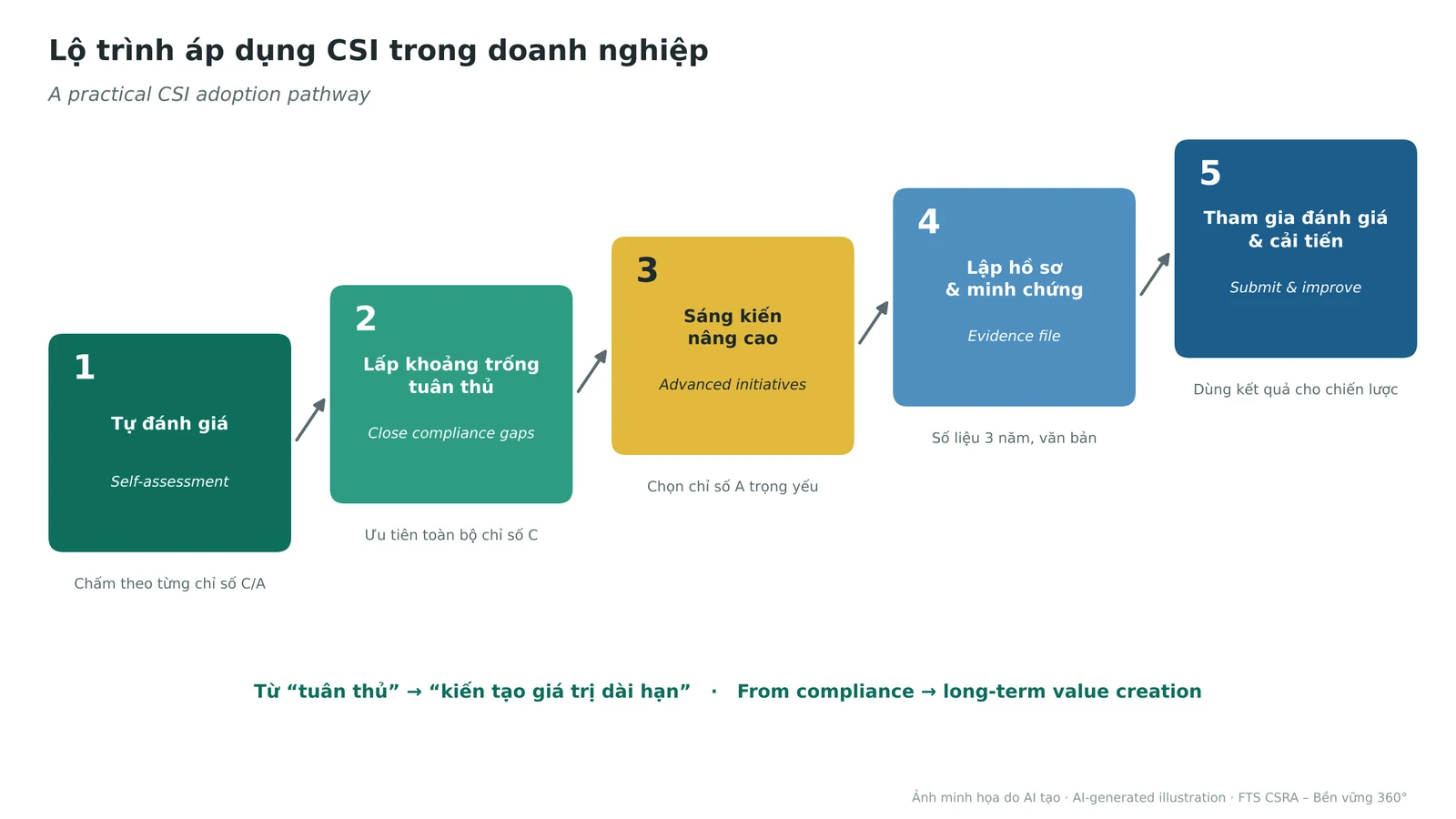
Applying it well: treat CSI as a year-round management tool, not a once-a-year “exam”.
- Self-assess: score every indicator using the Guidance Manual; mark met, partly met, not met.
- Close compliance gaps: fix all unmet C indicators first (environmental permits, social insurance, OSH, etc.).
- Choose advanced initiatives: invest in A indicators linked to your material issues and competitive advantage.
- Standardise evidence: 3-year data consistent with financial statements, signed and stamped documents, site photos.
- Take part and improve: use the scoring results as input to strategy, the annual report and the sustainability report.
Practical example
Hypothetical case: Garment Company X (Bac Ninh), 850 workers, exports to the EU, applying CSI for the first time.
| Step | Findings | Actions & results |
|---|---|---|
| Self-assessment | Meets 78/97 C indicators but only 12/69 A indicators. No 3-year energy/water data; no GHG inventory; no worker grievance mechanism. | Lists 19 C gaps and 6 priority A indicators. |
| Close C gaps | Workplace environment monitoring records incomplete; collective agreement not renewed. | Completed in 4 months; C indicators met rise to 95/97. |
| A initiatives | EU customers request emissions data. | Installs sub-meters per workshop, runs a Scope 1–2 GHG inventory; cuts electricity per unit by 9% with LED lighting and servo sewing motors. |
| Sustainability commitment | No public quantitative target. | Announces a 20% cut in emission intensity by 2030 vs. 2025, with annual progress reports. |
Lesson: the CSI score improved mainly through systematising data and evidence, not through big projects – and the data prepared for CSI is reusable for international customer requests.
Notes for use in Vietnam
- Always use the right year's version: the number of indicators and the structure change every year; do not reuse last year's self-assessment without checking.
- Compliance is the foundation: for small firms over 80% of indicators are about legal compliance – use CSI as a legal checklist on environment, labour, tax and corporate matters.
- Data must reconcile: revenue, headcount and emissions in the CSI file should match financial statements, social-insurance reports and environmental reports filed with authorities.
- Link to new obligations: the GHG inventory indicators relate to Decree 06/2022/ND-CP (and its amendments); exporters should prepare data for market requirements such as the EU CBAM.
- CSI does not replace international standards: it references GRI and ISSB but is not a reporting standard. Listed companies or those with international customers should still report under GRI/ISSB and use CSI for internal management.
- Avoid “dressing up” the file: sustainability awards are increasingly scrutinised by stakeholders; untruthful evidence creates reputational risk greater than the value of the title.
Method & scope
Content compiled and interpreted from FTS Impact Lab and documents of the issuing body; versions and sources should be verified before publication.
References
- CSI 2026 Index, Scoring Sheet and guidance documents – CSI Programme Secretariat (VCCI – VBCSD) ↗ (accessed 2026-10-24)
- VCCI: Launch of the 2026 Programme for Evaluating and Announcing Sustainable Companies in Vietnam (22 May 2026) ↗ (accessed 2026-10-24)
- Law on Environmental Protection 2020; Labour Code 2019; Law on Occupational Safety and Hygiene 2015; Decree 06/2022/ND-CP on GHG emission mitigation (accessed 2026-10-24)
- International cross-references: GRI Standards; IFRS S1/S2 (ISSB); TCFD recommendations; UN Guiding Principles on Business and Human Rights (UNGPs) (accessed 2026-10-24)