Contents
Overview and origin
| Item | Details |
|---|---|
| Vietnamese name | Hướng dẫn về trách nhiệm xã hội (in Vietnam: TCVN ISO 26000) |
| English name | ISO 26000:2010 – Guidance on social responsibility |
| Issuer / administrator | International Organization for Standardization (ISO); developed through a multi-stakeholder process with experts from over 90 countries and about 40 international organisations, representing six groups: industry, government, labour, consumers, NGOs and service/support/research. |
| Nature | A guidance standard with no requirements; not intended for certification. Any claim of being “ISO 26000 certified” misrepresents the standard. |
| Reference scope | All types of organisations (businesses, public bodies, non-profits) of any size. Linked to the ILO Declaration, UNGPs, OECD Guidelines for Multinational Enterprises, UN Global Compact and GRI. |
ISO 26000 was published on 1 November 2010 after five years of development – one of ISO's most widely consulted standards. Its core idea: social responsibility (SR) is not philanthropy but an organisation's responsibility for the impacts of its decisions and activities on society and the environment, through transparent and ethical behaviour that contributes to sustainable development.
Purpose and main structure
ISO 26000 helps organisations answer three questions: What does SR cover? Which issues are relevant and significant for us? How do we build them into daily operations? It has 7 clauses: 1 Scope; 2 Terms; 3 Understanding SR; 4 Principles; 5 Recognising SR and engaging stakeholders; 6 Guidance on core subjects; 7 Integrating SR throughout the organisation.
2.1. Seven principles (clause 4)
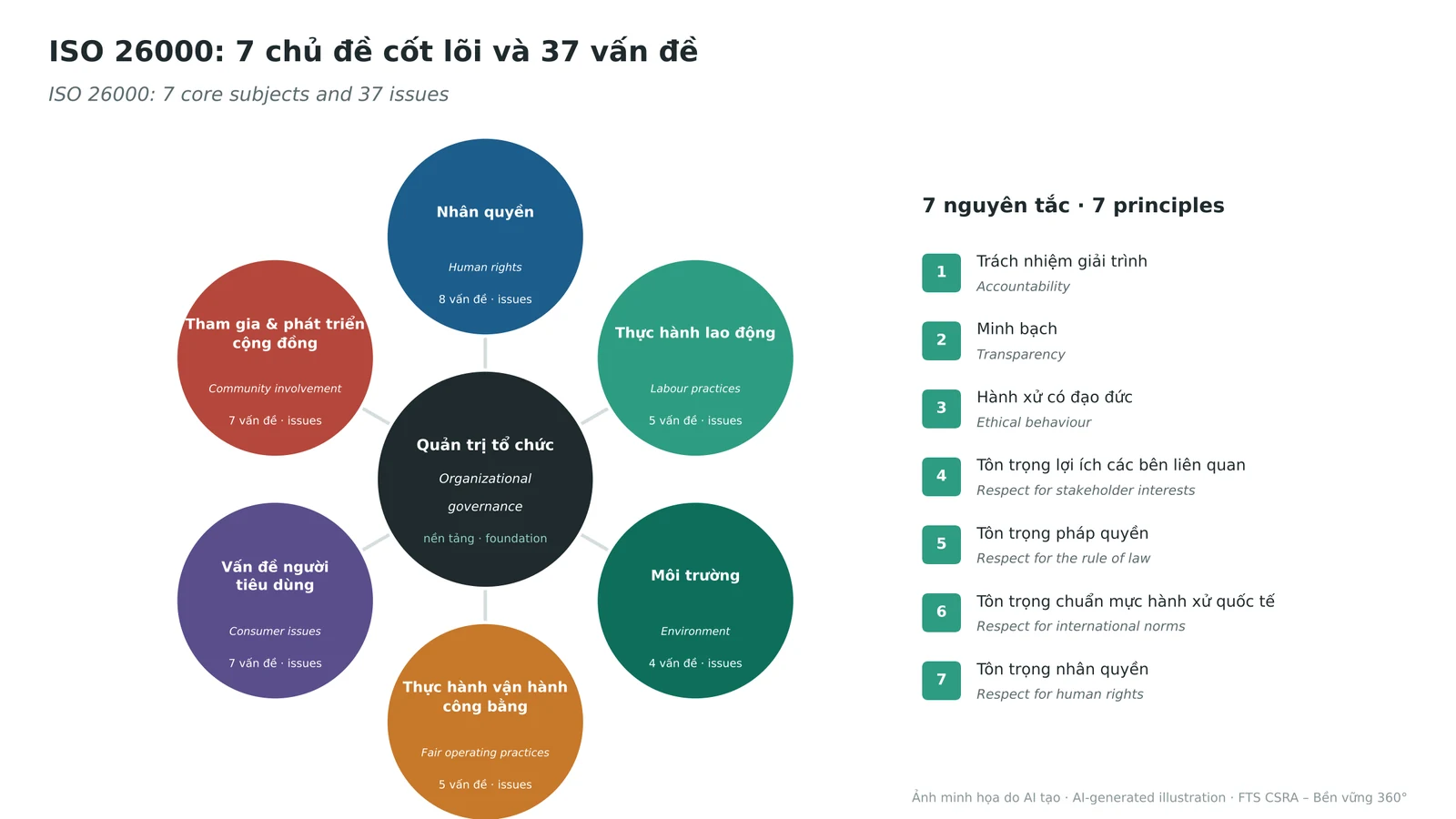
Accountability · Transparency · Ethical behaviour · Respect for stakeholder interests · Respect for the rule of law · Respect for international norms of behaviour · Respect for human rights.
2.2. Seven core subjects and 37 issues (clause 6)
| Core subject | Specific issues |
|---|---|
| 6.2 Organizational governance | The system by which decisions are made and implemented so that the 7 principles are applied (the foundation for all other subjects) |
| 6.3 Human rights (8) | (1) Due diligence; (2) Human rights risk situations; (3) Avoidance of complicity; (4) Resolving grievances; (5) Discrimination and vulnerable groups; (6) Civil and political rights; (7) Economic, social and cultural rights; (8) Fundamental principles and rights at work |
| 6.4 Labour practices (5) | (1) Employment and employment relationships; (2) Conditions of work and social protection; (3) Social dialogue; (4) Health and safety at work; (5) Human development and training in the workplace |
| 6.5 The environment (4) | (1) Prevention of pollution; (2) Sustainable resource use; (3) Climate change mitigation and adaptation; (4) Protection of the environment, biodiversity and restoration of natural habitats |
| 6.6 Fair operating practices (5) | (1) Anti-corruption; (2) Responsible political involvement; (3) Fair competition; (4) Promoting social responsibility in the value chain; (5) Respect for property rights |
| 6.7 Consumer issues (7) | (1) Fair marketing, factual and unbiased information and fair contractual practices; (2) Protecting consumers' health and safety; (3) Sustainable consumption; (4) Consumer service, support, and complaint and dispute resolution; (5) Consumer data protection and privacy; (6) Access to essential services; (7) Education and awareness |
| 6.8 Community involvement and development (7) | (1) Community involvement; (2) Education and culture; (3) Employment creation and skills development; (4) Technology development and access; (5) Wealth and income creation; (6) Health; (7) Social investment |
2.3. Suggested indicators for each core subject
ISO 26000 sets no quantitative indicators. FTS CSRA proposes the set below, linked to GRI disclosure codes so companies can both manage and report:
| Clause | Core subject | Suggested indicators (GRI link) |
|---|---|---|
| 6.2 | Organizational governance | Board-approved SR policy; SR/ESG lead; share of independent directors; frequency of board review of impacts (GRI 2-9 → 2-21) |
| 6.3 | Human rights | Human rights due diligence process; % operations/suppliers risk-assessed; grievances received and resolved; discrimination incidents (GRI 2-25, 2-26, 406-1, 408-1, 409-1) |
| 6.4 | Labour practices | % workers with contracts and social insurance; % covered by collective agreements; LTIFR, TRIR; average training hours; turnover (GRI 2-7, 2-30, 401-1, 403-9, 404-1) |
| 6.5 | The environment | Scope 1, 2, 3 emissions; energy and water use; waste generated and recycled; environmental violations; sites near high-biodiversity areas (GRI 102/305, 103/302, 303, 306, 101) |
| 6.6 | Fair operating practices | % staff trained on anti-corruption; confirmed corruption incidents; anti-competitive legal actions; % suppliers screened on social/environmental criteria (GRI 205, 206, 308-1, 414-1) |
| 6.7 | Consumer issues | Product safety, labelling and marketing non-compliance; data-privacy complaints; satisfaction; complaint resolution time (GRI 416, 417, 418-1) |
| 6.8 | Community involvement and development | % operations with community engagement; social investment; local jobs created; % spending on local suppliers (GRI 203, 204-1, 413-1) |
2.4. Guidance content in clauses 5 and 7
| Sub-clause | Content |
|---|---|
| Clause 5 – Recognizing SR and engaging stakeholders | |
| 5.2.1 | Impacts, interests and expectations (organization – society – stakeholders) |
| 5.2.2 | Recognizing core subjects and relevant issues |
| 5.2.3 | SR and the organization's sphere of influence |
| 5.3 | Stakeholder identification and engagement |
| Clause 7 – Integrating SR throughout the organization | |
| 7.2 | Relationship of the organization's characteristics to SR |
| 7.3.1 | Due diligence |
| 7.3.2 | Determining relevance and significance of core subjects and issues |
| 7.3.3 | Sphere of influence |
| 7.3.4 | Establishing priorities |
| 7.4 | Integration practices: awareness and competency; setting direction; building SR into governance, systems and procedures |
| 7.5 | Communication on SR |
| 7.6 | Enhancing credibility (stakeholder engagement, third-party verification where relevant, resolving disagreements) |
| 7.7 | Reviewing and improving actions and practices |
| 7.8 | Voluntary initiatives for SR |
Who uses it and how
Users: businesses of all sizes, public agencies, schools, hospitals and non-profits. ISO 26000 is especially useful for organisations just starting an SR/ESG strategy because it gives the full picture before choosing a specific reporting or certification scheme.
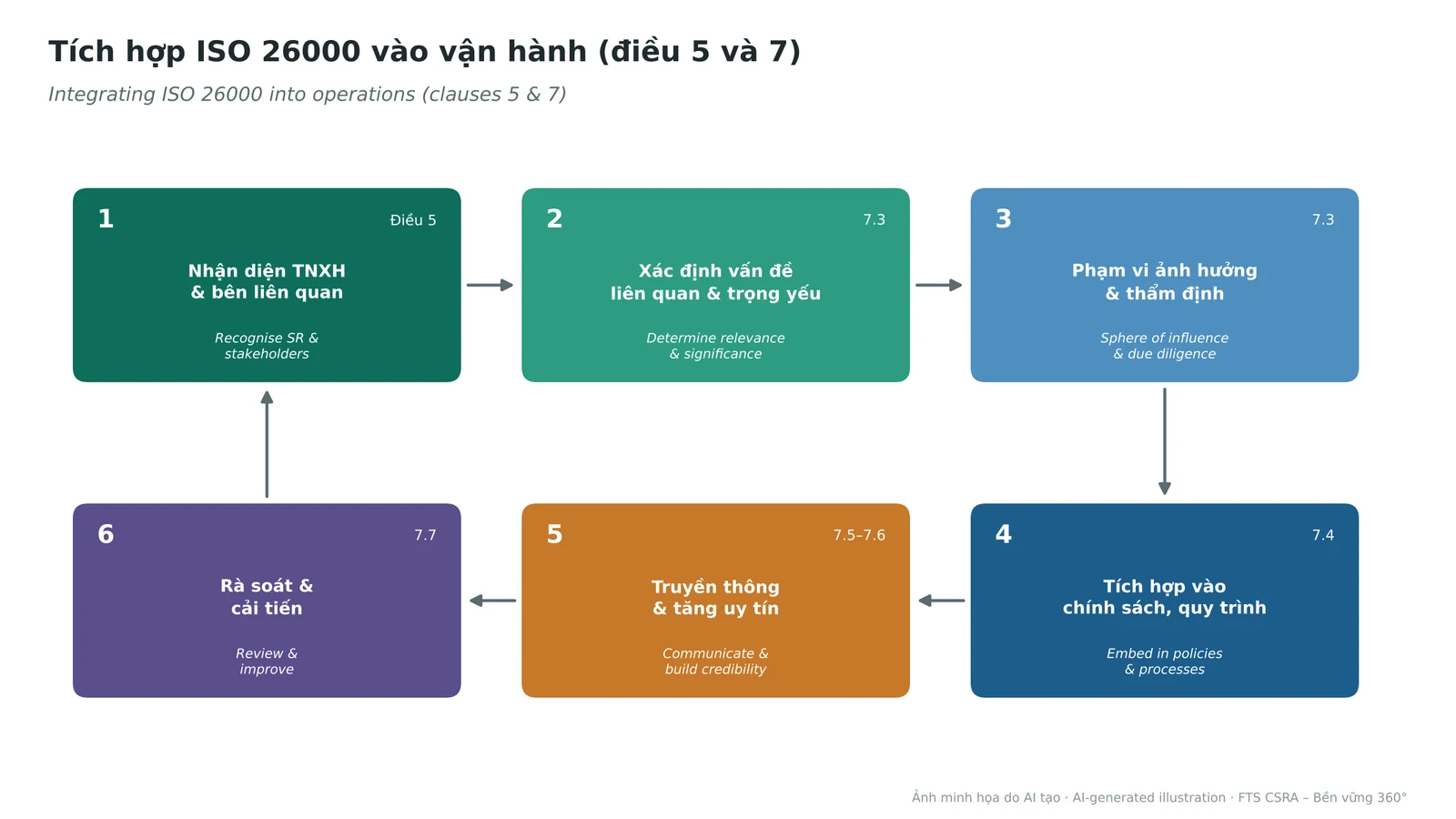
How to apply it (clauses 5 and 7):
- Recognise SR and stakeholders: list stakeholders (workers, customers, communities, suppliers, authorities, etc.), their interests and expectations.
- Determine relevance and significance: screen the 37 issues, drop irrelevant ones, assess significance by impact and stakeholder expectations.
- Define sphere of influence and do due diligence: consider impacts across the value chain, not only inside the factory gate.
- Integrate: build priorities into strategy, policies, procurement, HR and products; assign responsibilities and resources.
- Communicate and build credibility: disclose honestly; GRI can be used for reporting, with independent assurance.
- Review and improve: track indicators, review periodically, adjust priorities.
To embed ISO 26000 in a structured management system, organisations can refer to IWA 26:2017 (using ISO 26000 in management systems). If certification of labour conditions is needed, schemes such as SA8000 may be considered – but that is not ISO 26000 certification.
Practical example
Hypothetical case: Food Company Z (Dong Nai), 1,200 workers, sources produce from about 3,000 farming households and sells through supermarkets and e-commerce platforms.
| Core subject | Issue judged significant | Actions and indicators |
|---|---|---|
| Human rights / Labour | Seasonal workers at peak season; child-labour risk in sourcing areas | Supplier code of conduct; audit 10% of supplying households per year; grievance hotline; KPI: 100% of seasonal workers on contracts |
| Environment | Processing wastewater; plastic packaging | Upgrade treatment plant; target 60% recyclable packaging by 2028 |
| Fair operating practices | Purchase prices and payment to farmers | Off-take contracts with floor prices; payment within 7 days |
| Consumers | Food safety; online customer data | QR-code traceability; personal data protection policy |
| Community | Farming skills of supplying households | Training on reduced chemical fertiliser for 500 households per year |
Result: instead of scattered charity activities, the company focuses on the 5–7 issues with the greatest impact, with measurable targets, and uses the same frame to report under GRI.
Notes for use in Vietnam
- No “ISO 26000 certification”: if a consultant or body promises an ISO 26000 certificate, treat it as a red flag. A company may state that it “applies the guidance of ISO 26000”.
- SR ≠ charity: in Vietnam SR is often equated with sponsorship and donations. ISO 26000 focuses on the impacts of core business (labour, supply chain, products).
- Connect with domestic law: many issues are already legal duties – Labour Code 2019, Law on Environmental Protection 2020, Law on Consumer Rights Protection 2023, Anti-Corruption Law 2018, Decree 13/2023/ND-CP on personal data protection and the 2025 Personal Data Protection Law.
- Export supply chains: EU and US customers increasingly require human-rights and environmental due diligence in supply chains – clause 6.3 (due diligence) is a solid starting point.
- Use it as a “common language”: ISO 26000 helps align CSI, the UN Global Compact and GRI in one consistent frame, avoiding several disconnected files.
Method & scope
Content compiled and interpreted from FTS Impact Lab and documents of the issuing body; versions and sources should be verified before publication.
References
- ISO 26000 – Social responsibility, official ISO page ↗ (accessed 2026-10-24)
- IWA 26:2017 – Using ISO 26000:2010 in management systems ↗ (accessed 2026-10-24)
- Cross-references: ISO 26000 and the UN Global Compact Ten Principles; ISO 26000 and the OECD Guidelines; ISO 26000 – GRI Standards linkage (accessed 2026-10-24)
- TCVN ISO 26000 – Guidance on social responsibility (check the current edition with the national standards body) (accessed 2026-10-24)