Contents
Overview and origin
| Item | Details |
|---|---|
| Vietnamese name | Hiệp ước Toàn cầu của Liên Hợp Quốc – Mười nguyên tắc |
| English name | United Nations Global Compact (UNGC) – The Ten Principles |
| Issuer / administrator | UN Global Compact Office (New York) – a special initiative of the UN Secretary-General; implemented in countries through Local Networks. |
| Nature | A voluntary, commitment-based initiative led by top management. It is not a certification or a performance label; joining does not mean the UN endorses a company's performance. |
| Reference scope | 4 areas: Human rights, Labour, Environment, Anti-corruption; linked to the 17 Sustainable Development Goals (SDGs). Derived from the Universal Declaration of Human Rights, the ILO Declaration on Fundamental Principles and Rights at Work, the Rio Declaration on Environment and Development, and the UN Convention against Corruption. |
UN Secretary-General Kofi Annan proposed the idea at the World Economic Forum in Davos in 1999; the UN Global Compact was launched on 26 July 2000 with nine principles, and the tenth, on anti-corruption, was added in 2004. According to the UNGC Strategy 2026–2030, the initiative has over 23,000 participating companies in more than 160 countries.
Purpose and main structure
Purpose: to call on companies (1) to operate responsibly in line with the Ten Principles and (2) to take action to advance broader societal goals such as the SDGs. The structure consists of the Ten Principles plus a commitment and reporting mechanism.
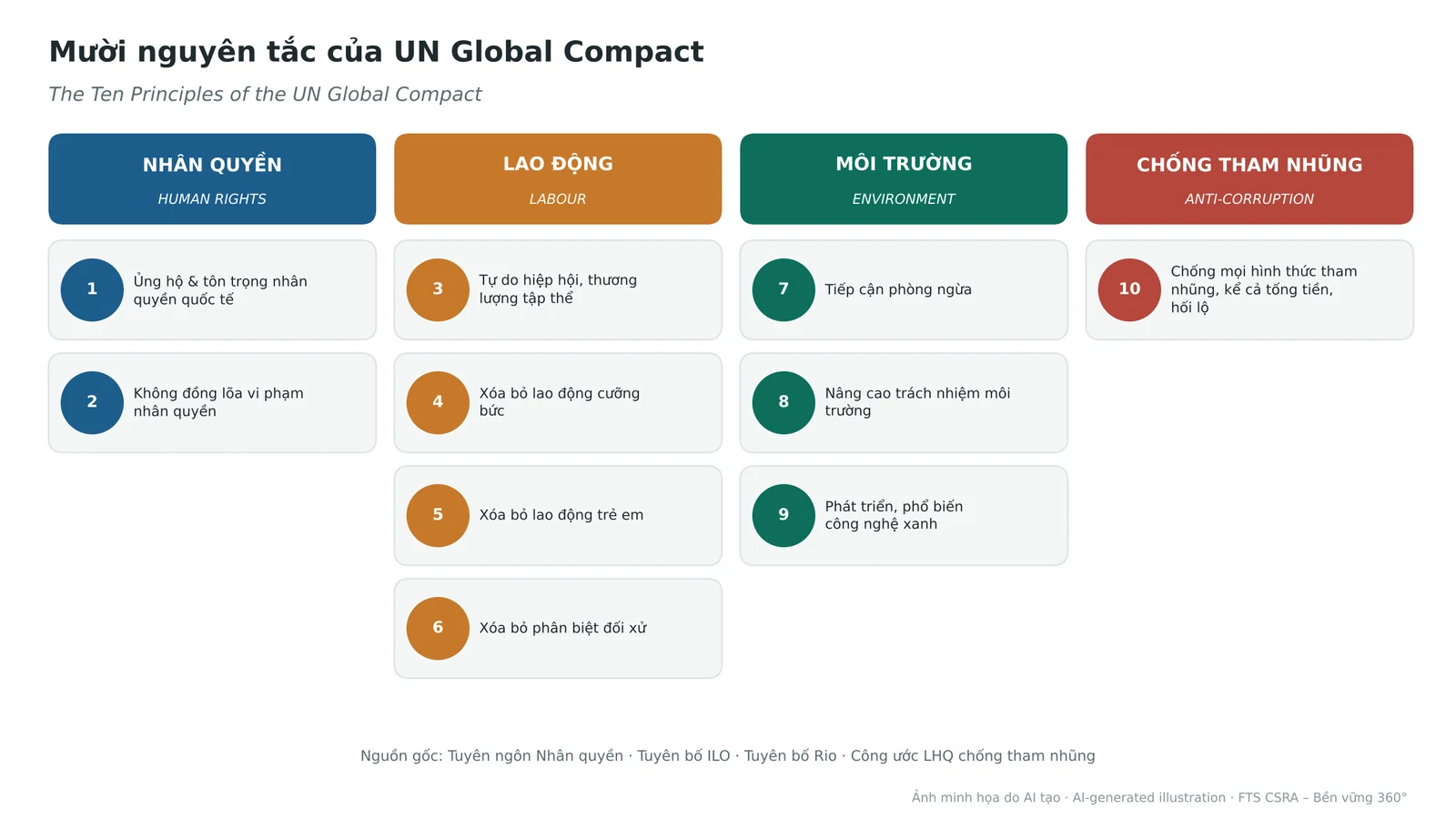
2.1. The Ten Principles and suggested indicators
| # | Principle – businesses should… | Suggested indicators/evidence |
|---|---|---|
| Human rights | ||
| 1 | Support and respect the protection of internationally proclaimed human rights | Board-approved human rights policy; human rights due diligence process; grievances received/resolved |
| 2 | Make sure that they are not complicit in human rights abuses | % of key suppliers assessed for human rights risk; human rights clauses in contracts |
| Labour | ||
| 3 | Uphold the freedom of association and the effective recognition of the right to collective bargaining | % of workers covered by collective agreements; number of workplace dialogues |
| 4 | Eliminate all forms of forced and compulsory labour | Policy banning retention of ID documents and recruitment fees; cases found and remediated |
| 5 | Effectively abolish child labour | Age-verification procedure; underage cases in the supply chain |
| 6 | Eliminate discrimination in respect of employment and occupation | % women in management; female/male pay ratio for equal roles; discrimination and harassment complaints |
| Environment | ||
| 7 | Support a precautionary approach to environmental challenges | Environmental and climate risk assessment; environmental management system (e.g., ISO 14001) |
| 8 | Undertake initiatives to promote greater environmental responsibility | Scope 1, 2, 3 GHG emissions; energy and water use; reduction targets; % of waste recycled |
| 9 | Encourage the development and diffusion of environmentally friendly technologies | Capex on clean technology; % of revenue from green products/services; % renewable energy |
| Anti-corruption | ||
| 10 | Work against corruption in all its forms, including extortion and bribery | Anti-corruption policy; % of staff trained; confirmed incidents of corruption and actions taken |
2.2. Communication on Progress (CoP)
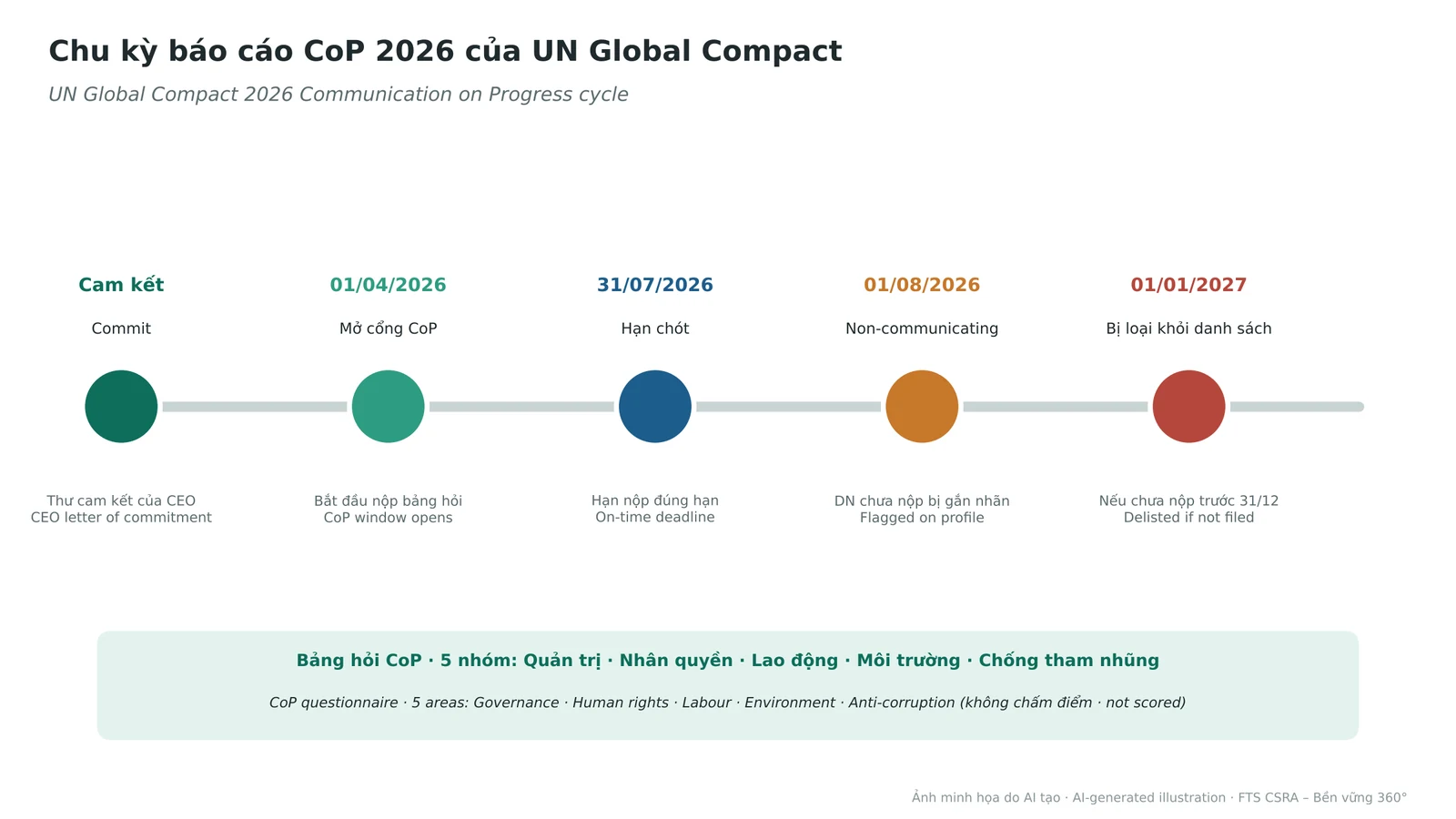
Since 2023 the CoP has been a standardised digital questionnaire submitted annually via the participant dashboard. It covers 5 areas – Governance, Human rights, Labour, Environment, Anti-corruption – and is not scored or ranked; the aim is transparency and progress. It is accompanied by a mandatory CEO Statement of Continued Support.
| 2026 CoP milestone | Meaning |
|---|---|
| 1 April 2026 | CoP submission window opens |
| 31 July 2026 | On-time submission deadline |
| 1 August 2026 | Participants that have not submitted are flagged “Non-communicating” on their public profile |
| 31 December 2026 | Last day for a late submission to avoid delisting |
| 1 January 2027 | Participants without a 2026 CoP are delisted |
Non-business participants (associations, civil society, academia, etc.) report through a Communication on Engagement (CoE) every two years.
2.3. Questions in the 2026 CoP questionnaire
These are the items companies actually answer each year. Question titles are condensed by FTS CSRA; use the exact wording on the CoP platform when submitting.
| Code | Question |
|---|---|
| Introduction and priorities | |
| R1 | Submission format: digital questionnaire or uploaded sustainability report |
| R2 | Reporting period covered |
| R3 | Scope of operations covered (optional) |
| S1 | Successful initiatives in the period (optional) |
| S2 | Priority issue areas for the next two years |
| Governance | |
| G1 | Board and senior management oversight of sustainability; annual statement |
| G2 | Whether the code of conduct covers each sustainability topic and to whom it applies |
| G3 / G3.1 | Accountable individual/group per topic; formal structures (sustainability committee, etc.) |
| G4 / G4.1 | Processes to identify, assess and mitigate sustainability-related business risks; monitoring high-risk relationships |
| G5 / G5.1 | Due diligence process for adverse impacts; details for significant-risk relationships |
| G6 / G6.1 | Confidential channels for raising concerns; who can use them and in which languages |
| G7 | Tracking effectiveness: goals, indicators, lessons learned |
| G8 | Executive pay linked to sustainability performance |
| G9 | Board/governing body composition (gender, age, independence) |
| G10 | % women in management |
| G11 | Gender composition of the C-suite |
| G12 | Sustainability embedded in financing and investment strategies |
| G13 | Sustainability reporting frameworks used (GRI, ISSB, etc.) |
| G14 | Third-party assurance of reported data |
| Human rights and Labour | |
| HR/L1 / 1.1 | Material human rights/labour topics (up to six) and salient topics by impact on people; labour and gender topics mandatory |
| HR/L2 / 2.1 | Human rights/labour policy commitment; senior approval, public, coverage, last review |
| HR/L2.2 | Policy on freedom of association and collective bargaining |
| HR/L2.3 | Policy on wages and living wages |
| HR/L3 | Engagement with affected stakeholders per topic |
| HR/L4 / 4.1 / 4.1.1 | Prevention and mitigation actions; how progress is assessed (KPIs, external verification); time-bound targets (optional) |
| HR/L5 | Remedy processes for adverse impacts |
| HR/L6 | Average gender pay gap for comparable roles (%) |
| HR/L7 | Recordable work-related injury rate per 200,000 hours worked |
| HR/L8 | Other actions, plans, difficulties (optional) |
| Environment | |
| E1 / E1.1 | Environmental policies (climate, water, oceans, nature, air, waste, circularity, energy); aligned with international standards, public, applied across the value chain |
| E2 | Engagement with affected stakeholders on environment |
| E3 / 3.1 / 3.1.1 / 3.1.2 | Prevention and mitigation actions; progress assessment; time-bound targets; monitoring and communicating progress |
| E4 | Remedy for negative environmental impacts caused or contributed to |
| E5 | Scope 1 and Scope 2 emissions (market- and location-based), tCO₂e |
| E6 / E6.1 | Scope 3 emissions and categories included |
| E7 / E7.1 | Third-party-validated reduction targets (short, medium, long term); net-zero targets by scope |
| E8 | Climate adaptation plan |
| E9 | Targets to phase out fossil fuels and procure renewables |
| E10 | 1.5°C-aligned transition plan (components, board oversight) |
| E11 | Material environmental topics – triggers E12–E16 |
| E12 | Water: withdrawal and consumption (megalitres) and % in water-stressed areas |
| E13 | Up to 10 priority water basins and actions |
| E14 | Nature/biodiversity action plan |
| E15 | Air pollutant emissions (NOx, SOx, CO, NH₃, NMVOC, PM10, PM2.5…), tonnes |
| E16 | Circular economy practices |
| E17 | Further description (optional) |
| Anti-corruption | |
| AC1 / 1.1 / 1.2 | Anti-corruption programme; public, approved, coverage; how it is monitored |
| AC2 | Policies on conflicts of interest, gifts, hospitality, donations, sponsorships, public officials |
| AC3 | Promoting collective action for integrity |
| AC4 / AC4.1 | Who receives anti-corruption training and how often |
| AC5 / AC5.1 | Detection mechanisms (reporting channels, whistleblower protection, audits) and actions on suspected cases |
| AC6 | Further description (optional) |
Who uses it and how
Users: companies of all sizes (with an annual contribution scaled to revenue) and non-business organisations. It suits companies that want to commit publicly at leadership level, join a global network and demonstrate commitment to international partners.
- Prepare internally: review existing policies against the Ten Principles; obtain approval from the CEO (and board, if any).
- Send a letter of commitment: the CEO signs a letter to the UN Secretary-General and applies online at unglobalcompact.org.
- Act: integrate the principles into strategy and processes; set targets (e.g., linked to SDGs, science-based climate targets).
- Report the CoP annually: complete the questionnaire in the 1 April–31 July window, reusing data prepared under GRI.
- Learn and engage: use the UN Global Compact Academy, Accelerator programmes and Local Network activities.
Practical example
Hypothetical case: Seafood Company W (Can Tho), 2,000 workers, exporting to the EU and Japan, joined the UN Global Compact in 2025.
- Commitment: the CEO signs the letter of commitment; the board assigns its Sustainability Committee to oversee implementation.
- Principles 3–6: reviews 12 raw-material agents; finds one charging workers recruitment fees – requires reimbursement and adds a prohibition clause to contracts.
- Principles 7–9: inventories Scope 1–2 emissions; installs 1.5 MWp rooftop solar; sets a 30% emission-intensity reduction target by 2030.
- Principle 10: issues gift and conflict-of-interest policies; trains 100% of procurement staff; opens an anonymous whistle-blowing channel.
- CoP 2026: submitted on 15 July 2026, reusing 70% of data from its GRI-based sustainability report.
Notes for use in Vietnam
- Commitment must come with action: missing the CoP deadline leads to a public “Non-communicating” flag and possible delisting – more damaging to reputation than not joining.
- No casual use of the logo: use of the UN Global Compact name and logo is governed by a specific policy; never present participation as “UN certified”.
- Principle 3 and Vietnamese law: the 2019 Labour Code provides for worker representative organisations at the enterprise level; companies should understand the legal framework to genuinely enable dialogue and collective bargaining.
- Local network: the Global Compact Network Vietnam (GCNV) was launched in 2007 by VCCI with UNDP. Companies should check the current status and contact point of the Vietnam network on unglobalcompact.org before applying.
- Leverage interoperability: CoP data overlaps heavily with GRI, CSI and EU customer requirements – build one shared data set.
Sources and cross-references
- UN Global Compact – The Ten Principles
- 2026 CoP Questionnaire and CoP Guidebook (UN Global Compact Academy/KSS)
- UN Global Compact Strategy 2026–2030
- Cross-references: Universal Declaration of Human Rights; ILO Declaration on Fundamental Principles and Rights at Work; Rio Declaration; UN Convention against Corruption (UNCAC); UNGPs
Method & scope
Content compiled and interpreted from FTS Impact Lab and documents of the issuing body; versions and sources should be verified before publication.
References
- UN Global Compact – The Ten Principles ↗ (accessed 2026-10-24)
- 2026 CoP Questionnaire and CoP Guidebook (UN Global Compact Academy/KSS) ↗ (accessed 2026-10-24)
- UN Global Compact Strategy 2026–2030 ↗ (accessed 2026-10-24)
- Cross-references: Universal Declaration of Human Rights; ILO Declaration on Fundamental Principles and Rights at Work; Rio Declaration; UN Convention against Corruption (UNCAC); UNGPs (accessed 2026-10-24)