Contents
Overview and origin
| Item | Details |
|---|---|
| Vietnamese name | Bộ tiêu chuẩn báo cáo phát triển bền vững GRI (Tiêu chuẩn GRI) |
| English name | GRI Sustainability Reporting Standards (GRI Standards) |
| Issuer / administrator | Global Reporting Initiative (GRI) – an independent international organisation; the standards are developed and approved by the Global Sustainability Standards Board (GSSB) through a public, multi-stakeholder due process. |
| Nature | A free disclosure/reporting standard used voluntarily (or mandatorily where referenced by law or stock exchanges). It is not a certification; credibility is strengthened through independent assurance. |
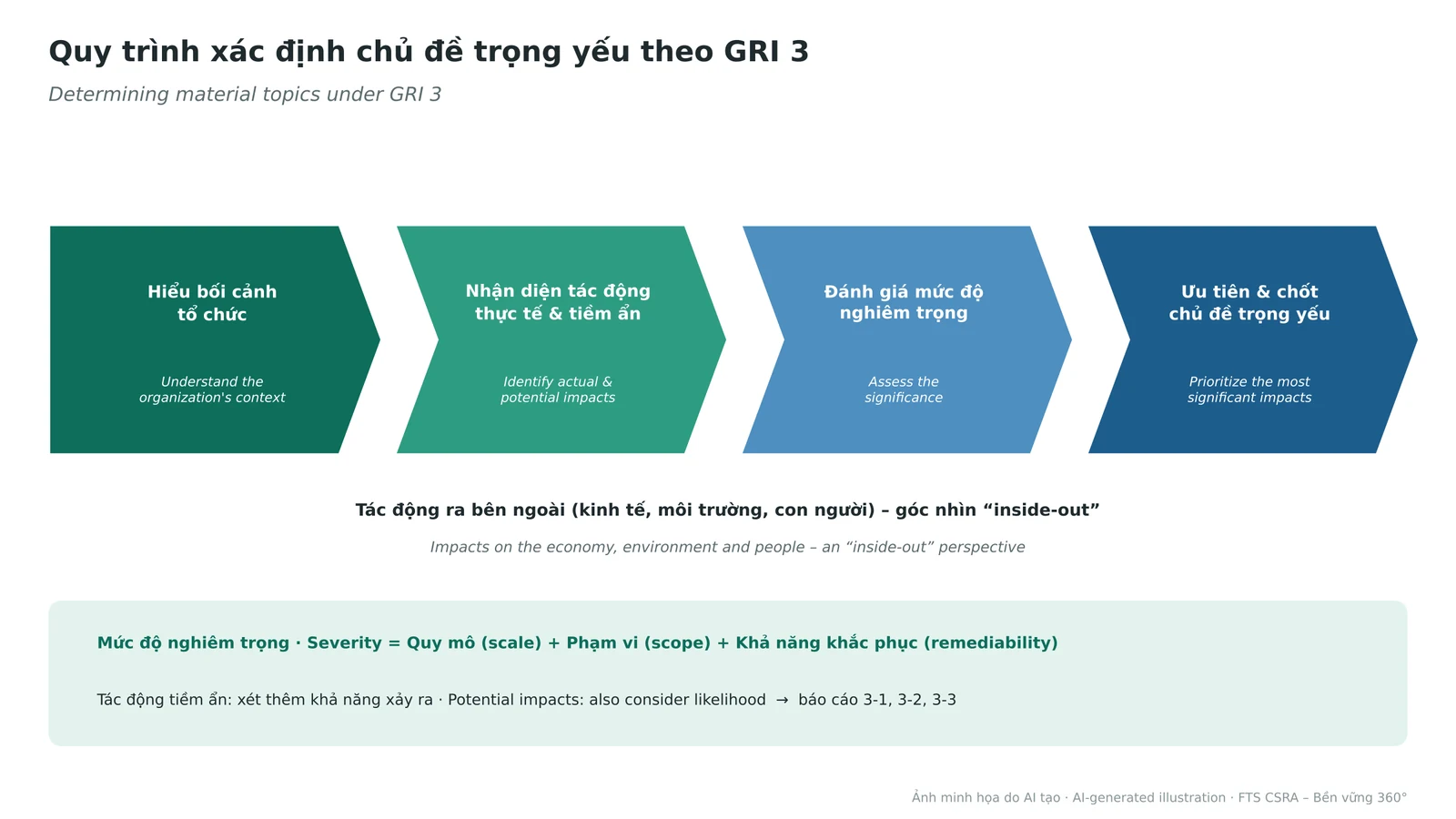
| Reference scope | An impact perspective (inside-out): the organisation's impacts on the economy, environment and people, including human rights. Interoperable with ESRS (EU), IFRS S1/S2 (ISSB), UN Global Compact, OECD and ISO 26000. |
GRI was founded in 1997 in Boston (USA) by CERES and the Tellus Institute, with UNEP involvement. Its guidelines evolved from G1 (2000) to G4 (2013) and became the GRI Standards in 2016. The Universal Standards 2021 (GRI 1, 2, 3) apply to reports published from 1 January 2023. Recent updates: GRI 101: Biodiversity 2024, effective 1 January 2026 (replacing GRI 304); GRI 102: Climate Change 2025 and GRI 103: Energy 2025, effective 1 January 2027 (replacing GRI 305-1 to 305-5, 201-2 and GRI 302).
Purpose and main structure
Purpose: to help organisations disclose transparently and comparably their most significant impacts and how they manage them, serving all stakeholders (investors, workers, communities, customers, regulators).
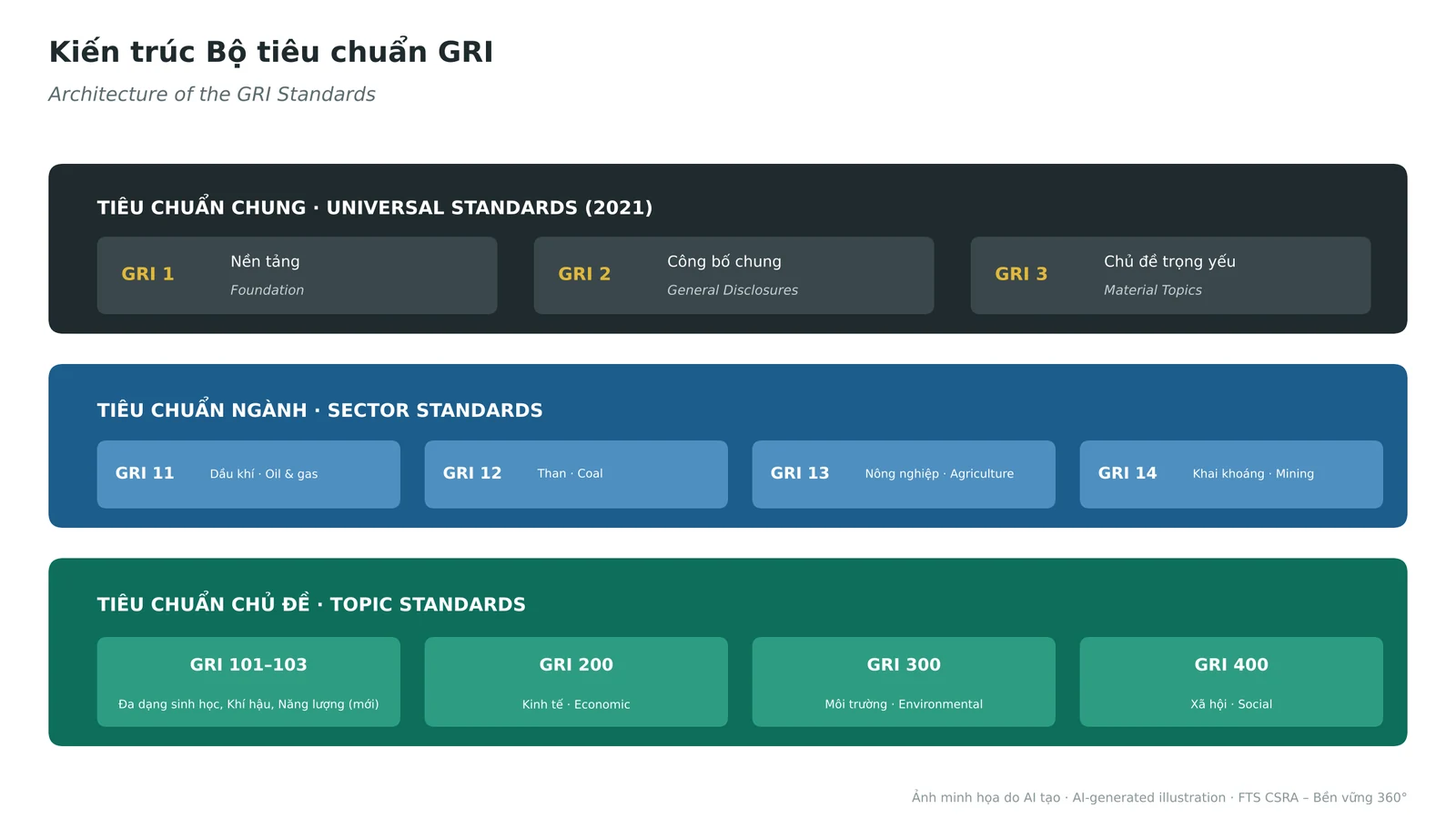
2.1. Universal Standards (required for every reporting organisation)
| Standard | Content and specific disclosures |
|---|---|
| GRI 1: Foundation 2021 | Key concepts (impacts, material topics, due diligence); 9 requirements to report “in accordance with” GRI; 8 reporting principles: accuracy, balance, clarity, comparability, completeness, sustainability context, timeliness, verifiability |
| GRI 2: General Disclosures 2021 (30 disclosures) | 2-1 → 2-5 The organisation and its reporting practices (details, entities, period, restatements, external assurance); 2-6 → 2-8 Activities and workers (value chain, employees, non-employee workers); 2-9 → 2-21 Governance (structure, nomination, chair, the board's role in overseeing impacts, conflicts of interest, remuneration policies, annual total compensation ratio); 2-22 → 2-28 Strategy, policies and practices (strategy statement, policy commitments, remediation, compliance with laws, memberships); 2-29 → 2-30 Stakeholder engagement, collective bargaining agreements |
| GRI 3: Material Topics 2021 | 3-1 Process to determine material topics; 3-2 List of material topics; 3-3 Management of each material topic (policies, actions, targets, tracking effectiveness, lessons learned) |
Full list of the 30 GRI 2 disclosures
| Code | Disclosure |
|---|---|
| The organization and its reporting practices | |
| 2-1 | Organizational details |
| 2-2 | Entities included in sustainability reporting |
| 2-3 | Reporting period, frequency and contact point |
| 2-4 | Restatements of information |
| 2-5 | External assurance |
| Activities and workers | |
| 2-6 | Activities, value chain and other business relationships |
| 2-7 | Employees |
| 2-8 | Workers who are not employees |
| Governance | |
| 2-9 | Governance structure and composition |
| 2-10 | Nomination and selection of the highest governance body |
| 2-11 | Chair of the highest governance body |
| 2-12 | Role of the highest governance body in overseeing the management of impacts |
| 2-13 | Delegation of responsibility for managing impacts |
| 2-14 | Role of the highest governance body in sustainability reporting |
| 2-15 | Conflicts of interest |
| 2-16 | Communication of critical concerns |
| 2-17 | Collective knowledge of the highest governance body |
| 2-18 | Evaluation of the performance of the highest governance body |
| 2-19 | Remuneration policies |
| 2-20 | Process to determine remuneration |
| 2-21 | Annual total compensation ratio |
| Strategy, policies and practices | |
| 2-22 | Statement on sustainable development strategy |
| 2-23 | Policy commitments |
| 2-24 | Embedding policy commitments |
| 2-25 | Processes to remediate negative impacts |
| 2-26 | Mechanisms for seeking advice and raising concerns |
| 2-27 | Compliance with laws and regulations |
| 2-28 | Membership associations |
| Stakeholder engagement | |
| 2-29 | Approach to stakeholder engagement |
| 2-30 | Collective bargaining agreements |
2.2. Sector Standards
GRI 11 Oil and Gas (effective 2023), GRI 12 Coal (2024), GRI 13 Agriculture, Aquaculture and Fishing (2024), GRI 14 Mining (2026). Organisations in a sector with a published standard must use it when determining material topics. GRI continues to develop standards for other sectors.
2.3. Disclosures in the Topic Standards
Companies report only the Topic Standards for their material topics (determined under GRI 3). Titles are translated by FTS CSRA; use the exact standard wording when reporting.
| Code | Disclosure |
|---|---|
| GRI 101: Biodiversity 2024 (effective 1 Jan 2026, replaces GRI 304) | |
| 101-1 | Policies to halt and reverse biodiversity loss |
| 101-2 | Management of biodiversity impacts |
| 101-3 | Access and benefit-sharing |
| 101-4 | Identification of biodiversity impacts |
| 101-5 | Locations with biodiversity impacts |
| 101-6 | Direct drivers of biodiversity loss |
| 101-7 | Changes to the state of biodiversity |
| 101-8 | Ecosystem services |
| GRI 102: Climate Change 2025 (effective 1 Jan 2027, replaces 305-1→305-5 and 201-2) | |
| 102-1 | Transition plan for climate change mitigation |
| 102-2 | Climate change adaptation plan |
| 102-3 | Just transition |
| 102-4 | GHG emissions reduction targets and progress |
| 102-5 | Scope 1 GHG emissions |
| 102-6 | Scope 2 GHG emissions |
| 102-7 | Scope 3 GHG emissions |
| 102-8 | GHG emissions intensity |
| 102-9 | GHG removals in the value chain |
| 102-10 | Carbon credits |
| GRI 103: Energy 2025 (effective 1 Jan 2027, replaces GRI 302) | |
| 103-1 | Energy policies and commitments |
| 103-2 | Energy consumption and self-generation within the organization |
| 103-3 | Upstream and downstream energy consumption |
| 103-4 | Energy intensity |
| 103-5 | Reduction in energy consumption |
| Economic (200) | |
| 201-1 | Direct economic value generated and distributed |
| 201-2 | Financial implications, risks and opportunities due to climate change (until the 2026 cycle) |
| 201-3 | Defined benefit plan obligations and other retirement plans |
| 201-4 | Financial assistance received from government |
| 202-1 | Ratios of standard entry-level wage by gender to local minimum wage |
| 202-2 | Proportion of senior management hired from the local community |
| 203-1 | Infrastructure investments and services supported |
| 203-2 | Significant indirect economic impacts |
| 204-1 | Proportion of spending on local suppliers |
| 205-1 | Operations assessed for risks related to corruption |
| 205-2 | Communication and training about anti-corruption policies and procedures |
| 205-3 | Confirmed incidents of corruption and actions taken |
| 206-1 | Legal actions for anti-competitive behavior, anti-trust and monopoly practices |
| 207-1 → 207-4 | Approach to tax; tax governance, control and risk management; stakeholder engagement on tax; country-by-country reporting |
| Environmental (300) | |
| 301-1 / 301-2 / 301-3 | Materials used by weight or volume; recycled input materials; reclaimed products and packaging |
| 302-1 → 302-5 | Energy consumption within/outside the organization, intensity, reductions (until the 2026 cycle) |
| 303-1 / 303-2 | Interactions with water as a shared resource; management of discharge-related impacts |
| 303-3 / 303-4 / 303-5 | Water withdrawal; water discharge; water consumption |
| 305-1 → 305-5 | Scope 1, 2, 3 emissions; intensity; reductions (until the 2026 cycle) |
| 305-6 / 305-7 | Ozone-depleting substances; NOx, SOx and other significant air emissions |
| 306-1 / 306-2 | Waste generation and significant impacts; management of significant impacts |
| 306-3 / 306-4 / 306-5 | Waste generated; diverted from disposal; directed to disposal |
| 308-1 / 308-2 | New suppliers screened using environmental criteria; negative environmental impacts in the supply chain |
| Social (400) | |
| 401-1 / 401-2 / 401-3 | New hires and turnover; benefits for full-time employees; parental leave |
| 402-1 | Minimum notice periods regarding operational changes |
| 403-1 → 403-8 | OHS management system; hazard identification and incident investigation; occupational health services; worker consultation; training; health promotion; impacts via business relationships; workers covered |
| 403-9 / 403-10 | Work-related injuries; work-related ill health |
| 404-1 / 404-2 / 404-3 | Average training hours; upskilling and transition programmes; % receiving regular performance reviews |
| 405-1 / 405-2 | Diversity of governance bodies and employees; ratio of basic salary and remuneration of women to men |
| 406-1 | Incidents of discrimination and corrective actions |
| 407-1 | Operations and suppliers where freedom of association may be at risk |
| 408-1 / 409-1 | Operations and suppliers at significant risk of child labour; forced labour |
| 410-1 | Security personnel trained in human rights |
| 411-1 | Incidents of violations involving rights of Indigenous Peoples |
| 413-1 / 413-2 | Operations with community engagement, impact assessments and development programmes; operations with significant negative community impacts |
| 414-1 / 414-2 | New suppliers screened using social criteria; negative social impacts in the supply chain |
| 415-1 | Political contributions |
| 416-1 / 416-2 | Health and safety impact assessment of products; related non-compliance incidents |
| 417-1 / 417-2 / 417-3 | Product information and labelling requirements; labelling non-compliance; marketing communications non-compliance |
| 418-1 | Substantiated complaints about breaches of customer privacy and losses of customer data |
GRI is revising eight labour-related Topic Standards and plans to update the economic Topic Standards. Always check the current list of standards and effective dates on globalreporting.org before each reporting cycle.
Who uses it and how
Users: any organisation – listed and private companies, state-owned enterprises, non-profits and public agencies. Especially relevant for public companies, exporters and firms raising international capital.
| Option | Requirements |
|---|---|
| In accordance with GRI | Meet all 9 requirements: apply the reporting principles; report all GRI 2 disclosures; determine material topics; report GRI 3 disclosures; report Topic Standard disclosures for each material topic; give reasons for omission; publish a GRI content index; provide a statement of use; notify GRI |
| With reference to GRI | Use only selected standards/disclosures; a GRI content index, statement of use and notification to GRI are still required. Suitable for beginners |
Reporting process: (1) define the organisational boundary and period; (2) determine material topics under GRI 3; (3) select the corresponding disclosures in Sector/Topic Standards; (4) collect data with quality controls; (5) write a balanced report (positives and negatives); (6) prepare the GRI content index; (7) obtain independent assurance where possible.
Practical example
Hypothetical case: Building Materials JSC V (listed on HOSE), three cement and unfired-brick plants, preparing its first 2026 sustainability report “in accordance with GRI”.
| Material topic (GRI 3) | Standards/disclosures used | Example disclosed data |
|---|---|---|
| GHG emissions | 305-1, 305-2, 305-4 (2026 cycle); preparing GRI 102 for 2027 | Scope 1: 1.82 million tCO₂e; Scope 2: 0.21 million tCO₂e; intensity 0.68 tCO₂e/tonne of cement |
| Energy | 302-1, 302-3 | Total energy 9.4 million GJ; 18% from waste-heat recovery |
| Dust and air emissions | 305-7 | Dust, NOx, SOx vs. national technical regulations; continuous automatic monitoring |
| Occupational safety | 403-9 | LTIFR 0.9; zero fatalities; 100% of contractors trained before site entry |
| Communities near quarries | 413-1 | Quarry rehabilitation plan; 4 community dialogues per year |
Practical tip: the GRI data above can be reused for the annual-report annex, the CSI Index, the UN Global Compact CoP and EU customers' CBAM declaration requests.
Notes for use in Vietnam
- Domestic framework: public companies must disclose environmental and social information in their annual reports under Circular 96/2020/TT-BTC (and its amendments); GRI is the most widely used standard for meeting this systematically.
- GHG inventory: facilities on the list required to inventory emissions under Decree 06/2022/ND-CP (and its amendments) should keep data reported to authorities and GRI data consistent in methodology and emission factors.
- Prepare for 2027: reports for 2027 onwards must use GRI 102 and GRI 103 – start preparing Scope 3 data, a transition plan and just-transition content in 2026.
- GRI and ISSB are complementary: GRI serves the impact perspective; IFRS S1/S2 serve investors (financial risk). Listed companies should follow Vietnam's roadmap for adopting ISSB standards and design shared data for both.
- Avoid greenwashing: reports must be balanced – include incidents, violations and missed targets (the “balance” principle). Reports that only list achievements lose credibility with investors and customers.
- Language: prepare bilingual Vietnamese–English reports and align terminology with GRI's official translation (where available) to avoid inconsistencies.
Method & scope
Content compiled and interpreted from FTS Impact Lab and documents of the issuing body; versions and sources should be verified before publication.
References
- GRI Standards – free download from the GRI Resource Center ↗ (accessed 2026-10-24)
- GRI 101: Biodiversity 2024; GRI 102: Climate Change 2025; GRI 103: Energy 2025 ↗ (accessed 2026-10-24)
- Interoperability: GRI – ESRS Interoperability Index; GRI and IFRS S2; linking GRI with the SDGs and UN Global Compact (accessed 2026-10-24)
- Circular 96/2020/TT-BTC on information disclosure on the securities market; Decree 06/2022/ND-CP (accessed 2026-10-24)