Bài viết được tổng hợp và phân tích từ các quy định pháp luật, tài liệu tham khảo và góc nhìn thực tiễn; một số nhận định có thể mang tính chủ quan của tác giả, rất mong được bạn đọc thông cảm.
I. TÀI CHÍNH – “XƯƠNG SỐNG” CỦA MỌI HOẠT ĐỘNG THIỆN NGUYỆN
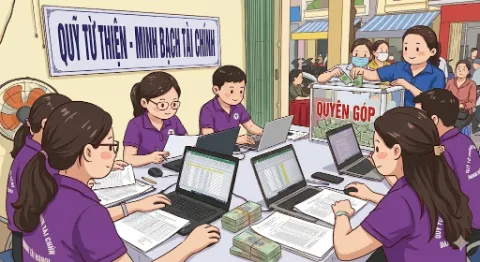
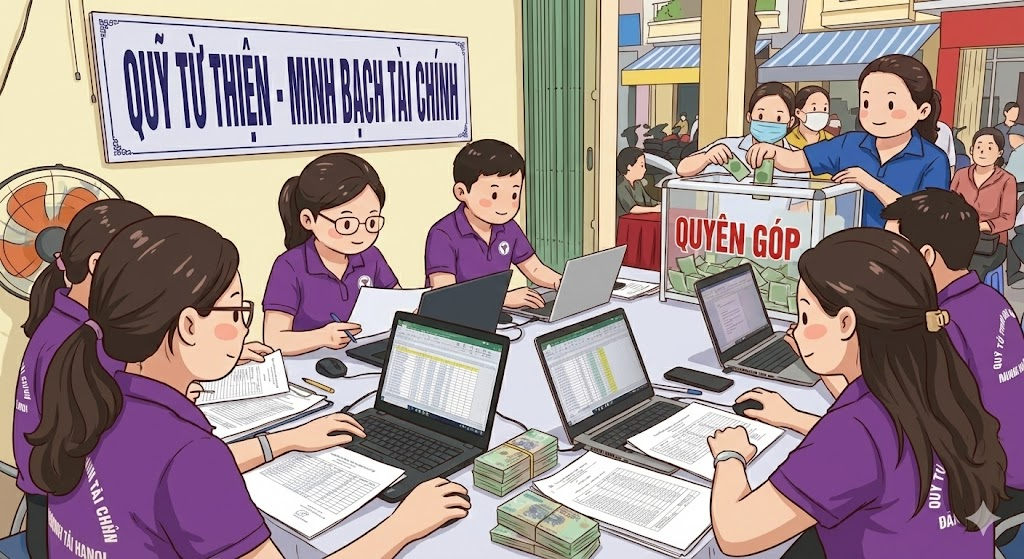
For many years, society has often viewed charitable activities through an emotional lens: “doing good from the heart” and “without calculation.” However, as the scale of activities expands, resources increase, and beneficiary groups become more diverse, weak financial management is no longer merely an internal issue, but becomes:
- Legal risks (penalties, and even potential criminal liability);
- Reputational risks (loss of trust from the community and donors);
- Sustainability risks (insufficient resources to maintain activities in the long term).
Therefore, financial management in charitable activities is not contrary to ethics; rather, it is a necessary condition for protecting those ethical values.
II. INDIVIDUALS ENGAGING IN CHARITABLE ACTIVITIES IN VIETNAM: RIGHTS, OBLIGATIONS AND FINANCIAL LIMITATIONS
1. Are individuals allowed to call for donations?
Yes, but not without limitations. Under Decree No. 93/2021/ND-CP (replacing Decree No. 64/2008/ND-CP), individuals are permitted to call for and receive donations in cash and in-kind relief in certain specific circumstances, typically:
- Natural disasters and epidemics;
- Serious incidents;
- Emergency and unexpected situations.
2. Financial obligations of individuals engaging in charitable activities
When an individual calls for donations, they must:
- Publicly disclose the purpose, scope, and duration of the fundraising campaign;
- Open a separate account for the fundraising campaign (without mixing it with their personal account);
- Provide statements and publicly disclose income and expenditure after the campaign ends;
- Distribute donations to the intended beneficiaries and in accordance with the commitments made.
Importantly, individuals may not deduct “management costs,” salaries, or remuneration from donated funds unless there is a clear agreement and approval from the community (which, in practice, remains a highly sensitive and potentially risky issue).
3. The biggest risks of the individual model
- No legal-entity status → unlimited personal liability;
- No formal accounting or auditing mechanism;
- High risk of disputes, complaints, allegations, and communication crises;
- Unsuitable for long-term, large-scale programs or corporate partnerships.
Therefore, individual charitable activities are generally suitable for small-scale, short-term, situational activities, but are not an appropriate model for sustainable development.
III. CHARITABLE GROUPS, SOCIAL FUNDS – CHARITABLE FUNDS: HOW ARE THEIR FINANCES REGULATED?
1. Charitable clubs/teams/associations/groups without legal-entity status
Many groups operate spontaneously:
- They are not legally registered; where applicable, they may primarily operate under the legal status or sponsorship of associations, unions, or other affiliated organizations;
- They do not have their own legal seal or legal-entity bank account.
Financial consequences:
- Difficult to sign large sponsorship agreements;
- Unable to issue lawful supporting documents or officially represent an organization in receiving sponsorships;
- Easily treated as equivalent to individuals;
- Financial liability ultimately falls on the group leader.
2. Social funds – charitable funds
Although charitable funds and social funds are considered formal legal models for community-oriented activities, in practice, establishing and operating such funds in Vietnam still presents a number of limitations, particularly for social initiatives launched by young people or small organizations.
Complex establishment procedures and lengthy processing times: The establishment of a fund must comply with Decree No. 93/2019/ND-CP and requires:
- Detailed legal documentation;
- A strict charter;
- A management board and supervisory board;
- A commitment of initial assets.
In practice:
- The licensing process may take 6–12 months, or even longer;
- It depends significantly on the relevant state management authorities;
- It is not suitable for initiatives that require rapid implementation or emergency response.
This may cause many social groups to miss the “golden window” for creating impact.
High charter capital and initial resource requirements: To establish a fund, founders must commit initial assets (in cash or in-kind) and ensure the capacity to maintain operations during the initial period.
For young groups, this means:
- Difficulty mobilizing initial capital;
- Lack of stable cash flow;
Risk of having “legal-entity status without operational capacity.”
Inflexible financial mechanisms
Charitable funds may only use their assets for the purposes specified in their charter. They may not conduct profit-generating business activities in the same manner as enterprises and rely heavily on sponsorships and donations.
Consequently:
- They have limited independent sources of revenue;
- They can become vulnerable when sponsorship decreases;
- They face difficulties investing in innovation, technology, and highly qualified personnel.
Administrative, reporting, and oversight burdens
Funds are required to carry out:
- Periodic reporting to the supervising authority;
- Financial disclosure;
- Internal controls;
- Audits in certain cases.
For small funds:
- Administrative costs can be high relative to the budget;
- Staff may lack specialized expertise;
- More time may be spent on administrative procedures than on project implementation.
Limitations in salary payments and attracting high-quality personnel
Although funds are permitted to pay salaries, social perceptions often make high salaries at charitable funds difficult to accept. Donors may also impose caps on management costs, while funds face greater challenges competing with businesses for talent.
Consequently:
- It is difficult to retain skilled personnel;
- Operational teams may lack stability;
- Organizations may become overly dependent on long-term volunteer commitment, which is not sustainable.
Difficulties in scaling up and developing commercial – CSR partnerships: Charitable funds may face difficulties in signing CSR and ESG consulting service agreements. They are not well suited to a “partner – shared value creation” model and tend to depend on one-way sponsorships.
Meanwhile, the global trend is for businesses to seek flexible partnerships with measurable impact and cost efficiency.
IV. SOCIAL ENTERPRISES – FLY TO SKY’S MODEL: HOW ARE FINANCES MANAGED?
1. Social enterprises under the Law on Enterprises
Under the 2020 Law on Enterprises, a social enterprise:
- Operates as a regular enterprise;
- But commits to social and environmental objectives and reinvests at least 51% of its annual profit in achieving those objectives.
The core point is that social enterprises are not prohibited from generating profits; rather, they are subject to requirements regarding how those profits are used.
2. Financial management at Fly To Sky (in accordance with its legal nature)
Fly To Sky is a social enterprise. Therefore, it applies the accounting regime applicable to enterprises and has:
- Financial statements;
- Tax obligations;
- Employment contracts;
- Salary, operational, and management expenses.
Unlike individuals or informal charitable groups:
- Fly To Sky is permitted to cover management, personnel, technology, and audit expenses;
- It may enter into CSR and ESG contracts, consulting agreements, and program implementation agreements;
- It may legally charge service fees.
3. “Management costs” – understanding them correctly
A common misconception is: “Charity means 100% of the money must go directly to beneficiaries.”
For a social enterprise:
- Management costs are not inherently negative. They cover:
+ Accounting and auditing;
+ Personnel coordination;
+ Transparency-related technology;
+ Risk management;
+ Legal compliance.
Fly To Sky’s approach to transparency:
- In the initial stage: the social enterprise covers its own operating expenses rather than deducting them from small-scale donations;
- As the scale grows: it develops a reasonable, transparent, legally compliant fee mechanism aligned with international practices.
This is a sustainable, professional, and responsible approach.
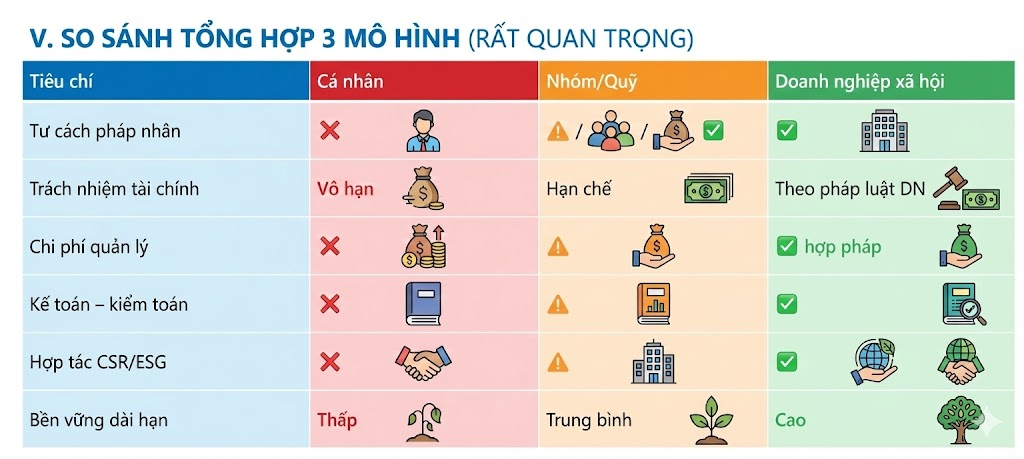
V. COMPREHENSIVE COMPARISON OF 3 MODELS
VI. CONCLUSION: SUSTAINABLE CHARITY MUST BE MANAGED AS A PROFESSIONAL ORGANIZATION
- Individuals: suitable for small acts of goodwill and short-term relief efforts.
- Groups/funds: suitable for stable activities, but less flexible.
- Social enterprises (such as Fly To Sky): an optimal model for the era of CSR, ESG, and sustainable development.
When charitable activities are placed within a clear legal framework, supported by transparent financial management and reasonable operating costs, social trust can be protected, resources can be multiplied, and community impact can truly become long-lasting.
—
For further information, please contact:
FLY TO SKY CHARITY NETWORK
Including Fly To Sky Charity And Community Development Support Social Enterprise Company Limitef and Fly To Sky Charity Organization
- Organizations and individuals wishing to accompany, collaborate, sponsor, or seek consultation on the implementation of customized CSR and ESG projects are welcome to contact us at 0935.939.446, or via email at [email protected] – [email protected]
- Website: flytoskycharity.vn
- Zalo OA: Fly To Sky Charity Network
- General Fanpage: https://www.facebook.com/flytoskycharity
- Volunteer Community with Fly To Sky: https://www.facebook.com/groups/392919558235980
#FlyToSky #FlyToSkyCharity #FlyToSkyCharityOrganization #FlyToSkySocialEnterprise #Volunteering #CSR #ESG #ForTheCommunity #SocialResponsibility #Charity #CommunityService