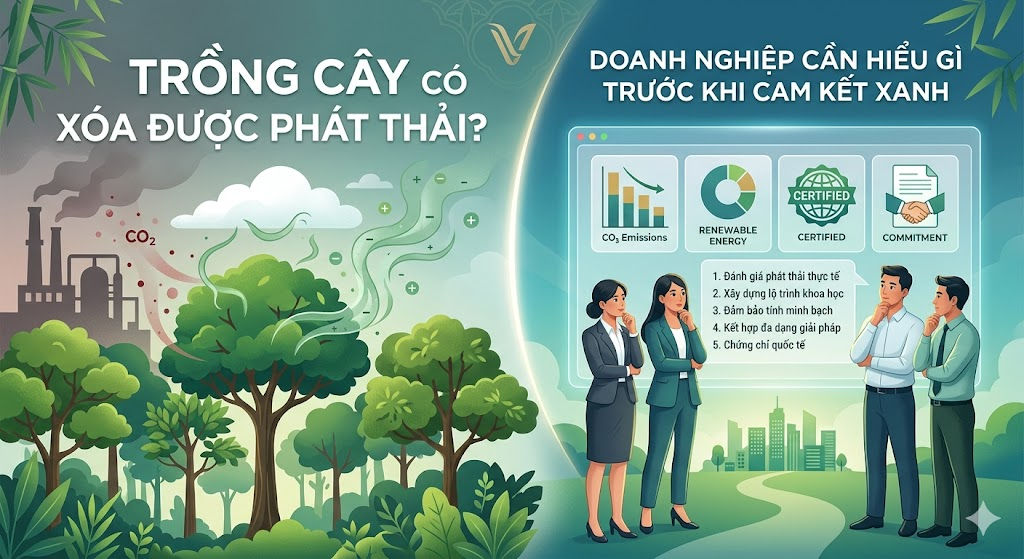
IPCC indicates that land-based activities, such as forest protection, forest restoration, and afforestation, can help reduce emissions and enhance carbon sequestration. However, their effectiveness depends heavily on timing, location, governance, and long-term risks. Biodiversity loss can also undermine ecosystems’ capacity to absorb carbon.
The most important point to understand is that trees do not absorb carbon in a way that delivers immediate results as soon as they are planted. During their early years, trees primarily develop their root systems, adapt to their environment, and accumulate relatively little biomass. A study published in Nature in 2025 found that carbon uptake rates in secondary forests vary substantially with forest age, peaking at approximately 20–40 years. Differences in carbon uptake rates can be significant across different stages of forest development. This means that claims such as “offsetting X tonnes of CO₂ in just one day of tree planting” often lack a sufficiently robust scientific basis.
Another noteworthy finding from international research is that, in many contexts, natural forest regeneration or well-protected secondary forests can sequester carbon more effectively than newly planted forests, particularly when assessed by area and over time. The IPCC also emphasizes that, in the short term, reducing deforestation and forest degradation often delivers greater climate benefits than focusing solely on new tree planting. In other words, “planting more trees” has value, but “protecting existing forests” is often even more urgent.
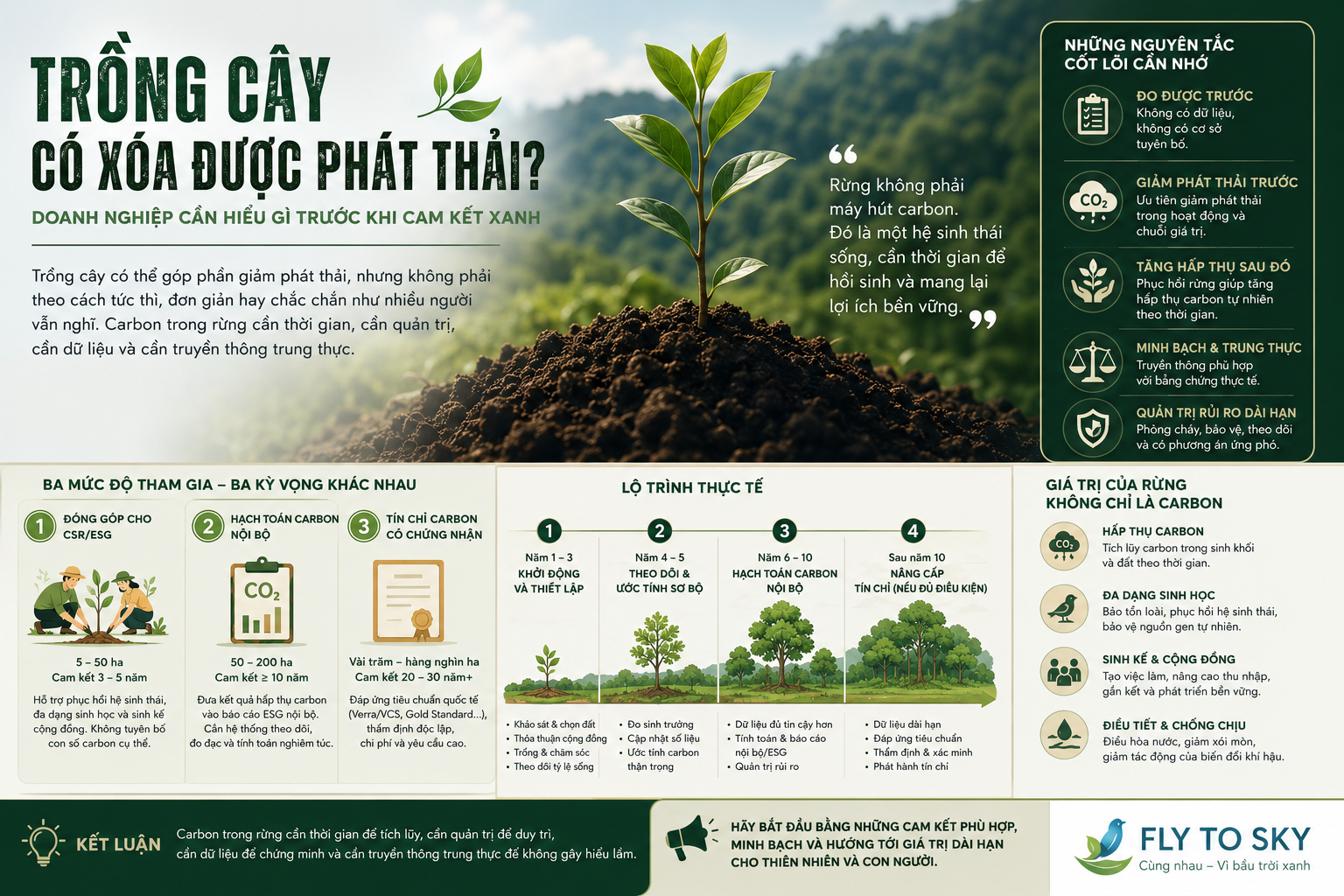
Forest restoration, carbon reporting, and carbon credits are three different things.
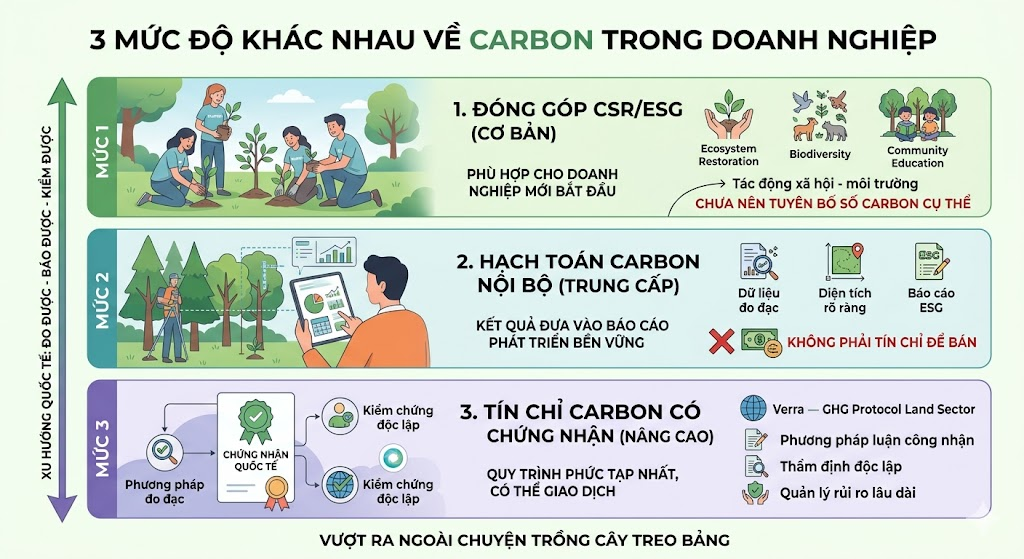
Businesses often group all these activities under the broad phrase “offsetting CO₂ through tree planting,” but in practice, there are three very different levels of engagement.
First, contributing to CSR/ESG initiatives. This is an appropriate starting point for many businesses: supporting ecosystem restoration, biodiversity, local livelihoods, and community education. At this level, businesses should communicate their social and environmental impacts without attaching specific carbon figures unless they have a sufficiently reliable measurement system.
Second, internal carbon accounting. When a business wants to include carbon sequestration results in its sustainability or ESG report, it needs clearly defined land areas, monitoring data, conservative calculation methods, and risk management mechanisms. These are not credits for sale, but the figures must not be “estimated to look good,” either.
Third, certified carbon credits. This is the most complex level, requiring an approved methodology, measurement, independent validation, periodic verification, and long-term risk management. Verra’s VM0047 methodology for afforestation, reforestation, and revegetation demonstrates that even at the certification level, different approaches—such as area-based and census-based methods—must be applied, alongside baselines and assessments of additionality during each verification period.
At the corporate level, the GHG Protocol has also issued its Land Sector and Removals Standard to guide organizations in quantifying, reporting, and tracking land-related emissions, CO₂ removals, and associated indicators. This reflects the direction of international practice: results must be measurable, reportable, and verifiable, rather than simply putting up a sign, planting trees, and immediately making climate claims.
Why “seedling costs + planting labor” is not enough
A forest restoration project with meaningful carbon benefits involves much more than purchasing seedlings and organizing a planting event. The actual costs often include site surveys, soil and ecological assessments, appropriate planting design, coordination with local authorities and communities, years of maintenance, replanting, fire prevention, and protection of young trees, as well as survival-rate monitoring, growth measurements, data management, and impact reporting. The IPCC also emphasizes that good governance, accountability, monitoring and verification capacity, and clear land tenure are important conditions for forest-based solutions.
In other words, if a business only provides funding based on a unit price per tree planted without investing in post-planting activities, there is little basis for making reliable claims about carbon outcomes. A forest is a living ecosystem, not a gift package that can be considered complete once it has been delivered.
Choosing the land can be harder than choosing the trees
A common misconception is that “if you have the money, you can secure the land.” In reality, land intended for forest restoration must meet multiple conditions: clear legal status, no disputes, compatibility with land-use plans, community consent, genuine ecological value, and no shifting of risks elsewhere. The IPCC notes that insecure land tenure is a major barrier to forest-based mitigation measures. Implementation must also account for the risks of emissions leakage, forest fires, and land-use change.
Furthermore, not every site is suitable for planting more trees to achieve climate benefits. Some studies indicate that in carbon-rich landscapes, particularly peatlands, planting trees or draining the land can cause soil carbon losses, reducing or even negating the climate benefits of new tree planting. Choosing the right location is therefore just as important as—and sometimes more important than—choosing the right tree species.
How to communicate without overstating the evidence
Communication should follow the data, not precede it. ISO 14068-1 establishes that a carbon-neutrality approach should follow a hierarchy of priorities: measure emissions, reduce them, increase removals within the value chain, and only then use offsets. SBTi likewise places net-zero within a science-based framework, emphasizing that businesses must first pursue substantial emissions reductions before using removals to neutralize residual emissions.
Therefore, at the initial stage, businesses should use language such as:
“We are supporting the restoration of native forests, contributing to increased carbon sequestration in the future, biodiversity recovery, and local community development.”
After several years of monitoring, they may state:
“The program is being monitored periodically to estimate carbon sequestration and assess ecological impacts.”
Only when a business has completed a comprehensive emissions inventory, established a clear internal emissions-reduction plan, and obtained reliable verification of its results should it consider using terms such as “carbon neutral” or “net zero.”
This is particularly important in the international context. The European Commission is tightening standards for green claims amid concerns that environmental statements may mislead consumers. The global trend is shifting from “saying the right things” to “proving what can be demonstrated.”
A practical roadmap for businesses
A more practical approach is to divide implementation into four phases.
Phase 1: Initiation and establishment. Conduct site surveys, select suitable locations, reach agreements with local communities, plant appropriate native species, maintain the site, and monitor survival rates. This phase requires patience, and businesses should avoid rushing to attach carbon labels to their activities.
Phase 2: Monitoring and preliminary estimation. Continue maintenance, measure tree growth, update maps, and develop conservative carbon estimates using appropriate methodologies. At this stage, businesses can begin communicating that their climate contributions are being monitored.
Phase 3: Internal accounting. If the data is sufficiently robust, businesses can incorporate carbon removal estimates into internal reports or ESG reporting, while remaining transparent about methodologies, assumptions, and uncertainty.
Phase 4: Progression to certification. Only when the project has sufficient land area, adequate long-term data, well-managed risks, and a genuine business need should certified carbon credits be considered. This approach may take longer, but it is more robust and credible.
Forests are about more than carbon
If forests are viewed solely as “carbon-absorbing machines,” businesses will overlook much of their greatest value. The IPCC highlights that forest restoration and sustainable forest management can deliver multiple co-benefits, including enhanced biodiversity, water regulation, reduced soil erosion, improved microclimates, livelihood opportunities, and greater landscape resilience to climate change.
For this reason, a well-designed forest restoration program should not focus solely on “optimizing carbon figures.” Instead, it should aim to genuinely restore ecosystems, ensure that local communities benefit, and help businesses fully understand the commitments they are making.
Conclusion
Tree planting can contribute to emissions reduction, but not in the immediate, simple, or guaranteed way that many promotional messages suggest. Carbon accumulates in forests over time, requires effective management to be maintained, relies on data to be demonstrated, and demands transparent communication to avoid misleading claims. International research and major standards and frameworks, including those of the IPCC, GHG Protocol, ISO 14068, SBTi, and Verra, point in the same direction: measure first, reduce emissions first, and prioritize transparency. Offsetting and carbon neutrality should come only as subsequent steps, once a sufficiently robust foundation has been established.
When businesses get it right, a forest becomes more than a beautiful photograph taken after a tree-planting ceremony. It becomes a long-term commitment to the climate, nature, and the integrity of corporate action.
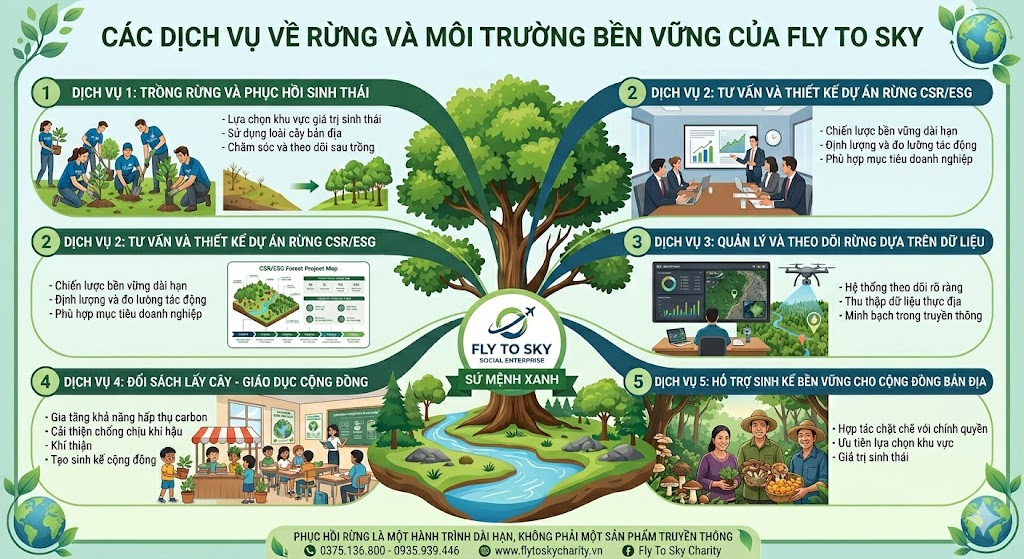
At Fly To Sky, we believe that forest restoration is not a “communications product” measured by the number of trees planted in a single day, but a long-term journey that requires the collaboration of businesses, communities, and relevant stakeholders.
Drawing on our experience implementing various environmental and sustainable development initiatives, Fly To Sky takes a cautious and responsible approach to tree-planting programs. We prioritize locations with ecological value, select tree species suited to local conditions, work closely with local authorities and residents, and place particular emphasis on post-planting care and monitoring rather than limiting our efforts to a single launch event.
We do not consider every tree planted to be a “carbon credit” generated immediately. Instead, each tree represents an investment in the future: contributing to ecosystem restoration, strengthening resilience to climate change, creating additional livelihood opportunities for local communities, and gradually enhancing nature’s capacity to absorb carbon over time.
Fly To Sky aspires to serve as a bridge that enables businesses to participate in forest restoration programs in a more meaningful way: starting with commitments aligned with their capabilities, communicating transparently, establishing clear monitoring systems, and pursuing long-term benefits for both nature and people. We believe that when a forest is genuinely restored, climate benefits will follow naturally from a healthy and sustainable ecosystem.
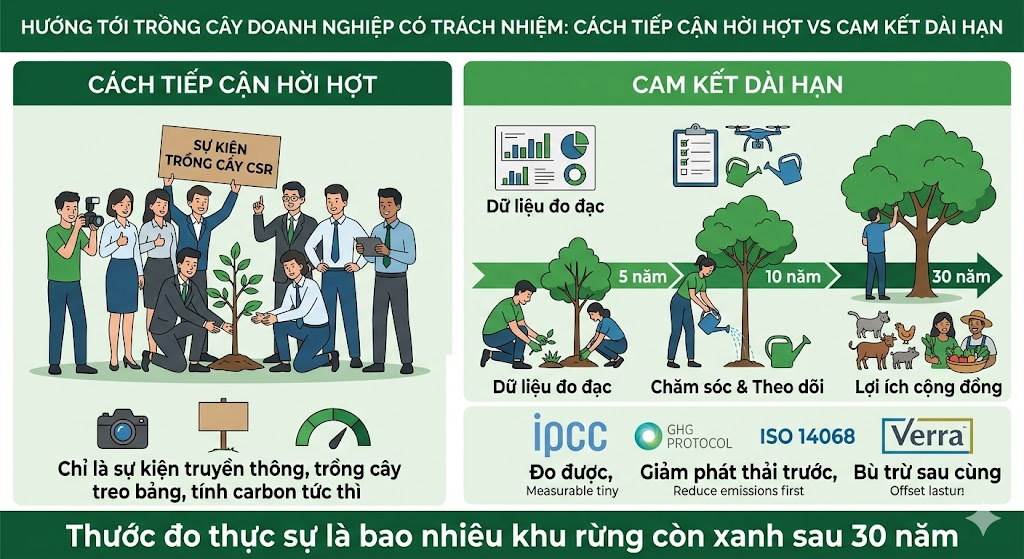
On the journey toward sustainable development, what matters most is not how many trees are planted today, but how many forests remain green five, ten, or even thirty years from now. That is the true measure of a genuine green commitment.
References
- Tài liệu tham khảo:
- Bài viết được tổng hợp từ các báo cáo của IPCC, GHG Protocol, ISO, SBTi, Verra cùng các nghiên cứu khoa học quốc tế về phục hồi rừng và hấp thụ carbon. Một số nhận định được diễn giải nhằm giúp doanh nghiệp Việt Nam dễ tiếp cận và ứng dụng trong thực tiễn triển khai các chương trình CSR, ESG và phục
- Intergovernmental Panel on Climate Change. (2022). Climate Change 2022: Mitigation of Climate Change. Working Group III Contribution to the Sixth Assessment Report of the Intergovernmental Panel on Climate Change – Chapter 7: Agriculture, Forestry and Other Land Uses (AFOLU). Cambridge University Pr
- Intergovernmental Panel on Climate Change. (2022). Climate Change 2022: Mitigation of Climate Change – Chapter 7: Agriculture, Forestry and Other Land Uses (AFOLU). Truy cập từ: IPCC AR6 Chapter 7 Website
- Greenhouse Gas Protocol. (2026). Land Sector and Removals Standard. World Resources Institute & World Business Council for Sustainable Development. Truy cập từ: GHG Protocol Land Sector and Removals Standard
- Greenhouse Gas Protocol. (2026). Land Sector and Removals Standard: What You Need to Know. Truy cập từ: GHG Protocol Overview Blog
- Greenhouse Gas Protocol. (2026). Frequently Asked Questions: Land Sector and Removals (LSR) Standard. Truy cập từ: GHG Protocol LSR FAQ
- International Organization for Standardization. (2023). ISO 14068-1:2023 – Climate change management — Transition to net zero — Part 1: Carbon neutrality. Geneva: ISO.
- Science Based Targets initiative. (2021). Corporate Net-Zero Standard. London: Science Based Targets initiative. Truy cập từ: SBTi Corporate Net-Zero Standard
- Verra. (2024). VM0047: Afforestation, Reforestation and Revegetation, Version 1.1. Washington, DC: Verra. Truy cập từ: Verra VM0047 Methodology
- European Commission. (2023). Green Claims Initiative: Reliable, Comparable and Verifiable Environmental Claims. Truy cập từ: European Commission Green Claims
- Cook-Patton, S. C., et al. (2020). The global potential for carbon removal from natural forest regeneration. Nature, 585(7826), 545–550. https://doi.org/10.1038/s41586-020-2686-x
- Poorter, L., et al. (2016). Biomass resilience of Neotropical secondary forests. Nature, 530(7589), 211–214. https://doi.org/10.1038/nature16512
- Bastin, J. F., et al. (2019). The global tree restoration potential. Science, 365(6448), 76–79. https://doi.org/10.1126/science.aax0848
- Friedlingstein, P., et al. (2023). Global Carbon Budget 2023. Earth System Science Data, 15, 5301–5369. https://doi.org/10.5194/essd-15-5301-2023
- Bộ Nông nghiệp và Phát triển nông thôn. (2022). Đề án 1 tỷ cây xanh giai đoạn 2021–2025. Hà Nội.
- Bộ Tài nguyên và Môi trường. (2022). Nghị định số 06/2022/NĐ-CP quy định giảm nhẹ phát thải khí nhà kính và bảo vệ tầng ô-dôn. Hà Nội.
- Quốc hội nước Cộng hòa xã hội chủ nghĩa Việt Nam. (2017). Luật Lâm nghiệp số 16/2017/QH14. Hà Nội.
- PanNature – Trung tâm Con người và Thiên nhiên. (n.d.). Các tài liệu, khuyến nghị và nghiên cứu về phục hồi rừng, quản trị rừng và thị trường carbon tại Việt Nam.