I. BACKGROUND AND GLOBAL TRENDS
In the context of significant global economic and social changes, issues related to environment, social and governance (ESG) are increasingly becoming core elements of business and organizational operations. Corporate Social Responsibility (CSR) Reports and Sustainability Reports are no longer merely voluntary activities or communication tools, but have become strategic management tools for measuring risks, enhancing reputation, and meeting legal, capital market and global supply chain requirements.
II. CORPORATE SOCIAL RESPONSIBILITY (CSR) REPORT
1. Definition: A CSR Report is a document reflecting a company’s commitments, policies, programs and results in fulfilling its responsibilities toward the community, employees, the environment and stakeholders.
2. Role of CSR reports
- Demonstrating the organization’s responsibility and ethical values
- Enhancing image, reputation and brand
- Strengthening trust among the community, partners and employees
- Providing a foundation for long-term sustainable development strategies
III. SUSTAINABILITY REPORT
1. Definition: A Sustainability Report is a comprehensive report on an organization’s economic, environmental and social impacts, developed based on international standards such as GRI, IFRS/ISSB, SASB, TCFD.
2. Key characteristics
- Based on data, indicators and clearly defined measurement criteria
- Closely linked to risk management and financial performance
- Serving diverse audiences: investors, regulators, communities and partners
IV. COMPARISON BETWEEN CSR REPORTS AND SUSTAINABILITY REPORTS
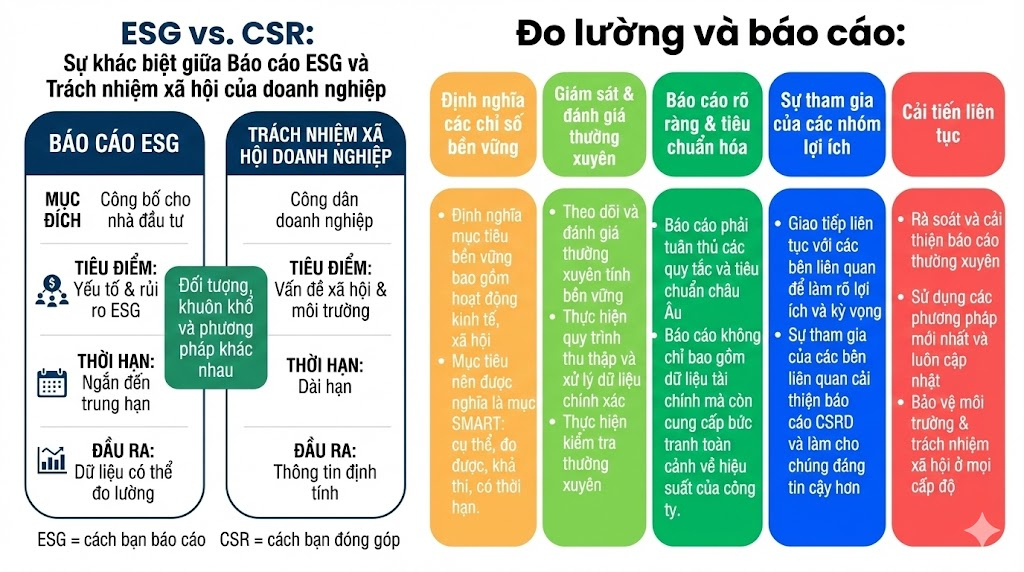
CSR reports focus on social responsibility activities and stories, while sustainability reports emphasize measuring, managing and increasing transparency of ESG impacts in connection with strategy and financial performance. Sustainability reports generally require a higher level of standardization, verification and comparability.
- CSR report (traditional): Usually describes social activities, community programs and community responsibility, focusing on actions and stories (qualitative).
- Sustainability / ESG report (modern): Focuses on indicators, data, sustainability-related financial risks and compliance with standards (GRI, ISSB/IFRS S1–S2, SASB, etc.). Requires evidence, standardized comparability and, in some cases, assurance.
- One key point: GRI implements double-materiality (outward impacts and financial impacts), while ISSB/IFRS focuses on sustainability-related financial disclosures (the impact on financial performance). Understanding this difference helps determine the objectives of reporting.
Why businesses/organizations need CSR reports / sustainability reports
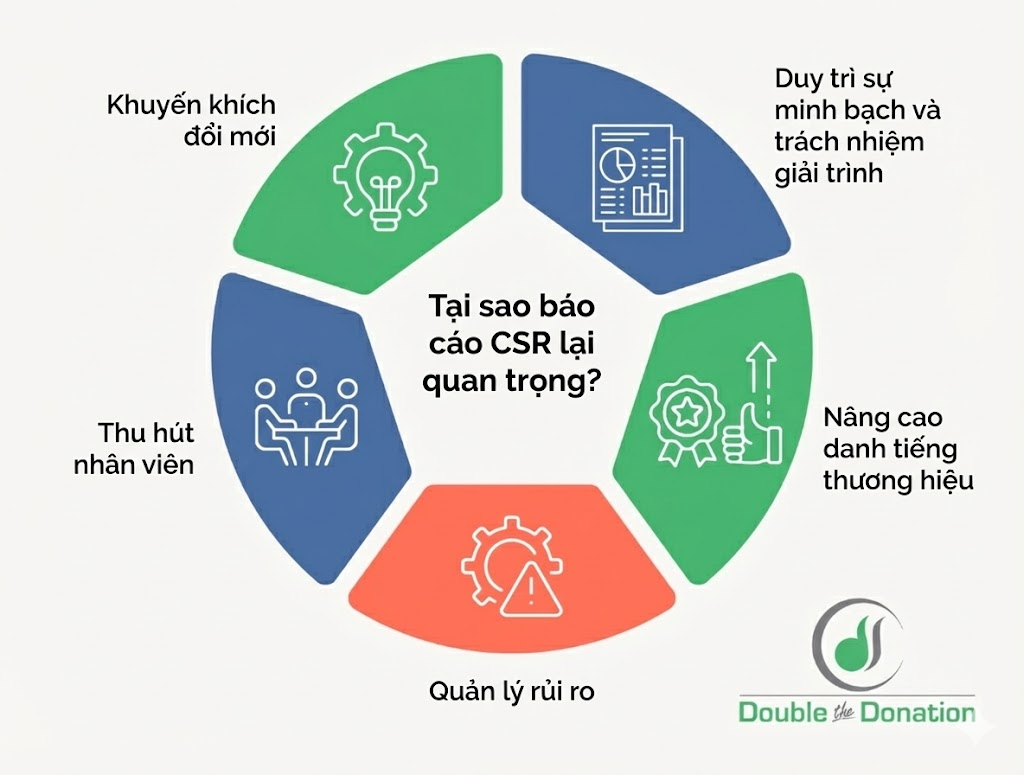
- Risk management & transparency: Non-financial reports help identify environmental-social-governance (ESG) risks at an early stage and link non-financial information with management strategies. (ISSB/IFRS framework perspective).
- Access to capital and investor requirements: Standards such as IFRS S1/S2 and ESG reporting requirements are increasingly becoming criteria used by investors to assess risk and sustainability.
- Regulatory compliance & markets: Listed companies/ bond issuers in Vietnam have been provided with guidance on disclosing environmental — social information; meanwhile, the EU CSRD/international supply chains are creating compliance pressure for related businesses.
- Reputation, brand and community relations: Structured reporting enables focused communication and strengthens the trust of customers, partners, funding communities and supporters.
In summary: reporting is not simply about “reporting good deeds”, but is a management and transparency tool that can open up financial opportunities.
V. COMMON REPORTING STANDARDS AND FRAMEWORKS
1. International standards
GRI Standards (Global Reporting Initiative) Objective: Reporting economic — environmental — social impacts for all audiences. Suitable when an organization seeks comprehensive transparency and responds to double-materiality requirements.
ISSB / IFRS S1 & S2 (International Sustainability Standards Board) Objective: Disclosure of sustainability information with financial implications — suitable for investors and financial accounting-based reporting. Used when a direct link between sustainability risks and financial statements is needed.
ISO 26000: Objective: Guidance on social responsibility actions (not a standard for “certification”); useful for designing internal CSR strategies, policies and social responsibility governance.
SASB (now operated/linked within the IFRS/ISSB system) Objective: Industry-specific indicators, useful for reporting according to financial/investor criteria.
TCFD / TNFD: TCFD: focuses on climate-related risks & opportunities (already adopted by many investors). TNFD: focuses on risks, dependencies and impacts on nature/biodiversity — a newer area of growing importance.
2. Regulations and directions in Vietnam
Relevant documents (for example, Circular 96/2020/TT-BTC guiding information disclosure on the securities market) have required many listed companies/ borrowers to disclose information related to E&S; at the same time, there are various guidelines and Sustainability Reporting Handbooks for Vietnamese businesses (note: Vietnam’s legal framework is developing in parallel with international pressures such as CSRD).
| Criteria | GRI | ISSB/IFRS (S1/S2) | ISO 26000 | SASB |
|---|---|---|---|---|
| Main objective | Impact transparency (community, environment) | Financially relevant information | CSR practice guidance | Industry indicators for investors |
| Materiality | Double-materiality (social & financial) | Financial/materiality (impact on enterprise value) | No mandatory quantification | Industry-specific financial materiality |
| Audience | broad: community, NGOs, investors, stakeholders | Mainly investors, capital market regulators | Internal & stakeholders | Investors, analysts |
| Mandatory/recommended | Usually NOT mandatory, but is best-practice | Becoming mandatory in many places through laws/regulations | Voluntary guidance | Commonly used for financial disclosures |
| Assurance | Usually may be required | Highly encouraged/ required in the future | _ | _ |
VI. CHALLENGES IN IMPLEMENTING CSR & SUSTAINABILITY REPORTING
- Non-financial data is fragmented and not standardized → solution: design data collection systems, templates and clear KPIs.
- Identifying materiality → organize workshops, stakeholder surveys; apply materiality matrices under GRI/ISSB.
- Linking ESG with finance → develop scenarios and conduct risk stress tests (especially for IFRS S1/S2).
- Assurance requirements → prepare internal audit processes and data before engaging third-party assurance.
- Lack of an integrated ESG data system
- Difficulty identifying material issues
- Lack of specialized personnel
- CSR is not yet linked to strategy and finance
VII. FLY TO SKY’S CSR & SUSTAINABILITY REPORTING CONSULTING SERVICES
Fly To Sky provides comprehensive consulting services, accompanying businesses and organizations from strategy development, readiness assessment and materiality identification to the preparation and publication of CSR Reports/Sustainability Reports in accordance with Vietnamese and international standards.
Fly To Sky - Social Responsibility Report & Sustainability Report Consulting: We help organizations move from fragmented charitable activities and CSR initiatives to a data-driven, transparent and internationally aligned sustainability strategy (GRI / ISSB / CSRD / ISO26000). Services include: readiness analysis, materiality assessment, report drafting, assurance preparation and communication programs for report publication.
1. Service packages
- Current-state assessment & Gap Analysis
- Identification of material issues & stakeholder engagement
- Development and drafting of reports according to GRI, ISSB, ISO 26000
- Internal training & preparation for independent verification
- Communication consulting and report publication
2. Value Fly To Sky brings
- Deep understanding of social, community and ESG activities
- Connecting CSR practices with sustainable development strategies
- Solutions suitable for businesses, social organizations and social enterprises
- Long-term partnership, aiming for sustainable impact
VIII. CONCLUSION
CSR Reports and Sustainability Reports are essential tools for organizations to demonstrate their commitment to sustainable development, strengthen trust and create long-term value for society. Fly To Sky is ready to accompany, advise and support businesses on their journey toward transparency, responsibility and sustainability.
—
For further information, please contact:
FLY TO SKY CHARITY NETWORK
Including Fly To Sky Charity And Community Development Support Social Enterprise Company Limited & Fly To Sky Charity Organization
- Organizations and individuals wishing to accompany, collaborate, sponsor or seek consultation on CSR and ESG Projects can contact 0935.939.446 or email [email protected] – [email protected]
- Website: flytoskycharity .vn.
- Zalo OA: Fly To Sky Charity Network
- Main Fanpage: https://www.facebook.com/flytoskycharity
#FlyToSky #FlyToSkyCharity #NhomtuthienFlyToSky #DNXHFlyToSky #Tinhnguyen #CSR #ESG #Vicongdong #Trachnhiemxahoi #Tuthien #Thiennguyen