
Current State of ESG Practices Among Vietnamese Enterprises
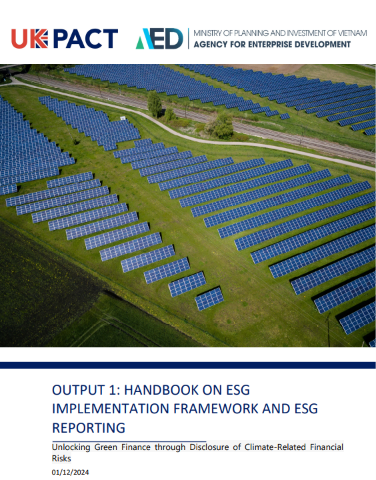
The Handbook on ESG Implementation Framework and ESG Reporting was developed under the initiative “Unlocking Green Finance through Disclosure of Climate-Related Financial Risks.” The initiative is funded by the UK Government through the Partnering for Accelerated Climate Transitions (UK PACT) programme, with the aim of strengthening domestic enterprises’ capacity to access sustainable finance. According to the handbook’s introduction, The Asia Foundation was selected as the Delivery Partner, with EY serving as the technical partner.
The handbook aims to provide guidance and reference materials for organisations and enterprises in Vietnam on integrating ESG into corporate governance, strategy and operations. Through this approach, businesses can identify and address sustainability-related risks while strengthening their capacity to disclose ESG information in accordance with domestic and international regulatory requirements and established practices. The handbook also provides climate-related recommendations to help businesses consider emerging material risks arising from their operations.
In its analysis of the Vietnamese market context, the handbook cites a survey conducted by the Agency for Enterprise Development under the Ministry of Planning and Investment between May and July 2024. The survey examined the extent to which enterprises had adopted sustainable business practices based on the Environmental, Social and Governance (ESG) framework. Among the 1,019 enterprises surveyed, 39% had never heard of ESG, while 62% were unclear about ESG-related regulations and policies in Vietnam. In terms of implementation, only 14% of enterprises were classified as pioneers, whereas 25% had undertaken virtually no ESG-related activities or initiatives, or had implemented very few.
The survey also found that Vietnamese enterprises performed best in the Social pillar, followed by Governance and Environment, with corresponding implementation rates of 68%, 63% and 52%. The three main challenges identified were a lack of or insufficient information about ESG, a shortage of ESG awareness-raising and training programmes, and the absence of specific government policies on ESG.
For micro, small and medium-sized enterprises (MSMEs), implementing sustainable business practices remains challenging due to factors such as initial investment costs, limited knowledge and expertise, data constraints, and the complexity of reporting guidelines. Nevertheless, the 2024 survey also recorded a positive development: approximately 26–30% of enterprises in each of the medium-sized, small and micro-sized categories had begun exploring or adopting ESG criteria.
In response to this situation, the handbook provides a practical roadmap to help enterprises gradually approach and integrate ESG, rather than implementing isolated activities that are disconnected from their business strategies and operations.
Six-Step Roadmap for Developing and Implementing an ESG Action Plan
One of the handbook’s key components is a six-step approach to developing and implementing an ESG action plan. It is designed to help enterprises assess their current status, identify priorities and progressively improve their ESG implementation capabilities.
Step 1 – Learn: Enterprises should proactively learn about ESG and sustainability issues relevant to their business activities, while building organisational support and commitment, particularly at the Board of Directors level. The handbook recommends that enterprises participate in capacity-building programmes, study specialised materials, and consult experts, partners, businesses in the same industry and relevant stakeholders. Training, information updates and assessments of the Board of Directors’ performance are also considered ways to strengthen leadership engagement.
Step 2 – Assess and Understand: Enterprises identify material ESG impacts, risks and opportunities arising from their business activities and value chains. On this basis, they assess the maturity of their existing ESG capabilities and examine their ability to manage and respond to the identified issues. The handbook presents two assessment options: conducting an overall assessment of ESG maturity at the organisational level or assessing individual material ESG issues separately. Areas for consideration may include the business model and value chain, governance and strategy, people and culture, risk management, stakeholder engagement, data and technology, reporting and monitoring.
Step 3 – Plan: After assessing their current status, enterprises identify the capabilities that need to be prioritised for improvement and develop an ESG action plan. This process involves assigning responsible teams and implementation responsibilities; establishing strategic directions, objectives and priorities for each material issue; identifying necessary changes to business models, products, services and value chains; and developing improvement initiatives for the short, medium and long term.
The handbook also emphasises the importance of integrating the ESG action plan into the enterprise’s financial plan. Factors to consider include the financial resources required, potential impacts on the financial position, operating performance and cash flows, as well as access to sustainable finance and supporting policies. In addition, enterprises should establish specific, measurable, relevant and time-bound key performance indicators (KPIs) to monitor implementation results.
Step 4 – Implement: Enterprises carry out the initiatives and activities identified in the plan to improve their ESG capabilities. To ensure consistent implementation, the handbook recommends establishing clear policies, procedures and guidelines; securing support from senior management; providing training and raising employee awareness; and communicating the action plan and related requirements to suppliers and customers. Assigning specific responsibilities and communicating procedures throughout the organisation are essential to sustaining implementation and continuous improvement.
Step 5 – Track Progress and Review: Enterprises should identify appropriate quantitative or qualitative indicators, collect reliable ESG data and regularly assess performance against established objectives. Data may be collected through observation, measurement, surveys, interviews with employees and external stakeholders, as well as document reviews. Based on the monitoring results, enterprises should examine emerging issues, evaluate implementation progress and adjust their plans or objectives when necessary.
Step 6 – Report: The final step focuses on formalising the ESG action plan, consolidating objectives and achievements, explaining unmet targets, and outlining the direction for subsequent implementation. Enterprises should identify stakeholders who need access to the information and regularly communicate implementation progress through appropriate channels. Disclosure methods may include corporate websites, sustainability reports or digital ESG disclosure platforms.
Integrating ESG into Corporate Governance, Strategy and Operations
In addition to the six-step roadmap, the handbook provides a range of tools, approaches, practical guidance and supporting resources to help enterprises integrate ESG across different capability areas. These are organised into four main categories: Governance and Strategy; Operations; Data and Reporting; and Monitoring.
In the Governance and Strategy category, the document emphasises the role of the Board of Directors and executive management in establishing ESG-related vision, direction and responsibilities. Enterprises should consider material environmental, social and governance issues when defining their vision, mission and long-term objectives, while clearly establishing governance structures and the roles and responsibilities of different management levels. The handbook also addresses ESG training for Board members, the establishment of dedicated committees or working groups, and the inclusion of ESG issues in oversight mechanisms.
Another important area is ESG Materiality Assessment. This process helps enterprises identify sustainability issues that are significant to their operations, including impacts, risks and opportunities. The assessment results enable enterprises to allocate resources to priority issues, shape their strategies and determine which information should be disclosed. This process should be conducted periodically, taking into account internal conditions, industry-specific factors and stakeholder perspectives.
The handbook also provides guidance on establishing ESG commitments and objectives and aligning them with business strategies and specific action plans. Rather than making general statements about sustainability, enterprises should set objectives that can be monitored, assessed and adjusted throughout implementation.
In the Operations category, the content focuses on supply chain management, risk management and stakeholder engagement. ESG integration should not be limited to internal operations but should also be considered across the entire value chain, from suppliers and production activities to distribution, customers and affected communities. Enterprises need to identify ESG risks arising from their operations and establish appropriate management mechanisms, while maintaining communication with stakeholders to better understand the impacts and expectations associated with their business activities.
For the Data and Reporting category, the handbook addresses sustainability reporting, ESG disclosure, data management and the application of technology. Establishing a data system plays an important role in monitoring performance, verifying information and ensuring consistency across departments. Meanwhile, the Monitoring category focuses on internal and external assurance mechanisms to strengthen the reliability of disclosed ESG data, processes and information.
Guidance on Preparing Sustainability Reports and Disclosing ESG Information
The third part of the handbook focuses on preparing sustainability reports, from organising resources and identifying content to verifying data and finalising reports. The document outlines a six-step process.
First, enterprises need to establish the resources required for ESG reporting, with senior management providing strategic direction and the Board of Directors affirming its commitment. Enterprises should establish a responsible team with clearly defined duties and authority, involve representatives from relevant departments, and develop an information storage system to support reporting activities.
Next, enterprises should develop a transition plan suited to their chosen reporting approach, which may involve preparing a standalone report or incorporating ESG information into an existing report. The plan should identify activities, responsibilities, timelines and expected outputs. Enterprises should also review their current reporting practices, assess the completeness and reliability of available information, identify data gaps and assign responsibility for data collection.
When determining the content of the report, enterprises should select topics that are significant to both the organisation and its stakeholders. Material issues may be identified through stakeholder consultations, comparisons with industry practices or risk analysis. The information presented should combine quantitative and qualitative data, using charts or visual tools where appropriate to help readers understand performance and results.
Enterprises should then assess their information systems and control mechanisms to ensure that data is collected accurately, completely and reliably. The responsible team should examine data sources, system integrity, and the processes for processing, reporting and reviewing information. Enterprises may also engage third-party assurance services to verify their systems, control processes or performance data.
Once the data has been reviewed, enterprises proceed to consolidate their sustainability reports, ensuring that the content is reviewed, approved and updated consistently. Finally, enterprises should develop an improvement plan, document issues arising during the reporting process, identify bottlenecks in data collection and adjust procedures for subsequent reporting periods.
In addition to the implementation process, the handbook addresses principles for determining reporting content and quality. These include strategic and long-term orientation, connectivity of information, stakeholder engagement, materiality, and the relevance and completeness of information. Reports should demonstrate the relationships between strategy, business models, risks, opportunities, ESG indicators and targets, thereby helping stakeholders understand how enterprises create value and respond to changes in their operating environment.
In terms of structure, sustainability reports are developed with reference to international standards and frameworks. The main content areas include statements of compliance with reporting standards and frameworks, assurance, reporting scope, materiality assessment, governance, strategy, risk management, metrics and targets, and the basis of reporting. The document also sets out climate-related disclosure requirements alongside broader ESG reporting content.
Simplified Disclosure Guidance for Small and Medium-Sized Enterprises
Another notable component is the section on simplified disclosure guidance for small and medium-sized enterprises (SMEs). This section provides a simplified set of disclosure topics to help SMEs monitor and report ESG data. The proposed topics are applicable across various industries, although their significance and order of priority may differ depending on the characteristics of each enterprise. Therefore, each organisation needs to determine the materiality of these topics in relation to its own operations.
The topics are divided into three pillars. Under Environment, enterprises are guided to monitor greenhouse gas emissions, energy management, water and wastewater, waste, biodiversity, ecological impacts and material efficiency. Under Social, the topics include labour practices, employee health and safety, employee engagement, diversity and inclusion, affected communities, consumers and end-users. Under Governance, the topics focus on corporate governance, strategy, risk management and ESG action plans.
Through this guidance, the handbook provides a basis for enterprises of different sizes and with varying resources to gradually approach ESG data collection, monitoring and disclosure. This section also addresses the challenges identified in the 2024 survey, particularly limited knowledge, data constraints and insufficient reporting capabilities among small and medium-sized enterprises.
With its three main parts covering the ESG landscape, guidance on integrating ESG into governance and operations, and information disclosure, the Handbook on ESG Implementation Framework and ESG Reporting provides a relatively comprehensive reference framework for Vietnamese enterprises seeking to develop and implement ESG practices. The document emphasises a step-by-step approach based on identifying material issues, assessing existing capabilities, setting objectives and monitoring results, while encouraging enterprises to adapt their implementation roadmaps to their strategic directions and available resources.
References
- UK Pact I https://www.ukpact.co.uk/hubfs/2021-Fund-Page/Vietnam/20241230%20UK%20PACT%20So%20tay%20ESG_AED_EN_v3.pdf? I 2026-11-06