1. Re-reading the numbers
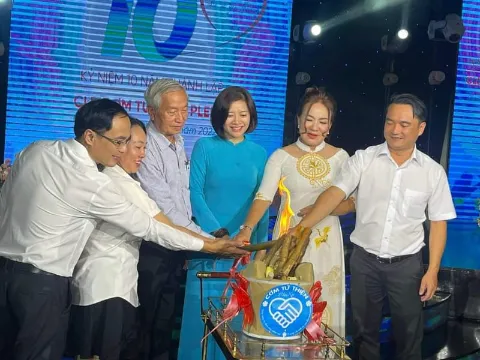
The club was founded in Pleiku on 13 September 2012 by Ms. Lý Thị Hồng Trị and a few associates, starting with roughly 40 meals a week. According to the club's own 14-year review, it has since served more than 364,000 meals of rice and porridge to patients, handed out over 50,000 gift packages, and contributed more than VND 30 billion in total to welfare activities and community works [1].
Spread over 14 years, that is about 26,000 meals a year, or around 500 a week. Current scale is considerably larger: the club targets 750-1,000 Sunday lunches across four hospitals and 300-500 Saturday-morning portions of porridge and bread at two specialist hospitals [1]. That adds up to roughly 1,050-1,500 meals a week - two to three times the historical average. In other words, the model is not just surviving but accelerating, which is unusual for informal volunteer groups that often plateau after their first few years.
The VND 30 billion figure shows a remarkable capacity for mobilising resources for a community club. It spans several forms of contribution: cash, in-kind donations converted to money, and resources the club mobilised for partners to deliver directly (for example housing or clean-water projects). If future reports present these three parts separately, supporters will see even more clearly the "bridge" role the club plays.
2. The gap a free meal fills
To understand why a Sunday lunch box matters, look at what a course of treatment really costs.
Vietnam's health-insurance coverage now exceeds 95% of the population [3]. But coverage is not the same as financial protection: the Ministry of Health considers household out-of-pocket health spending still relatively high, while the WHO treats roughly 30% as the threshold for a sustainable system [4]. Health officials also acknowledge that illness can still push people into poverty, especially those with chronic or serious conditions who need long treatment [5].
More importantly, those figures cover medical costs only. Food for the patient and family, transport from the commune to the provincial capital, a place to sleep, and the income lost by whoever stops working to care for the patient - none of it is insured. For a farming household in a remote area, these can exceed the hospital co-payment itself.
Gia Lai's context sharpens the gap. The province is home to 44 ethnic groups, with ethnic minorities making up about 46% of the population; at the end of 2023, the poverty rate among minority households was still above 17%, with nearly another 17% classed as near-poor [6]. The province has reduced poverty quickly - its 2026 plan aims to bring the overall poverty rate down to about 1.43% [7] - yet Pleiku's provincial hospitals remain where the most vulnerable households converge, at the very moment they are most vulnerable.
In neighbouring Đắk Lắk, a fundraising campaign for charity kitchens reported families abandoning treatment even after fees were waived, simply because they had nothing left to eat [8]. That is the strongest argument for hospital kitchens: they do not replace health care; they keep patients in it.
3. Value beyond the meal itself
An inpatient needs about 21 meals a week, not counting the caregiver. With the current schedule - Saturday porridge, Sunday lunch - each person receives one or two of those. The model's value should therefore not be measured only by the food money each family saves.
Comparisons help: at Chợ Rẫy Hospital in Ho Chi Minh City, a kitchen coordinated by the hospital's social-work department with several charity groups serves more than 4,000 meals a day [9]; in Đắk Lắk, over 20 kitchens together cook roughly 34,000-35,000 meals a month [8]. Pleiku operates at a different scale, suited to a model run entirely by weekend volunteers - and sustaining that rhythm for 14 years is an achievement in itself.
The meal's greatest value lies in three things beyond calories. First, a regular signal that patients are not forgotten. Second, a recurring point of contact between the community and the hardest-hit families. Third, a bridge through which people facing greater hardship – without an insurance card, at risk of abandoning treatment, with children at risk of dropping out – can choose to seek support. This is the model's most promising room for growth, as section 6 discusses.
4. From relief to opportunity: where do the activities sit on the ladder of change?
A useful way to assess a charity's portfolio is to place activities on a ladder: relief (meeting immediate needs) → risk reduction (stopping a shock from becoming a disaster) → opportunity (building self-reliance) → system change (addressing root causes).
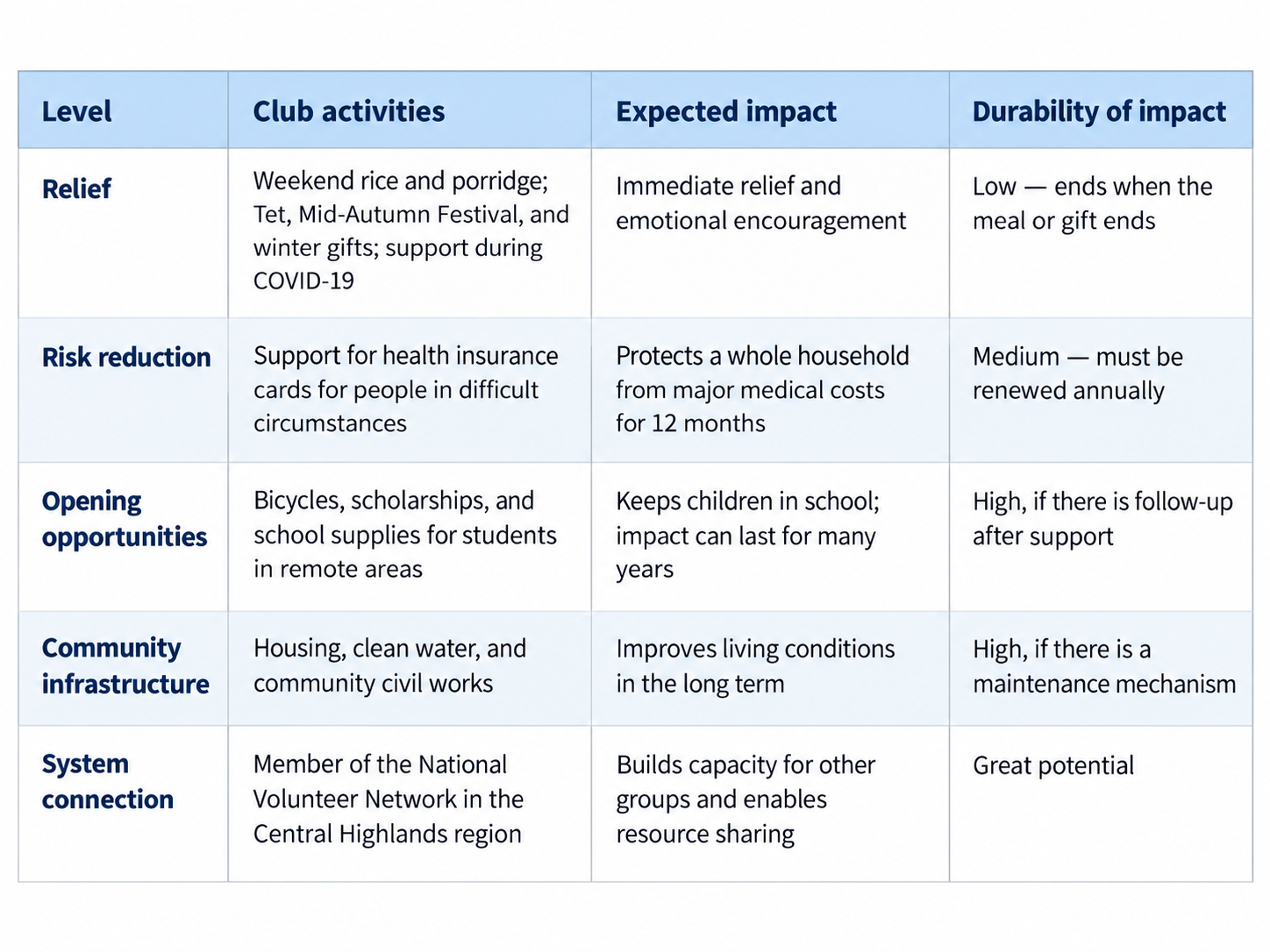
The picture shows the club has naturally climbed the ladder over 14 years. Most notable is health-insurance support: per dong spent, it is probably the club's highest-leverage activity, since one card can stop a whole family falling into debt when someone falls seriously ill - addressing the root of the problem that the kitchen tackles at the surface. However, officially poor households usually already have their premiums paid by the State, so the real added value lies in reaching people who fall outside the policy net: near-poor households, informal workers, families that have only just left poverty.
If the club also publishes how resources are split across the rungs, supporters will see this commendable journey more clearly - from the meal in front of them to lasting change.
5. Structural strengths
Continuity: Fourteen years of a fixed weekly cooking schedule is a rare asset. For patients, reliability matters as much as volume: a meal that is guaranteed every Sunday helps families plan their spending.A distributed resource base: Resources come from many layers: volunteers give time, market traders give ingredients (traders from Thắng Lợi market have supported the club for more than a decade), and businesses and families sponsor specific occasions. Many small sources absorb shocks better than reliance on one large donor.Institutional recognition: The 2019 National Volunteer Award and membership of the National Volunteer Network for the Central Highlands give the club a convening position most informal groups lack [1].Real-time cash transparency: Statements for the donation account are displayed directly from the Thiện Nguyện platform, where the club cannot edit the figures [2]. This level of input transparency is better than the norm among volunteer groups.
6. Room to go further
The points below are not unique to the Pleiku club; they are shared by most community volunteer groups in Vietnam as they move from running on passion to running on systems. With a 14-year foundation, the club is well placed to lead on this journey - and its own review already commits to responsible, transparent work that creates lasting value [1].
From cash transparency to results transparency: The club's transparency page already commits to publishing an income-and-expenditure report for each programme [2]; with the website newly launched for its 14th anniversary, this is a natural next step. Reports that also show what the money achieved will add a further layer of donor trust.From a personal account to a collective mechanism: The donation account is currently in the club chair's name [2] - common practice for groups without legal-entity status. Gradually moving to a jointly held account or a legal entity would both protect the leader and strengthen the organisation as it keeps growing.Preparing the next generation: The 14-year journey bears the strong imprint of its founder, and the review already mentions developing the team. Documenting operating procedures and gradually sharing leadership will help that spirit carry on.Telling the impact story while fully protecting privacy: The 364,000 figure counts meals. The club can show its impact more clearly through aggregate, non-identifying figures – such as portions per hospital over the years, or general statistics provided by hospital social-work departments – without collecting any personal or medical information from recipients. Respect for recipients’ privacy and dignity is already a principle the club has published [2], and should remain its first priority.Meals suited to the patient: Patients with kidney disease, diabetes or cancer have different dietary needs. Advice from partner hospitals' nutrition departments could raise the value of every portion.A greener kitchen: At over a thousand meals a week, choices on packaging (for example encouraging recipients to bring their own containers, as at Chợ Rẫy [9]), food waste and local sourcing could cut costs and make the club a model of environmentally friendly charity.
7. Another view: not every act of charity must pay for itself
Before demanding that every charity "teach people to fish", one counter-argument deserves a hearing. A hospitalised patient does not need vocational training; they need to eat, today. A hospital kitchen is closer to a function of the social safety net than a development project, and asking it to create livelihoods is asking the wrong question. The right sustainability questions for this model are: can the organisation sustain itself, and does it help the wider system work better?
The second question leads to a harder debate: who should bear the cost of feeding poor patients - hospitals, the insurance fund, local budgets or the community? If charity kitchens quietly fill the gap, pressure for policy change may ease. Yet policy is slow, and patients cannot wait. The way through is reliable aggregate figures: when the kitchen and hospitals can show the scale and regularity of the need, that becomes the strongest evidence for changes such as the supplementary health-insurance packages now under proposal [5], meal support for patients in hardship, or lodging for caregivers. In Ho Chi Minh City, many kitchens have been integrated into hospitals' social-work departments [9] - showing that charity and the system can complement rather than run in parallel.
8. Assessment through the Sustainability 360° lens
Sustainability 360° looks at a social initiative not just by its output but across six dimensions: social impact, depth of change, governance and transparency, financial and organisational resilience, environment, and measurement and learning. The observations below are based on public information, are indicative, and aim to suggest directions for growth.
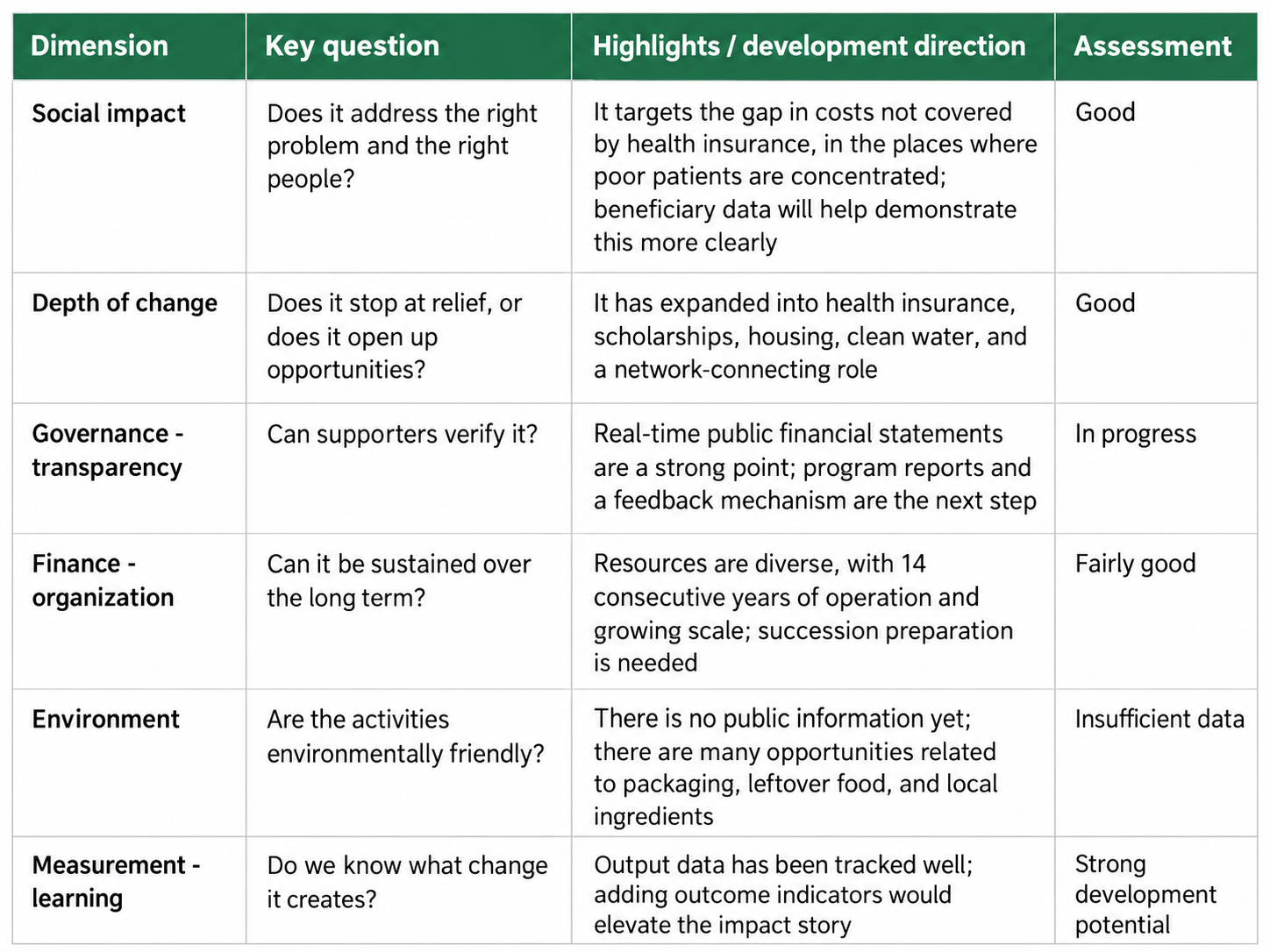
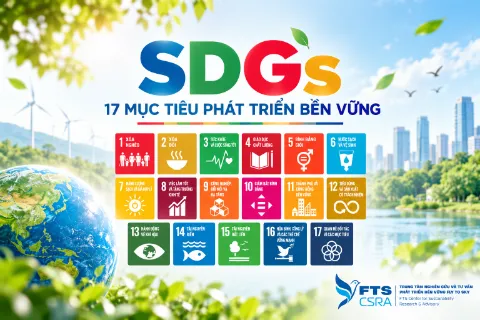
Link to the Sustainable Development Goals (SDGs). The club contributes directly to SDG 2 (Zero Hunger) and SDG 3 (Good Health - particularly protecting people from financial risk when ill), and indirectly to SDG 1 (No Poverty - safety nets), SDG 4 (Education), SDG 6 (Clean Water) and SDG 17 (Partnerships) through its network role.
Six suggestions for the road ahead
Simple measurement that respects privacy: Do not collect personal or medical information from meal recipients – health information is sensitive personal data under Decree 13/2023/ND-CP, and a meal should be given without conditions or questions. Instead, the club can track portions per hospital, note general trends through volunteers’ observations, and, when needed, ask hospital social-work departments – which already manage patient records – to share aggregate figures.Connect, don’t screen: When patients or relatives choose to share their difficulties, volunteers can refer them to the hospital’s social-work department or to the club’s health-insurance and scholarship programmes – entirely voluntarily, with no questioning or note-taking at the meal table.Publish regular programme reports: Quarterly or annual reports that separate cash, in-kind value and partner-spent resources, with a few outcome indicators rather than outputs alone.Institutionalise governance: Form a management board, document operating procedures, plan succession; consider a jointly held account or operating under a legal entity (a social/charity fund, or a host organisation with legal status).Safe meals that suit the illness: Consult hospital nutrition departments to offer suitable options for common conditions; apply food-safety procedures and sample retention for large-volume cooking.A greener kitchen: Cut foam and single-use plastic, encourage recipients to bring containers, measure food waste and prioritise local ingredients - lowering both costs and environmental footprint.
Conclusion
The Pleiku Charity Rice Club has proved the hardest thing in volunteering: persistence. Fourteen years, week after week, is a foundation few organisations have - and persistence is the root of sustainability. On that foundation, the next stage may not mean cooking more, but understanding more deeply - the people it serves and the change it creates - and building a structure strong enough for its spirit of mutual care to carry on for generations. Then the Sunday lunch box becomes more than a meal: it becomes the first door leading poor families to support that can change their lives.
Methodology note: This article draws on the Pleiku Charity Rice Club's public materials and on press and official statistics; the authors have not interviewed the club, beneficiaries or hospitals. Activity figures are self-reported by the club and have not been independently verified. Derived calculations (annual averages, weekly meals) and the Sustainability 360° ratings are the authors' estimates and judgements. The club is welcome to respond so the article can be updated.
References
[1] Pleiku Charity Rice Club - 14-year review (Oct 2026): comtuthienpleiku.org/noi-dung/post/cau-lac-bo-com-tu-thien-pleiku-14-nam-ben-bi-gieo-mam-nhan-ai-lan-toa-yeu-thuong-tu-nhung-dieu
[2] Pleiku Charity Rice Club - Transparency report page: comtuthienpleiku.org/minh-bach
[3] Vietnam Financial Times - Expanding health-insurance benefits while keeping the fund sustainable: thoibaotaichinhvietnam.vn/mo-rong-quyen-loi-bao-hiem-y-te-di-doi-voi-bao-dam-ben-vung-quy-194518.html
[4] Người Quan Sát - Expanding benefits for health-insurance card holders (Jul 2024): nguoiquansat.vn/se-mo-rong-quyen-loi-cho-nguoi-co-the-bao-hiem-y-te-140741.html
[5] Znews - Proposal for new supplementary health insurance: znews.vn/de-xuat-them-loai-bhyt-moi-giam-ganh-nang-chi-phi-cho-nguoi-dan-post1612631.html
[6] Nông nghiệp & Môi trường - Gia Lai steps up poverty reduction in ethnic-minority areas: nongnghiepmoitruong.vn/gia-lai-tang-cuong-xoa-doi-giam-ngheo-vung-dong-bao-dan-toc-thieu-so-d730614.html
[7] Labour Research Journal - Gia Lai focuses on sustainable poverty reduction: tcnnld.vn/news/detail/72728
[8] Từ Tâm Fund Đắk Lắk / MoMo - Fundraising for patient meals in Đắk Lắk: momo.vn/cong-dong/gay-quy-trao-tang-suat-com-dinh-duong-cho-benh-nhan-tai-dak-lak
[9] Nhân Dân - Love overflowing in the hospital kitchen: nhandan.vn/ocop/ngap-tran-yeu-thuong-noi-can-bep-benh-vien-post978017.html
Method & scope
This article draws on the Pleiku Charity Rice Club's public materials and on press and official statistics; the authors have not interviewed the club, beneficiaries or hospitals. Activity figures are self-reported by the club and have not been independently verified. Derived calculations (annual averages, weekly meals) and the Sustainability 360° ratings are the authors' estimates and judgements. The club is welcome to respond so the article can be updated.