
Contents
##
Overview and origin
| Item | Details |
|---|---|
| Vietnamese name | Sáu tiêu chí đánh giá của Ủy ban Hỗ trợ Phát triển OECD |
| English name | OECD-DAC Evaluation Criteria (Better Criteria for Better Evaluation, 2019) |
| Issuer / administrator | The OECD Development Assistance Committee (DAC), through its Network on Development Evaluation (EvalNet). |
| Nature | An evaluation criteria framework (definitions and principles for use); not a certification or fixed indicator set. |
| Reference scope | Evaluation of development and humanitarian projects, programmes and policies; used by the UN, development banks, bilateral donors and many civil society organizations. |
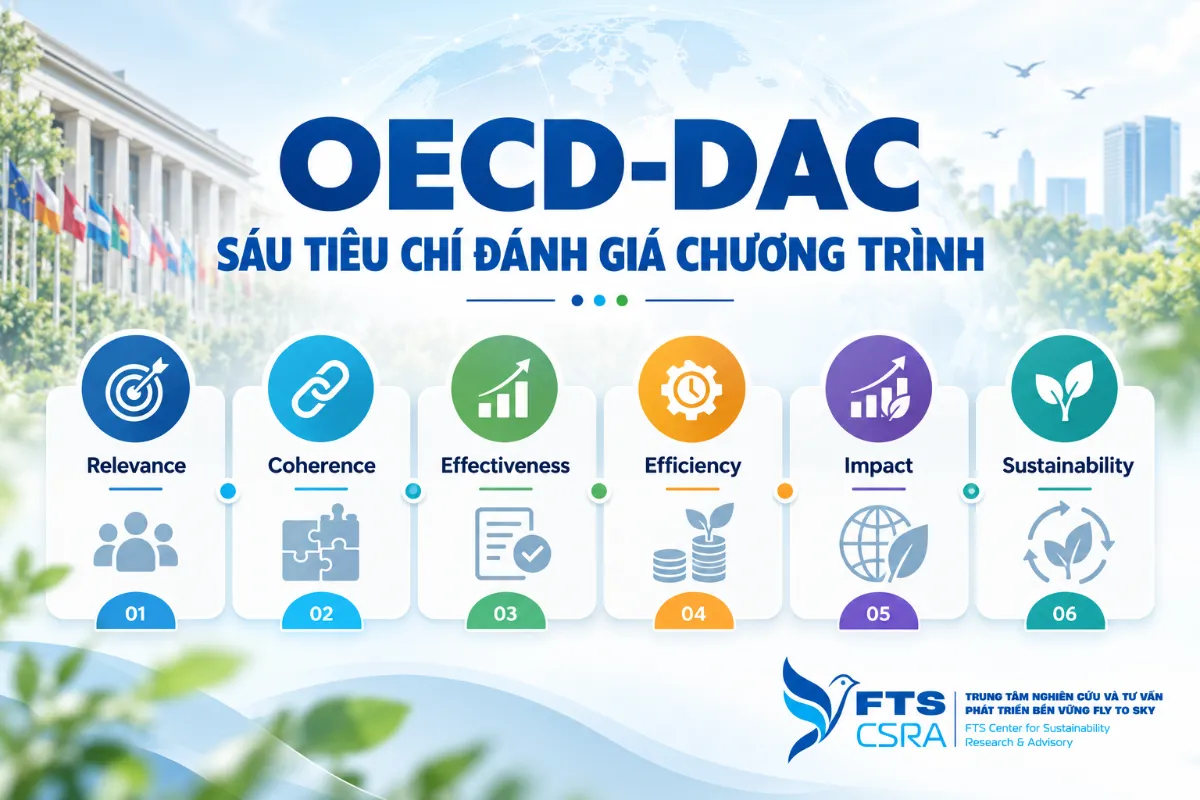
The original five criteria (relevance, effectiveness, efficiency, impact, sustainability) were introduced by the OECD-DAC in 1991. In 2019 the DAC revised the definitions, added a sixth criterion – Coherence, and issued two principles for use. Detailed application guidance followed in 2021.
Purpose and main structure
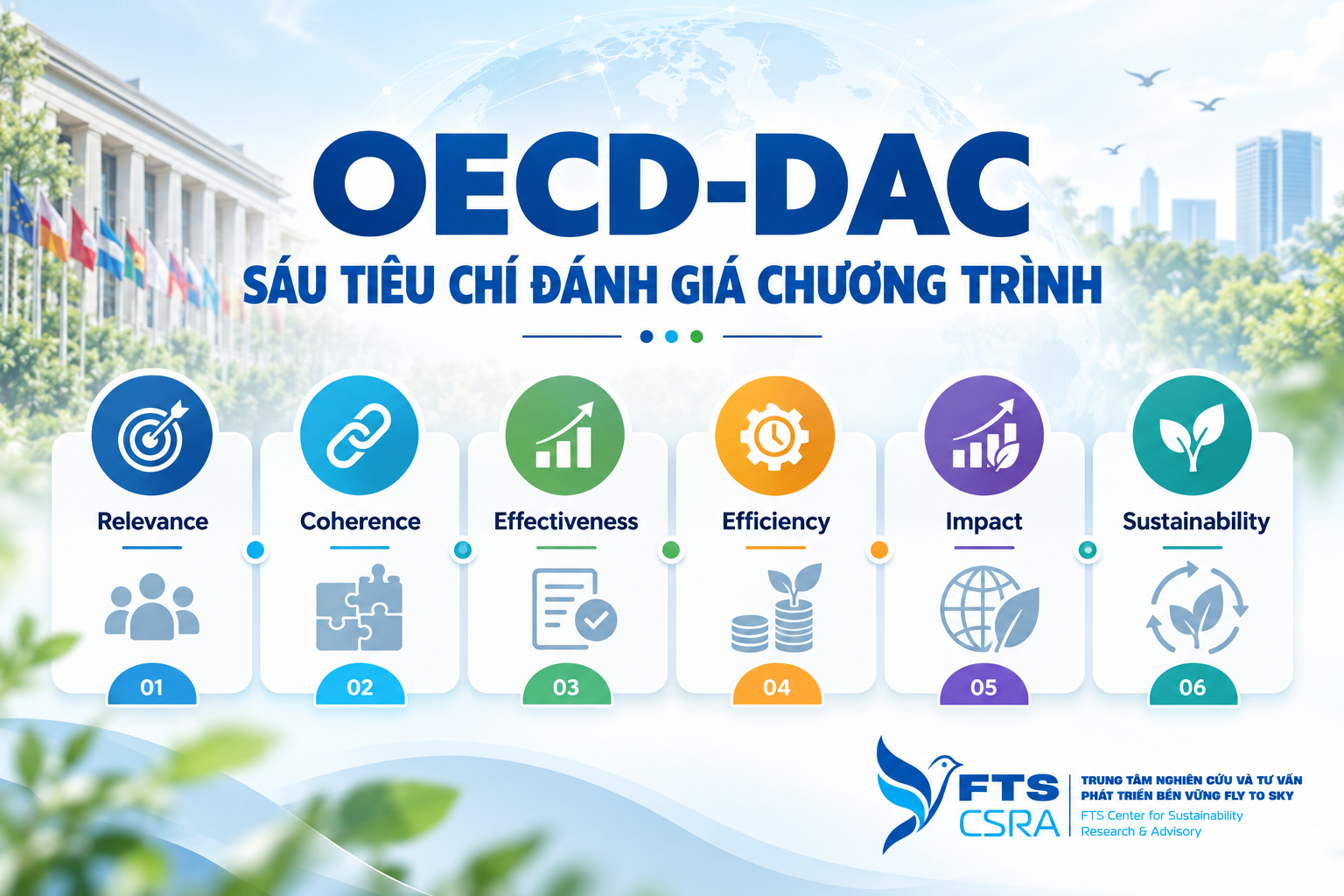
Purpose: a common frame to judge the merit and worth of an intervention for accountability and learning. Two principles for use: (1) apply thoughtfully, in light of context, evaluation purpose and stakeholder needs; (2) do not apply mechanically – choose relevant criteria; using all six is not required.
2.1. The six criteria: definitions, questions and indicators
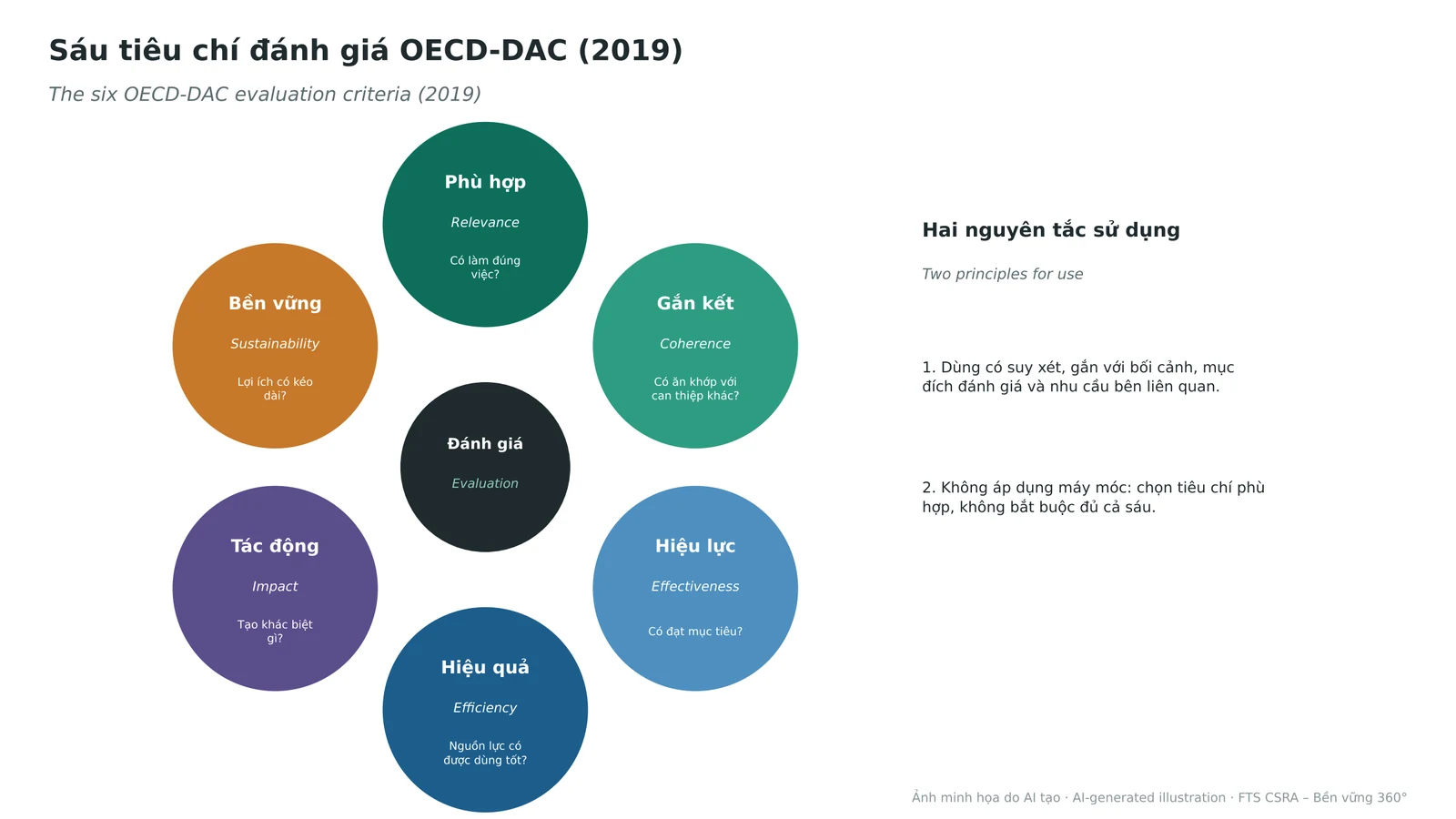
| Criterion | Definition (FTS CSRA paraphrase) | Sample evaluation question | Suggested indicator |
|---|---|---|---|
| Relevance | How far objectives and design respond to the needs, policies and priorities of beneficiaries, country and partners – and keep doing so as circumstances change | Does it address the target group's priority problem? Does the design consider vulnerable groups? | % of beneficiaries saying activities meet their needs; alignment with national/sector strategy |
| Coherence | Compatibility with other interventions in the country, sector or institution (internal and external coherence) | Any duplication or contradiction with other programmes? Are synergies used? | Coordination mechanisms joined; joint activities with other programmes |
| Effectiveness | How far objectives and results were (or are expected to be) achieved, including differences across groups | What % of outcome targets were met? What helped or hindered? | % of outcome targets met; results disaggregated by sex, ethnicity, area |
| Efficiency | How far results are delivered economically and on time | Is cost per result reasonable? Any delays? Are resources optimally allocated? | Cost per beneficiary; % disbursed on schedule; management cost ratio |
| Impact | How far the intervention generates significant higher-level effects, positive or negative, intended or unintended | Lasting change in income, health or institutions? Any unintended negative effects? | Change in impact indicators vs. baseline and comparison group |
| Sustainability | How far net benefits continue, or are likely to continue, after the intervention ends | Who will sustain activities and with what resources? Is local capacity sufficient? | % of activities taken over by authorities/partners; committed follow-on budget |
2.2. Reference rating scale
| Score | Meaning (reference scale used by many funders) |
|---|---|
| 4 | Highly satisfactory: meets or exceeds expectations, no significant shortcomings |
| 3 | Satisfactory: largely meets expectations, minor shortcomings |
| 2 | Unsatisfactory: significant shortcomings |
| 1 | Highly unsatisfactory: serious shortcomings |
Who uses it and how
Users: ODA project management units, NGOs, funders, government agencies, CSR teams and independent evaluators.
- Define the evaluation purpose (accountability, learning, decision-making) and the users of results.
- Choose relevant criteria and build an evaluation matrix: question – indicator – data source – method.
- Use the Theory of Change to see which links need testing.
- Collect mixed data: monitoring data, surveys, in-depth interviews, focus groups.
- Rate each criterion with justification; set out findings, lessons and recommendations.
Practical example
Hypothetical case: final evaluation of a 3-year rural clean-water programme in 20 communes of Soc Trang province, budget VND 30 billion.
| Criterion | Key finding | Score | Recommendation |
|---|---|---|---|
| Relevance | Meets urgent needs in saline-intrusion areas; aligned with national target programmes | 4 | Maintain |
| Coherence | Some communes overlap with another organization's project | 2 | Set up provincial coordination |
| Effectiveness | 92% of target households connected; only 70% of poor households due to connection fees | 3 | Subsidise fees for poor households |
| Efficiency | Cost per household 12% below norm; 4 months late | 3 | Improve procurement |
| Impact | Clear drop in child diarrhoea per commune health-station data | 3 | Deeper impact evaluation |
| Sustainability | Operating cooperative lacks revenue to replace equipment | 2 | Review tariffs and maintenance fund |
Notes for use in Vietnam
- ODA projects: evaluations follow ODA management rules and donor requirements; the OECD-DAC criteria are usually mandatory in terms of reference.
- Effectiveness vs. efficiency: often confused in Vietnamese; effectiveness is achieving objectives, efficiency is using resources well.
- Coherence matters especially where several national target programmes and donor projects operate in the same area.
- Impact data: requires a baseline from the start; local statistics can serve as reference.
- Corporate CSR: use the six criteria to self-evaluate community programmes, together with B4SI for inputs, outputs and impacts.
Method & scope
Content compiled and interpreted from FTS Impact Lab and documents of the issuing body; versions and sources should be verified before publication.
References
- OECD – Evaluation criteria ↗ (accessed 2026-10-24)
- OECD (2019) Better Criteria for Better Evaluation: Revised Evaluation Criteria Definitions and Principles for Use (accessed 2026-10-24)
- OECD (2021) Applying Evaluation Criteria Thoughtfully (accessed 2026-10-24)
- Cross-references: Theory of Change; CHS 2024 (Commitment 7 – learning); SROI (accessed 2026-10-24)