Contents
##
Overview and origin
| Item | Details |
|---|---|
| Vietnamese name | 17 Mục tiêu Phát triển bền vững (Chương trình nghị sự 2030 vì sự phát triển bền vững) |
| English name | Sustainable Development Goals (SDGs) – Transforming our world: the 2030 Agenda for Sustainable Development |
| Issuer / administrator | Adopted by the UN General Assembly (Resolution A/RES/70/1, 25 September 2015). The global indicator framework is managed by the UN Statistical Commission. In Vietnam: the National Action Plan (Decision 622/QD-TTg, 2017). |
| Nature | A global political commitment, not legally binding; 17 goals, 169 targets and more than 230 global indicators. |
| Reference scope | All countries for 2016–2030; companies and organizations use it for strategy and to report their contribution. |
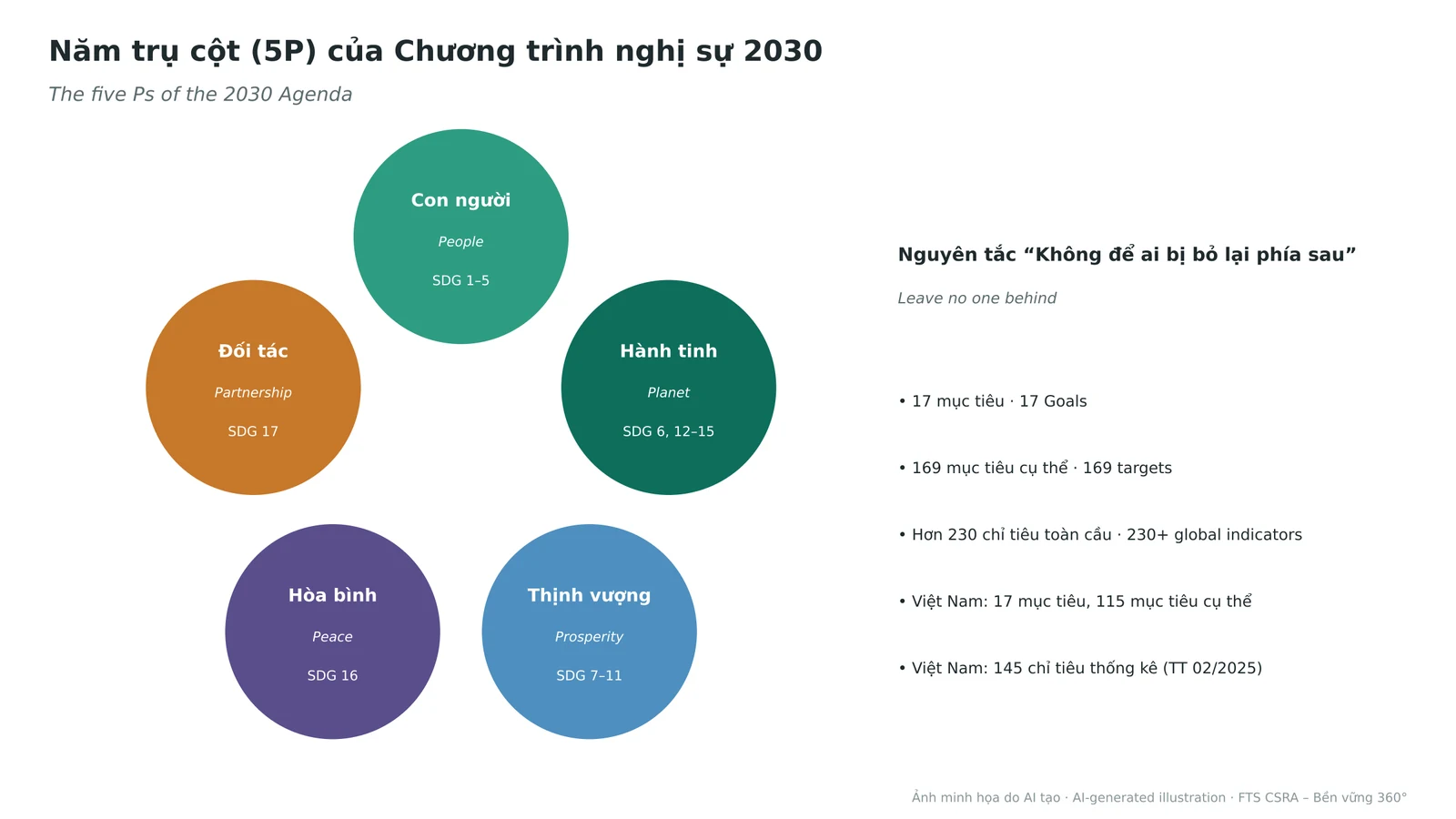
The SDGs build on the eight Millennium Development Goals (MDGs, 2000–2015) but extend to environment, inequality and institutions, under the principle “Leave no one behind”. Vietnam localised them into 17 goals and 115 national targets (VSDGs), with a roadmap to 2030 and a statistical set of 145 indicators (Circular 02/2025/TT-BKHDT).
Purpose and main structure
Purpose: end poverty, protect the planet and ensure prosperity and peace for all. Three tiers: 17 goals → 169 targets → more than 230 indicators; numbered targets (e.g., 8.7) are outcomes, lettered ones (e.g., 8.a) are means of implementation.
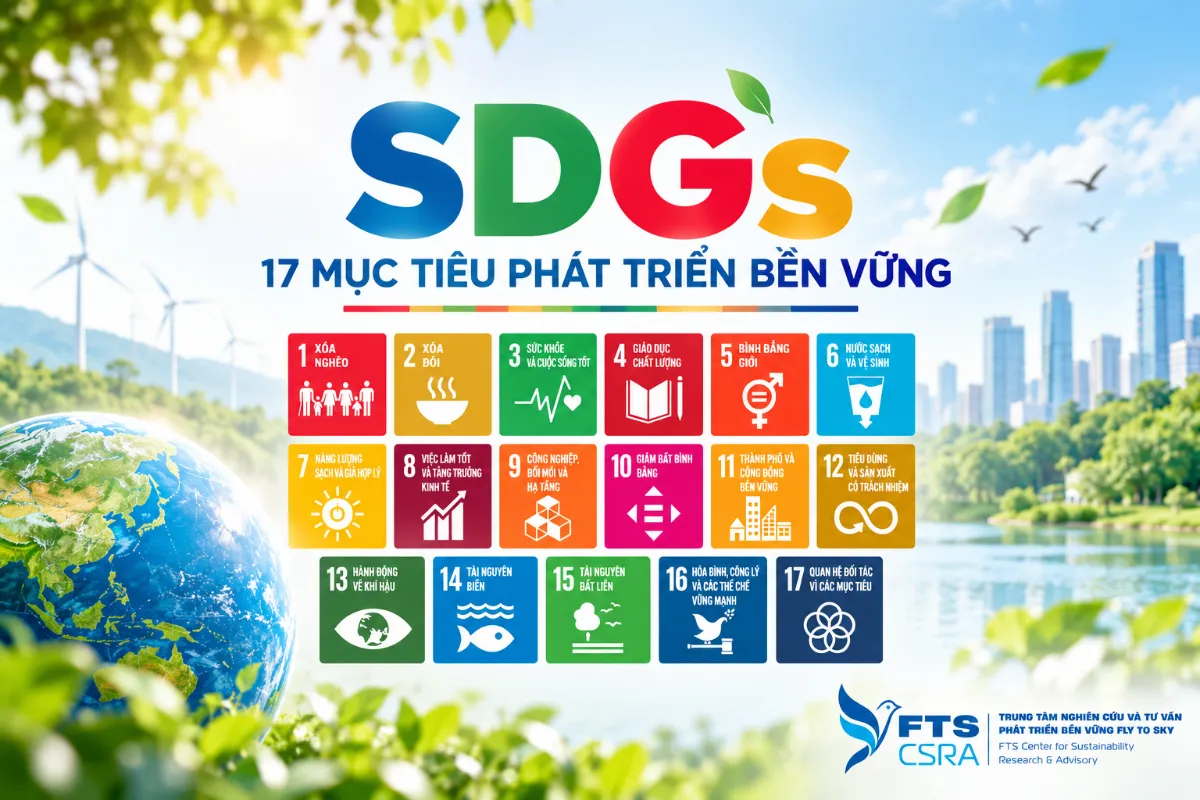
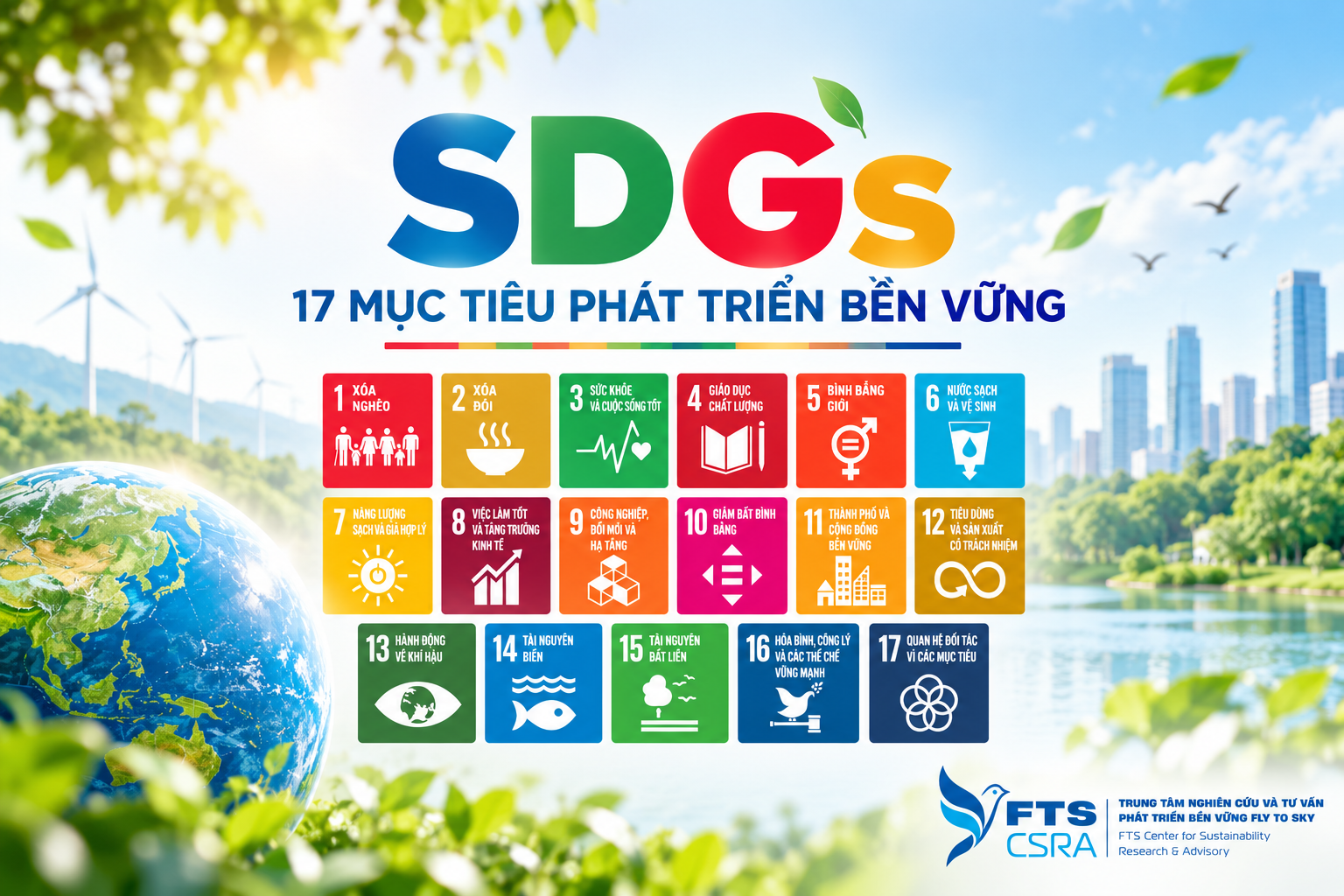
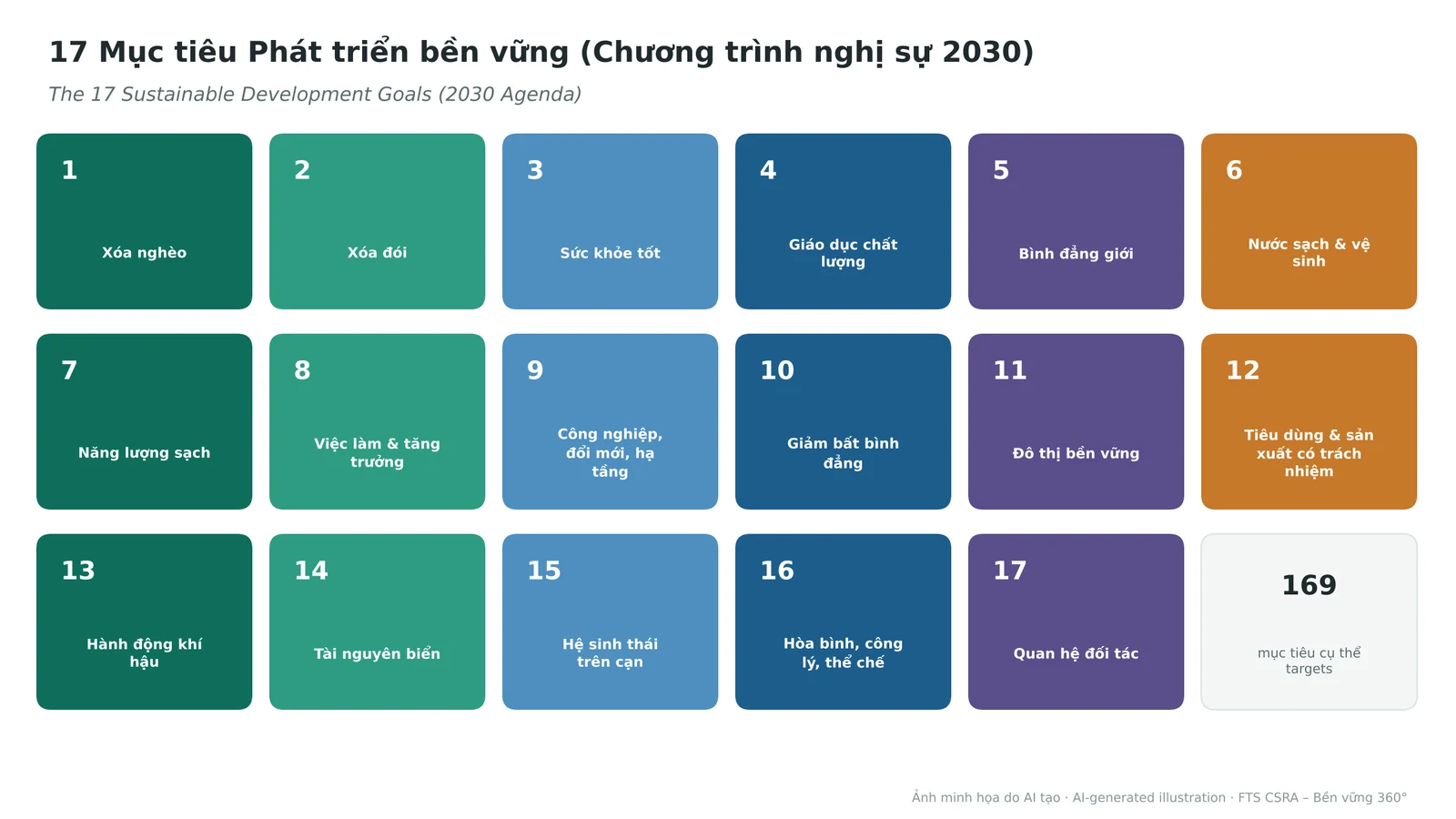
2.1. All 17 goals, number of targets and suggested business indicators
| # | Goal | Targets | Example business indicator |
|---|---|---|---|
| 1 | End poverty in all its forms everywhere | 7 | Living wage; % workers with social insurance |
| 2 | End hunger, achieve food security and improved nutrition and promote sustainable agriculture | 8 | Income of smallholder suppliers; % sustainably farmed inputs |
| 3 | Ensure healthy lives and promote well-being for all at all ages | 13 | LTIFR; % workers with periodic health checks |
| 4 | Ensure inclusive and equitable quality education and promote lifelong learning opportunities for all | 10 | Average training hours per worker; scholarships |
| 5 | Achieve gender equality and empower all women and girls | 9 | % women managers; gender pay gap |
| 6 | Ensure availability and sustainable management of water and sanitation for all | 8 | Water withdrawal; % wastewater treated to standard |
| 7 | Ensure access to affordable, reliable, sustainable and modern energy for all | 5 | % renewable energy; energy intensity |
| 8 | Promote sustained, inclusive and sustainable economic growth, full and productive employment and decent work for all | 12 | Jobs created; employee turnover |
| 9 | Build resilient infrastructure, promote inclusive and sustainable industrialization and foster innovation | 8 | R&D spend/revenue; innovations |
| 10 | Reduce inequality within and among countries | 10 | Highest-to-median pay ratio; employees with disabilities |
| 11 | Make cities and human settlements inclusive, safe, resilient and sustainable | 10 | Certified green buildings; worker housing |
| 12 | Ensure sustainable consumption and production patterns | 11 | % waste recycled; % recyclable packaging |
| 13 | Take urgent action to combat climate change and its impacts | 5 | Scope 1–2–3 emissions; reduction targets |
| 14 | Conserve and sustainably use the oceans, seas and marine resources | 10 | % certified sustainable seafood; plastic leakage |
| 15 | Protect, restore and promote sustainable use of terrestrial ecosystems, sustainably manage forests, combat desertification, halt land degradation and biodiversity loss | 12 | % FSC-certified timber; area restored |
| 16 | Promote peaceful and inclusive societies, access to justice for all and effective, accountable and inclusive institutions | 12 | Confirmed corruption cases; % staff trained on business ethics |
| 17 | Strengthen the means of implementation and revitalize the Global Partnership for Sustainable Development | 19 | Public-private partnerships; taxes paid by country |
Who uses it and how
Users: government agencies, companies, investors, civil society and universities. For companies, a common approach is the SDG Compass (GRI, UN Global Compact, WBCSD):
- Understand the SDGs and the company's responsibility.
- Define priorities: map the value chain to find the biggest positive and negative impacts.
- Set specific goals with indicators, linked to SDG targets (e.g., 7.2, 8.7, 12.5).
- Integrate them into strategy, processes and incentives.
- Report and communicate with data (GRI, UN Global Compact CoP).
Practical example
Hypothetical case: Coffee processor P (Dak Lak), sourcing from 4,000 farming households and exporting to the EU.
| SDG target | Activity | Indicator |
|---|---|---|
| 2.3 / 2.4 | Training on regenerative farming, seedling support | Farmer yield and income; % area under sustainable practices |
| 8.7 | Child-labour checks during harvest | % of households checked; cases found and remediated |
| 12.5 | Coffee husks reused as organic fertiliser | % of by-products reused |
| 13.2 | Emissions inventory, switch to biomass dryers | tCO₂e per tonne of product |
| 15.2 | Deforestation-free traceability (for the EUDR) | % of volume with plot coordinates, deforestation-free |
Instead of adding 17 icons, the company picks five targets where its impact is largest and measurable – a meaningful way to link to the SDGs.
Notes for use in Vietnam
- Avoid “SDG-washing”: link to an SDG only with concrete activities, indicators and data; disclose negative impacts too.
- Use the VSDGs: check against Vietnam's 115 national targets and 145 national statistical indicators to align with domestic priorities.
- Link to other frameworks: GRI, IRIS+, the SDG Impact Standards and ISO/UNDP 53001 all provide SDG linkage guidance.
- The final stretch to 2030: many global targets are off track; companies should prioritise goals they directly and measurably affect.
- Do not use the official SDG icons commercially without following UN icon-use guidelines.
Method & scope
Content compiled and interpreted from FTS Impact Lab and documents of the issuing body; versions and sources should be verified before publication.
References
- United Nations – The 17 Goals ↗ (accessed 2026-10-24)
- UN Statistics Division – Global indicator framework ↗ (accessed 2026-10-24)
- SDG Compass (GRI, UN Global Compact, WBCSD) ↗ (accessed 2026-10-24)
- Vietnam: Decision 622/QD-TTg (2017) National Action Plan for the 2030 Agenda; Circular 02/2025/TT-BKHDT (accessed 2026-10-24)