Contents
##
Overview and origin
| Item | Details |
|---|---|
| Vietnamese name | Lý thuyết thay đổi |
| English name | Theory of Change (ToC) |
| Issuer / administrator | No single issuer. A cross-disciplinary method popularised by the Aspen Institute and the Center for Theory of Change, with application guidance from UNDG/UNSDG, UNICEF and development funders. |
| Nature | A design, management and evaluation method; not a certifiable standard or a fixed indicator set. |
| Reference scope | Development projects, social programmes, CSR, impact investment, public policy; a foundation for logframes, OECD-DAC evaluation, SROI and IRIS+ measurement. |
Carol Weiss popularised the concept in the mid-1990s in evaluating community initiatives. In 2017 the UN Development Group issued Theory of Change companion guidance for UN Development Assistance / Cooperation Frameworks. Unlike a logframe, which is usually just a table, a Theory of Change explains why and under what conditions change happens.
Purpose and main structure
Purpose: (1) build a shared vision among partners; (2) choose evidence-based interventions; (3) identify indicators and data to collect; (4) provide a frame for monitoring, evaluation and learning.
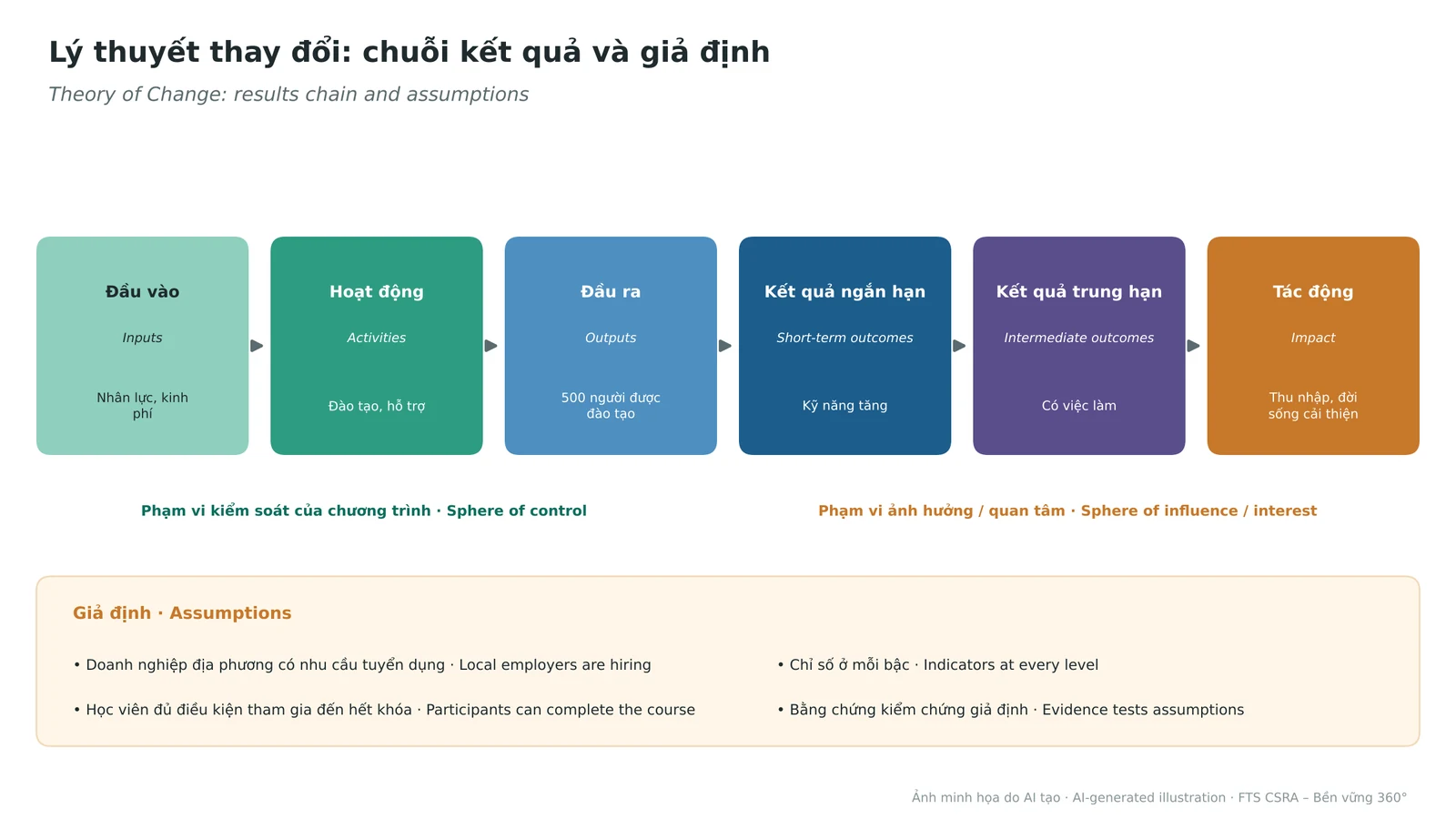
2.1. Components and example indicators
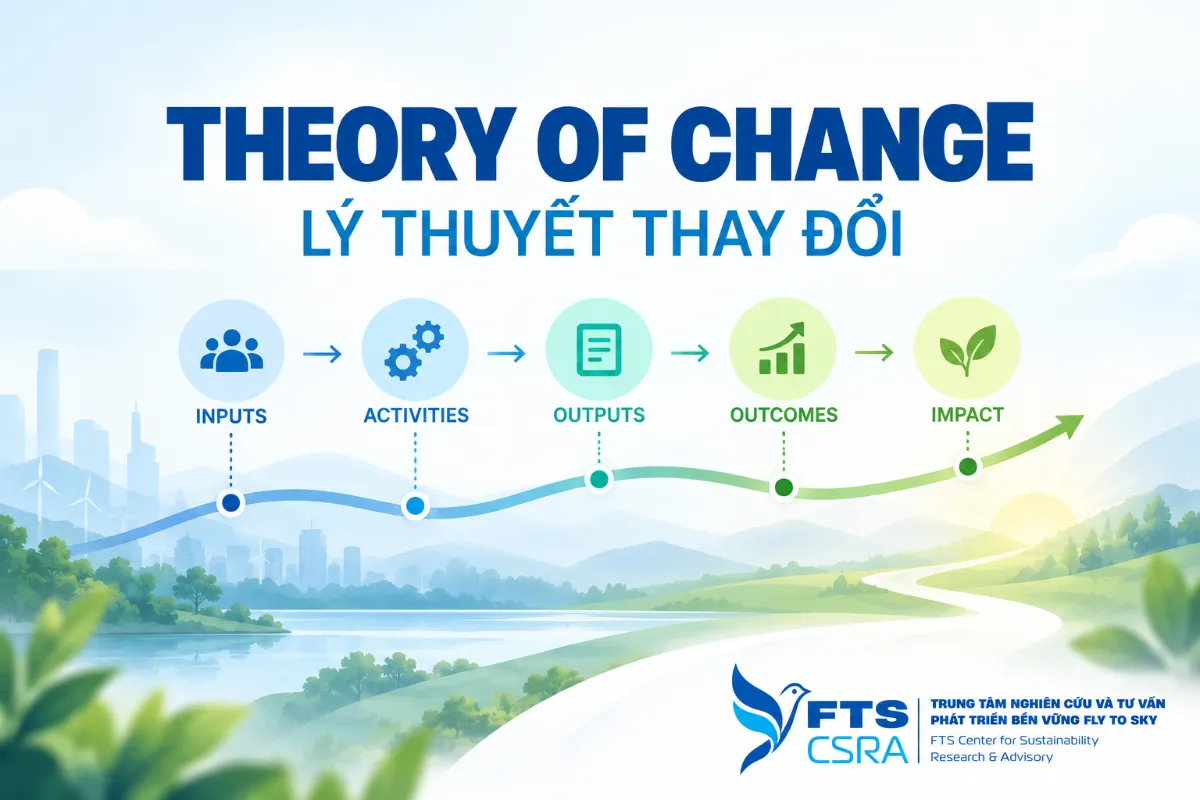
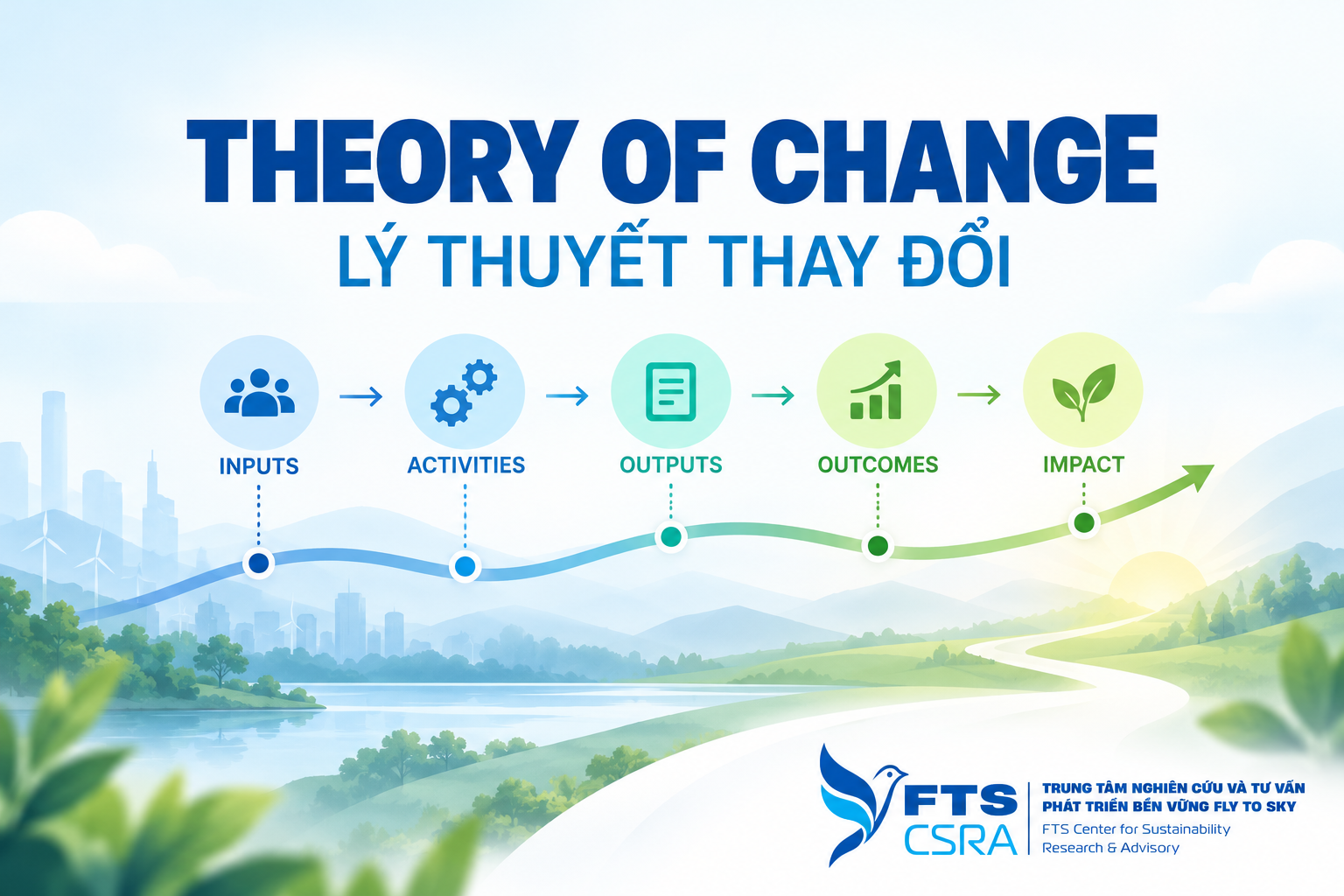
| Component | Definition | Example indicator |
|---|---|---|
| Impact | Long-term, society-level change the programme contributes to | Share of households leaving multidimensional poverty |
| Long-term / intermediate outcomes | Changes in behaviour, living conditions or institutions of the target group | % of trainees employed after 6 months; average income |
| Short-term outcomes | Changes in knowledge, skills, attitudes | % of trainees passing the skills test |
| Outputs | Direct products and services the programme delivers | People trained; courses delivered |
| Activities | What the programme does | Recruitment, training, job matching |
| Inputs | Resources: funding, staff, partners, facilities | Budget; number of trainers |
| Assumptions | Conditions that must hold for one link to lead to the next | Local employers are hiring |
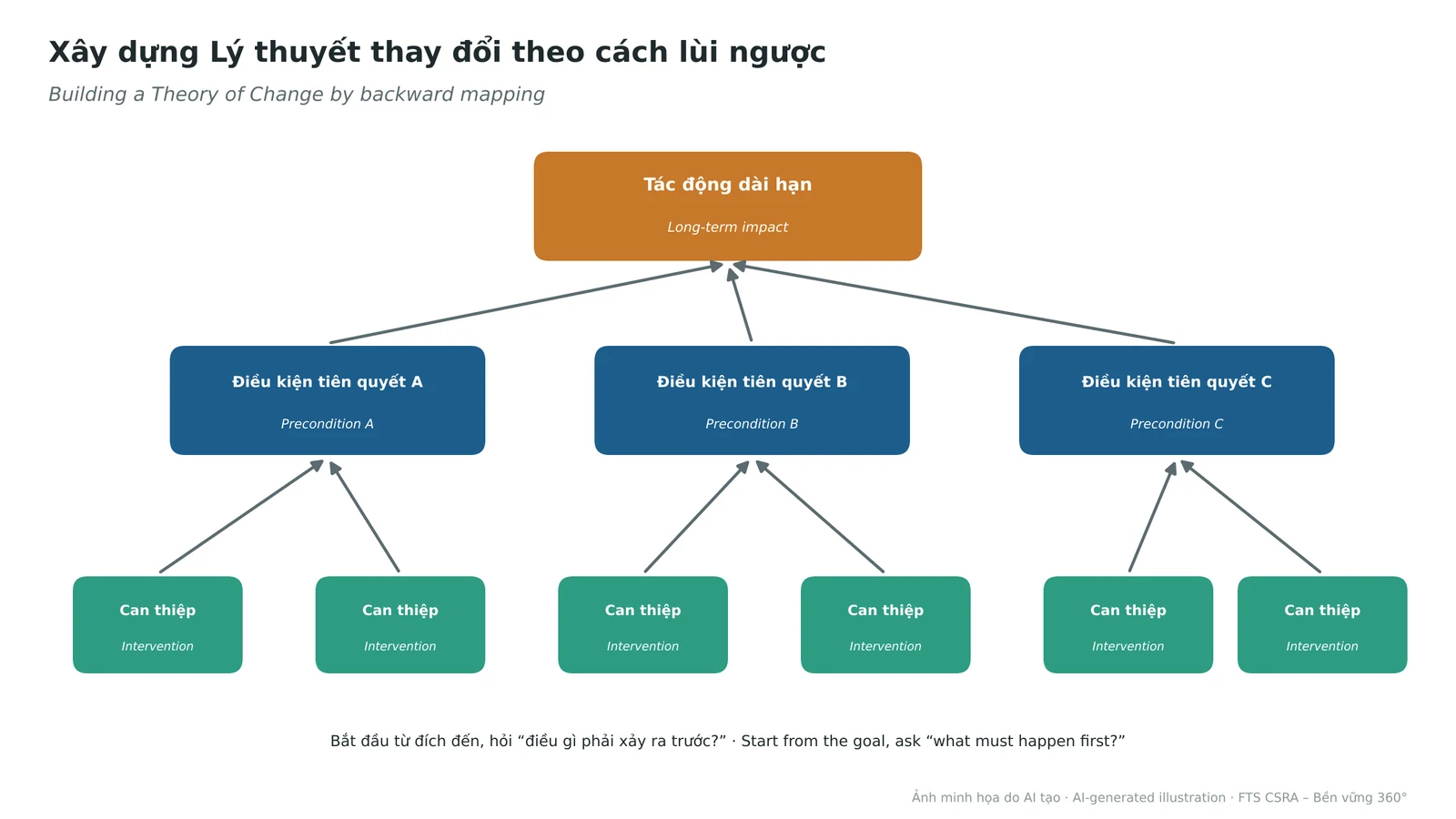
| Preconditions | Intermediate results needed before higher-level results | Trainees have transport |
| Rationale | Evidence and research explaining why the intervention leads to change | Research on vocational training effectiveness |
2.2. Eight quality-check criteria for a Theory of Change
| # | Quality check criterion |
|---|---|
| 1 | Is the problem, target group and context clearly defined? |
| 2 | Is the long-term impact specific, measurable and time-bound? |
| 3 | Does every link have at least one indicator and data source? |
| 4 | Are assumptions written down with a plan to test them? |
| 5 | Is the sphere of control distinguished from the sphere of influence? |
| 6 | Were stakeholders, especially beneficiaries, involved in building it? |
| 7 | Are risks and unintended negative effects considered? |
| 8 | Is the ToC reviewed regularly against new evidence? |
Who uses it and how
Users: non-profits, social enterprises, CSR/ESG teams, funders, impact investors and policymakers.
- Define the problem, the desired long-term impact and the specific target group.
- Map backwards: ask “what must happen first?” to find intermediate outcomes and preconditions.
- Identify interventions (activities) and required resources.
- Write down assumptions at each link and the supporting evidence.
- Attach indicators, baselines, targets and data sources at each level.
- Present it as a diagram with a short narrative; review it annually.
Practical example
Hypothetical case: an electrician training project for ethnic-minority youth in Lao Cai, 300 trainees per year.
| Level | Content | Indicator and target |
|---|---|---|
| Impact | Sustained rise in trainees' household income | Average income up ≥ 30% after 2 years |
| Intermediate outcome | Trainees employed or self-employed in electrical services | ≥ 70% employed after 6 months |
| Short-term outcome | Trainees have trade and electrical-safety skills | ≥ 85% pass the final test |
| Output | 3-month course with company placement | 300 trainees/year; 40% women |
| Assumption | Employers hiring within 30 km; families support trainees | Annual employer-demand survey |
Monitoring showed the “family support” assumption did not hold for female trainees, so the project added family dialogues and travel support – exactly the learning value of a Theory of Change.
Notes for use in Vietnam
- Not the same as a logframe: many grant forms only ask for a logframe; build the Theory of Change first, then condense it.
- Avoid vague “impact”: “contributing to local socio-economic development” is hard to measure; make it specific with indicators.
- Link to official statistics: indicators in Vietnam's SDG statistical indicator set (Circular 02/2025/TT-BKHDT), such as the multidimensional poverty rate, can serve as impact indicators.
- Beneficiary participation: hold workshops with community and commune representatives to test assumptions.
- For corporate CSR: shifts reporting from “money spent” to “change created”, in line with impact reporting under GRI and B4SI.
Method & scope
Content compiled and interpreted from FTS Impact Lab and documents of the issuing body; versions and sources should be verified before publication.
References
- Center for Theory of Change – What is Theory of Change? ↗ (accessed 2026-10-24)
- UNDG (2017) Theory of Change – UNDAF Companion Guidance ↗ (accessed 2026-10-24)
- UNICEF – Evaluation resources ↗ (accessed 2026-10-24)
- Cross-references: OECD-DAC criteria; Five Dimensions of Impact (Impact Frontiers); SROI; IRIS+ (accessed 2026-10-24)