Contents
##
Overview and origin
| Item | Details |
|---|---|
| Vietnamese name | Năm chiều của tác động (và phân loại ABC của tác động doanh nghiệp) |
| English name | Five Dimensions of Impact; ABC of Enterprise Impact |
| Issuer / administrator | Impact Frontiers – a collaborative investor initiative continuing the Impact Management Project (IMP, 2016–2021). |
| Nature | Consensus norms on describing and managing impact; not an indicator set or certification. Works with IRIS+, GRI and the SDGs. |
| Reference scope | Enterprises, investors, funds and civil society; positive and negative impacts on people and the planet. |
The Impact Management Project (IMP), launched in 2016 and consulting more than 2,000 organizations, reached consensus on the five dimensions of impact. Since 2021 the norms have been stewarded by Impact Frontiers, together with the 15 data categories, nine impact risk types and the ABC classification.
Purpose and main structure
Purpose: a shared language so everyone describes impact consistently, compares projects and portfolios, and makes better impact management decisions.
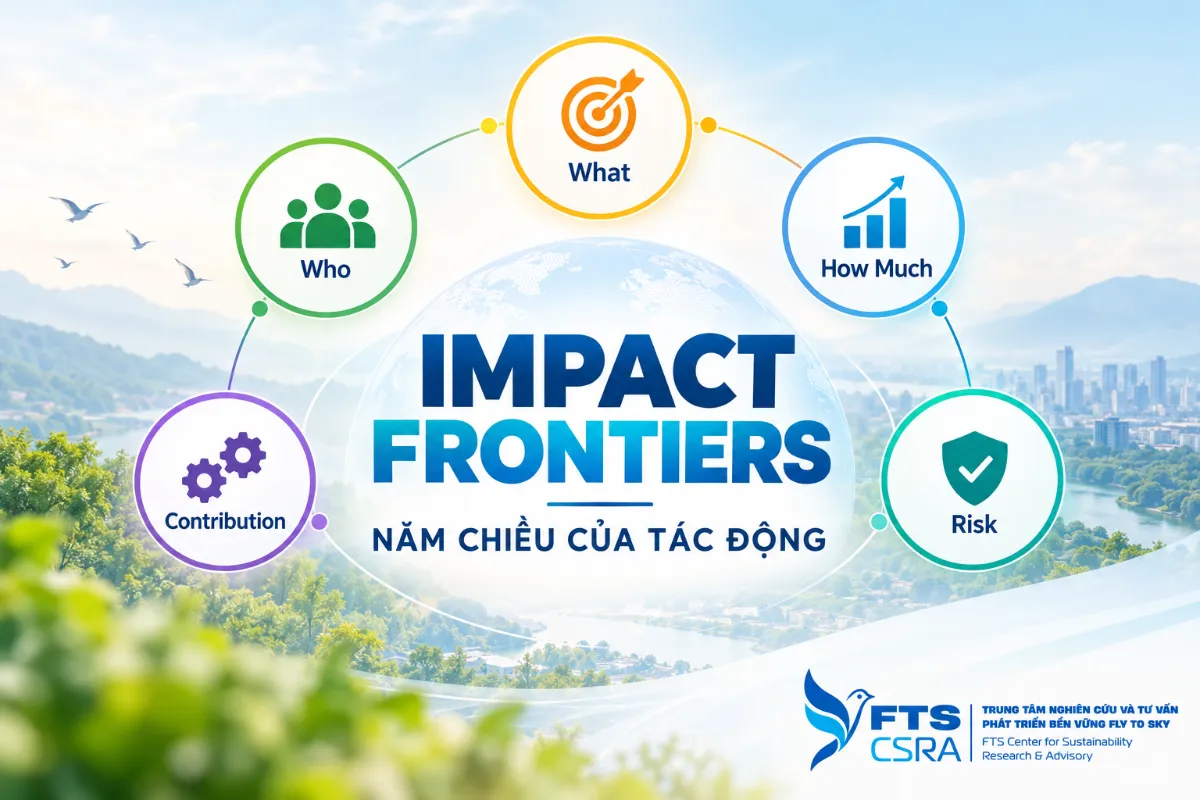
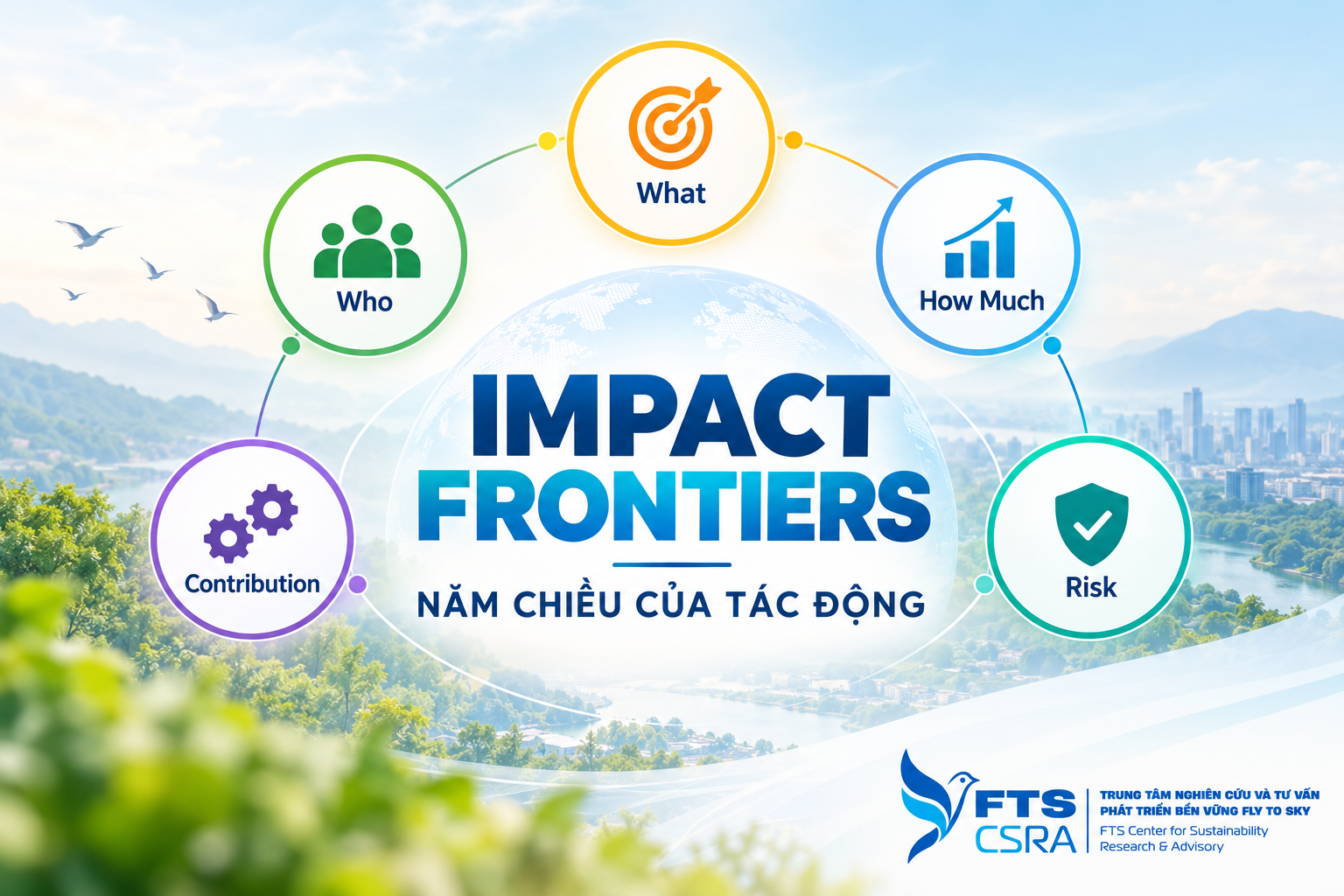
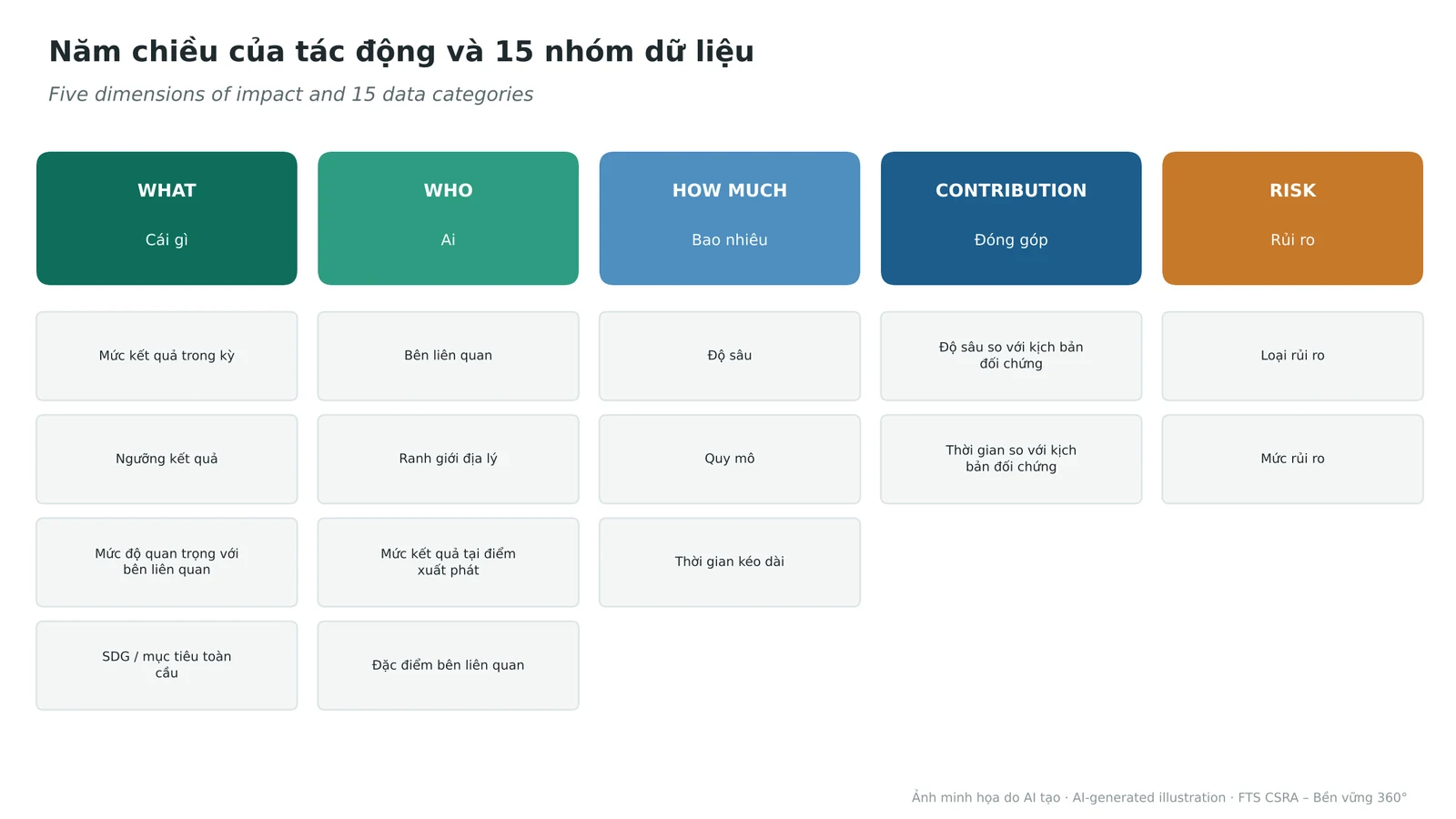
2.1. The five dimensions and 15 impact data categories
| Dimension | Key question | Data categories (15) |
|---|---|---|
| What | Which outcome occurs, and how important is it to people or planet? | 1. Outcome level in period · 2. Outcome threshold · 3. Importance of the outcome to stakeholder · 4. SDG or other global goal |
| Who | Who experiences the outcome, and how underserved are they? | 5. Stakeholder · 6. Geographical boundary · 7. Outcome level at baseline · 8. Stakeholder characteristics |
| How much | How much of the outcome occurs: scale, depth, duration? | 9. Depth · 10. Scale · 11. Duration |
| Contribution | What is the enterprise's contribution compared with what would happen anyway? | 12. Depth counterfactual · 13. Duration counterfactual |
| Risk | What is the risk that impact does not occur as expected? | 14. Risk type · 15. Risk level |
2.2. Nine types of impact risk
| # | Risk type | Meaning |
|---|---|---|
| 1 | Evidence risk | Insufficient high-quality data to know whether impact is occurring |
| 2 | External risk | External factors disrupt the ability to deliver impact |
| 3 | Stakeholder participation risk | Stakeholder expectations or experiences are misunderstood or not taken into account |
| 4 | Drop-off risk | Positive impact does not endure or negative impact is no longer mitigated |
| 5 | Efficiency risk | The impact could have been achieved with fewer resources or at lower cost |
| 6 | Execution risk | Activities are not delivered as planned |
| 7 | Alignment risk | Impact is not locked into the business model and may be dropped |
| 8 | Endurance risk | Required activities are not delivered for long enough |
| 9 | Unexpected impact risk | Significant unexpected positive or negative impact is experienced |
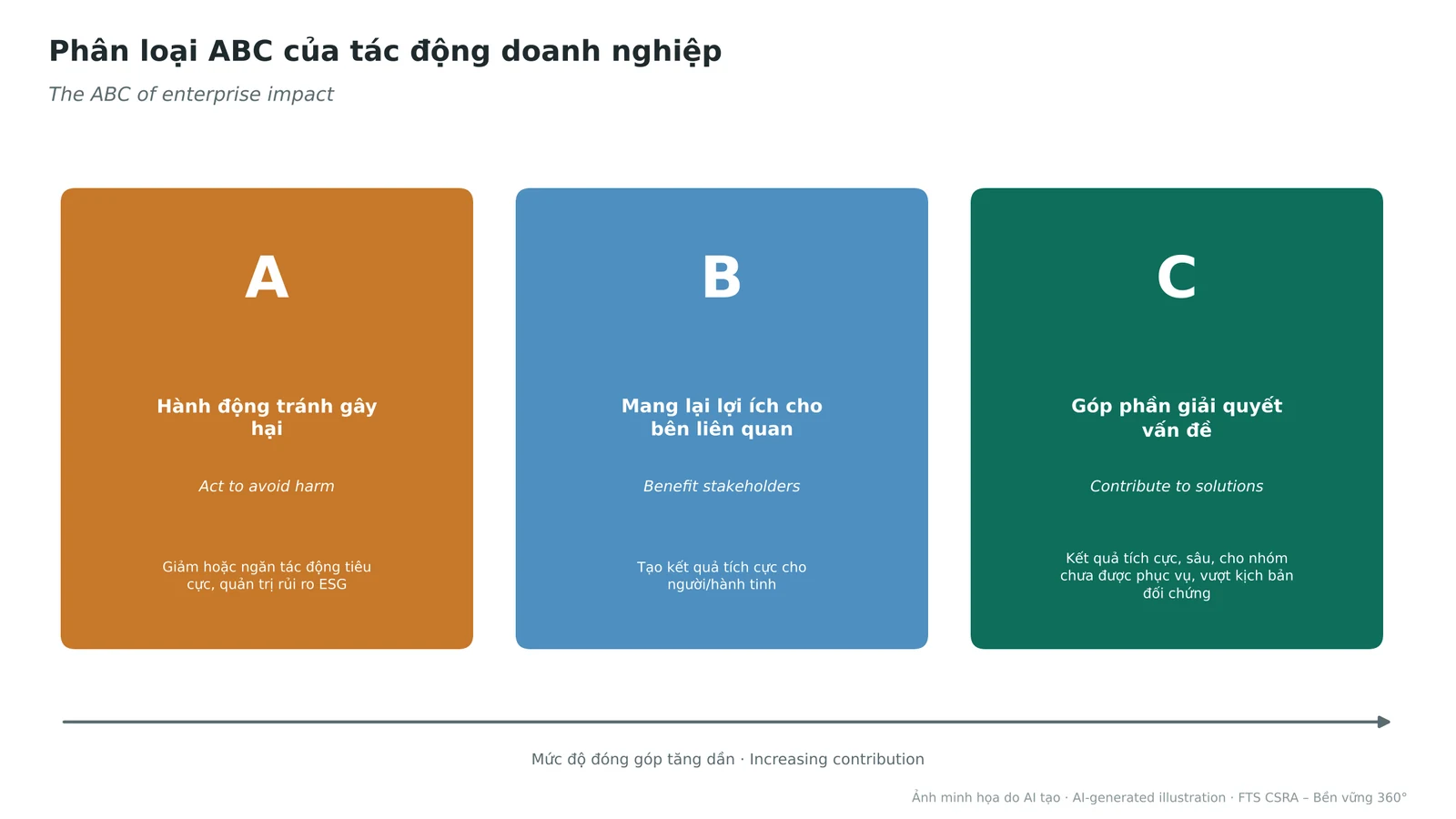
2.3. The ABC classification
- A – Act to avoid harm: reduce or prevent significant negative effects.
- B – Benefit stakeholders: create positive outcomes for people and planet.
- C – Contribute to solutions: create significant positive outcomes for underserved groups, clearly better than the counterfactual.
Who uses it and how
Users: social enterprises, companies with ESG strategies, impact funds, microfinance institutions and funders.
- List the outcomes (positive and negative) the enterprise creates – What.
- Identify affected groups and their baseline – Who.
- Measure scale, depth and duration of change – How much.
- Estimate the counterfactual to find the real contribution – Contribution.
- Assess the nine risk types and mitigations – Risk.
- Classify each outcome and the portfolio as A, B or C; choose matching IRIS+ metrics.
Practical example
Hypothetical case: Impact Fund M invests in a company supplying water-filtration systems to rural schools in the Mekong Delta.
| Dimension | Analysis | Indicator |
|---|---|---|
| What | Pupils drink safe water; fewer intestinal illnesses | School days missed due to illness |
| Who | Primary pupils in 120 schools in saline areas, previously drinking untreated water | % of pupils from poor households |
| How much | 36,000 pupils; sick days down 35%; maintained 5 years under service contracts | Scale, depth, duration |
| Contribution | Without the project, only about 20% of schools would install systems within 3 years | Counterfactual |
| Risk | Endurance risk (no budget for filter replacement) → maintenance costs built into community co-funding | Risk level: medium |
Conclusion: the investment is classified C – Contribute to solutions: it serves an underserved group with significant depth and clearly beats the counterfactual.
Notes for use in Vietnam
- Missing baseline data is common – official statistics (Vietnam's SDG indicator set, household living standards surveys) can serve as reference points.
- Do not ignore negative impact: the five dimensions apply to harmful effects too (e.g., pollution, job pressure).
- Handle counterfactuals carefully: state assumptions and avoid over-claiming – like the SROI principle “do not over-claim”.
- Combine with standard metrics: IRIS+ to choose indicators, GRI to disclose, SDGs to link to national goals.
- Investors and funds: the ABC classification is useful for reporting portfolios to international investors.
Sources and cross-references
- Impact Frontiers – Five Dimensions of Impact
- Impact Frontiers – ABC of Enterprise Impact
- Impact Management Project (2018) – A guide to classifying the impact of an investment
- Cross-references: IRIS+ (GIIN); SDG Impact Standards (UNDP); GRI 3 (material topics)
Method & scope
Content compiled and interpreted from FTS Impact Lab and documents of the issuing body; versions and sources should be verified before publication.
References
- Impact Frontiers – Five Dimensions of Impact ↗ (accessed 2026-10-24)
- Impact Frontiers – ABC of Enterprise Impact ↗ (accessed 2026-10-24)
- Impact Management Project (2018) – A guide to classifying the impact of an investment ↗ (accessed 2026-10-24)
- Cross-references: IRIS+ (GIIN); SDG Impact Standards (UNDP); GRI 3 (material topics) (accessed 2026-10-24)