Contents
##
Overview and origin
| Item | Details |
|---|---|
| Vietnamese name | Chuẩn tác động SDG (chuẩn quản trị tác động hướng tới các Mục tiêu Phát triển bền vững) |
| English name | UNDP SDG Impact Standards |
| Issuer / administrator | United Nations Development Programme (UNDP), through the SDG Impact initiative. |
| Nature | Voluntary internal management practice standards, not a reporting standard or indicator set. Includes a self-assessment tool, an assurance scheme and the SDG Impact Seal. |
| Reference scope | Enterprises, investment funds, bond issuers and development finance institutions; linked to the SDGs, the Five Dimensions of Impact, GRI and IRIS+. |
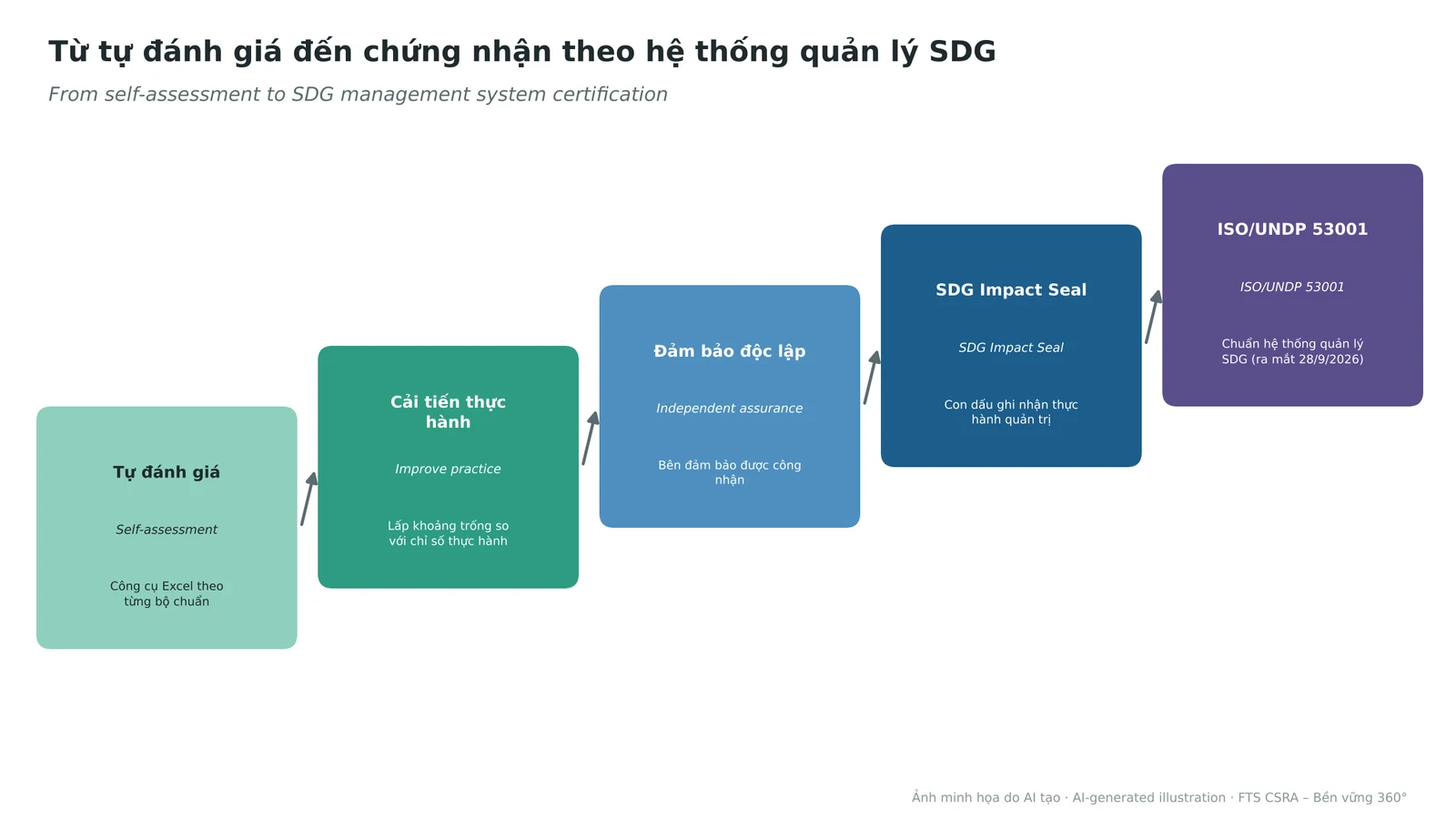
UNDP launched SDG Impact in 2018. Standards for private equity funds and bonds followed in 2020–2021, the enterprise standards were released in 2021 and the guidance updated in October 2023. On 28 September 2026, ISO and UNDP launched ISO/UNDP 53001 – Management systems for the United Nations Sustainable Development Goals – Requirements, the first international standard for managing SDG contribution.
Purpose and main structure
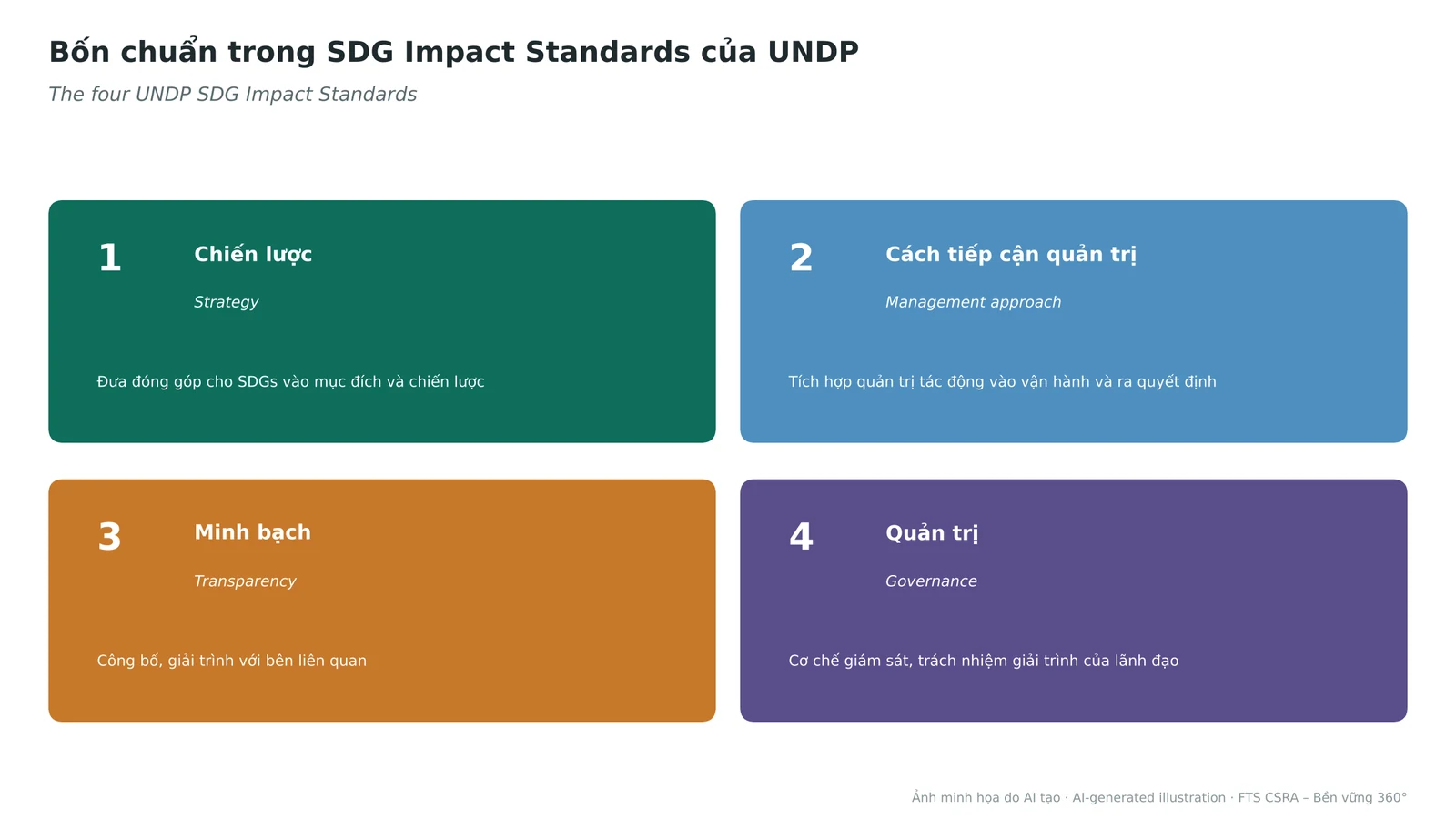
Purpose: help organizations build sustainability and the SDGs into decision-making, so positive impact becomes part of strategy rather than a side activity. Each set has four standards: Strategy, Management approach, Transparency, Governance; each has practice indicators for self-assessment.
2.1. Four standard sets by user
| Standard set | Users |
|---|---|
| SDG Impact Standards for Enterprise | Enterprises of any size |
| SDG Impact Standards for Private Equity Funds | Funds and fund managers |
| SDG Impact Standards for Bond Issuers | Issuers of sustainable, green and social bonds |
| OECD-UNDP Impact Standards for Financing Sustainable Development | Donors and development finance institutions |
2.2. Practice content of the enterprise standards
The table lists the Standard 1 guidance items using UNDP's numbering (guidance updated October 2023); for Standards 2–4, FTS CSRA summarises the main content groups. For self-assessment, use the exact practice indicators in the official standards.
| Item | Practice content |
|---|---|
| Standard 1 – Strategy | |
| 1.1.1 | Making sustainability and the SDGs central and contributing positively |
| 1.1.2 | Interdependency |
| 1.1.3 | Foundational principles: business and human rights, transparency and anti-corruption, planetary boundaries, gender equality; science-based targets |
| 1.1.4 | Understanding the sustainable development context |
| 1.1.5 | Stakeholder identification |
| 1.1.6 | Determining material impacts |
| 1.1.7 | Business models, partnerships and collaborations |
| 1.1.8 | Incorporating sustainability risks and opportunities |
| 1.1.9 | Scenario and sensitivity analysis |
| 1.1.10 | Adequate resourcing |
| 1.1.11 | Strategy always on, embedding continuous improvement |
| 1.2 | Impact goals aligned with purpose, strategy, stakeholder expectations and sustainability context |
| Standard 2 – Management approach | |
| 2.x | Integrate impact management into operations and decisions: indicators, data, thresholds; managing negative impacts; stakeholder participation; continuous improvement |
| Standard 3 – Transparency | |
| 3.x | Disclose approach, goals and impact results (positive and negative) to stakeholders in an accessible, usable, comparable way |
| Standard 4 – Governance | |
| 4.x | Governing body commitment and oversight; accountability; remuneration linked to impact; culture that supports SDG contribution |
Who uses it and how
Users: companies with ESG strategies, conglomerates, impact funds, banks and issuers of green and social bonds.
- Download the standards and the self-assessment tool (Excel) for your organization type.
- Self-assess against each practice indicator; identify gaps.
- Build an improvement plan: impact goals, indicators, board oversight.
- Implement and disclose impact results transparently (e.g., using GRI and IRIS+).
- Engage an accredited assurer to qualify for the SDG Impact Seal; consider ISO/UNDP 53001 certification once a scheme exists.
Practical example
Hypothetical case: Real-estate and energy Group R self-assesses against the SDG Impact Standards for Enterprise.
| Standard | Gap found | Improvement action |
|---|---|---|
| 1. Strategy | No SDG-based material impacts; no science-based targets | Double materiality assessment; SBTi-aligned targets; priority on SDGs 7, 11, 13 |
| 2. Management approach | New projects lack a social impact assessment step | Add an “impact gate” to investment approval |
| 3. Transparency | Report lists only achievements | Report under GRI, disclosing negative impacts and missed targets |
| 4. Governance | Executive pay not linked to impact | 20% of executive bonus linked to emissions and safety targets |
Notes for use in Vietnam
- A management standard, not a badge: do not advertise “SDG compliant” without independent assurance.
- Combine with the VSDGs: check material impacts against Vietnam's 115 national targets.
- Green and social bonds: Vietnamese issuers can use the bond standards to strengthen issuance frameworks and use-of-proceeds reporting.
- ISO/UNDP 53001: watch for an equivalent national standard and certification arrangements in Vietnam.
- Avoid duplicate files: data for the SDG Impact Standards can be reused for GRI, the UN Global Compact CoP and the CSI Index.
Method & scope
Content compiled and interpreted from FTS Impact Lab and documents of the issuing body; versions and sources should be verified before publication.
References
- UNDP SDG Impact – Practice Standards ↗ (accessed 2026-10-24)
- UNDP (Oct 2023) Standards Guidance for SDG Impact Standards for Enterprises ↗ (accessed 2026-10-24)
- UNDP – ISO and UNDP launch world's first International Standard to advance action on the SDGs (28 Sep 2026) ↗ (accessed 2026-10-24)
- Cross-references: SDGs; Five Dimensions of Impact; IRIS+; GRI (accessed 2026-10-24)