Contents
##
Overview and origin
| Item | Details |
|---|---|
| Vietnamese name | Hệ thống chỉ số quản trị tác động IRIS+ |
| English name | IRIS+ (Impact Reporting and Investment Standards) |
| Issuer / administrator | Global Impact Investing Network (GIIN). |
| Nature | A free metrics and guidance system; not a mandatory reporting standard or certification. Current catalogue: IRIS version 5.3c, about 780 metrics. |
| Reference scope | Impact investing, social enterprises, microfinance, funds; linked to the SDGs (goal and target level), the Five Dimensions of Impact and the Joint Impact Indicators (jobs, gender, climate). |
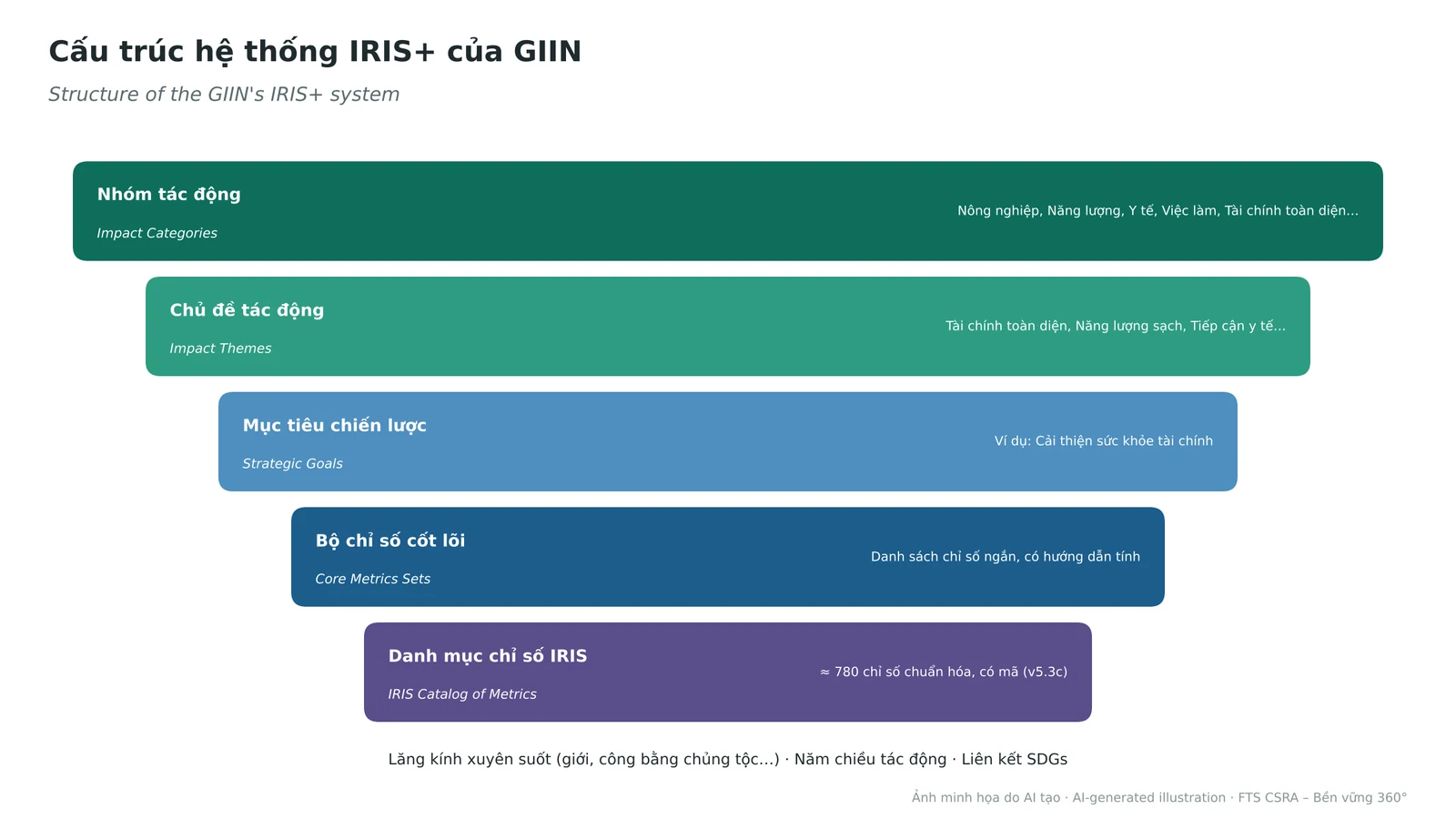
IRIS was launched in 2009 by the Rockefeller Foundation, Acumen and B Lab and later handed to the GIIN. In 2019 the GIIN upgraded it to IRIS+, adding Core Metrics Sets by strategic goal, calculation guidance and SDG alignment. According to a 2025 GIIN paper, IRIS metrics align with 78 of the 169 SDG targets, covering 83% of the catalogue.
Purpose and main structure
Purpose: help investors and companies measure the same way, reduce reporting burden and compare impact results across investments.
- Impact Categories: broad areas aligned to ISIC sectors.
- Impact Themes: strategies within each category (e.g., financial inclusion, clean energy).
- Lenses: cross-cutting approaches such as a gender lens or racial equity.
- Strategic Goals: each has a Core Metrics Set with calculation guidance.
- IRIS Catalog of Metrics: every metric has an ID, definition, unit and usage guidance.
2.1. Main impact categories
| Impact category | Impact category |
|---|---|
| Agriculture | Air |
| Climate | Biodiversity & Ecosystems |
| Education | Employment |
| Energy | Financial Services |
| Health | Infrastructure |
| Land | Oceans & Coastal Zones |
| Real Estate | Pollution |
| Waste | Water |
| Diversity & Inclusion |
2.2. Metric IDs and concrete example metrics
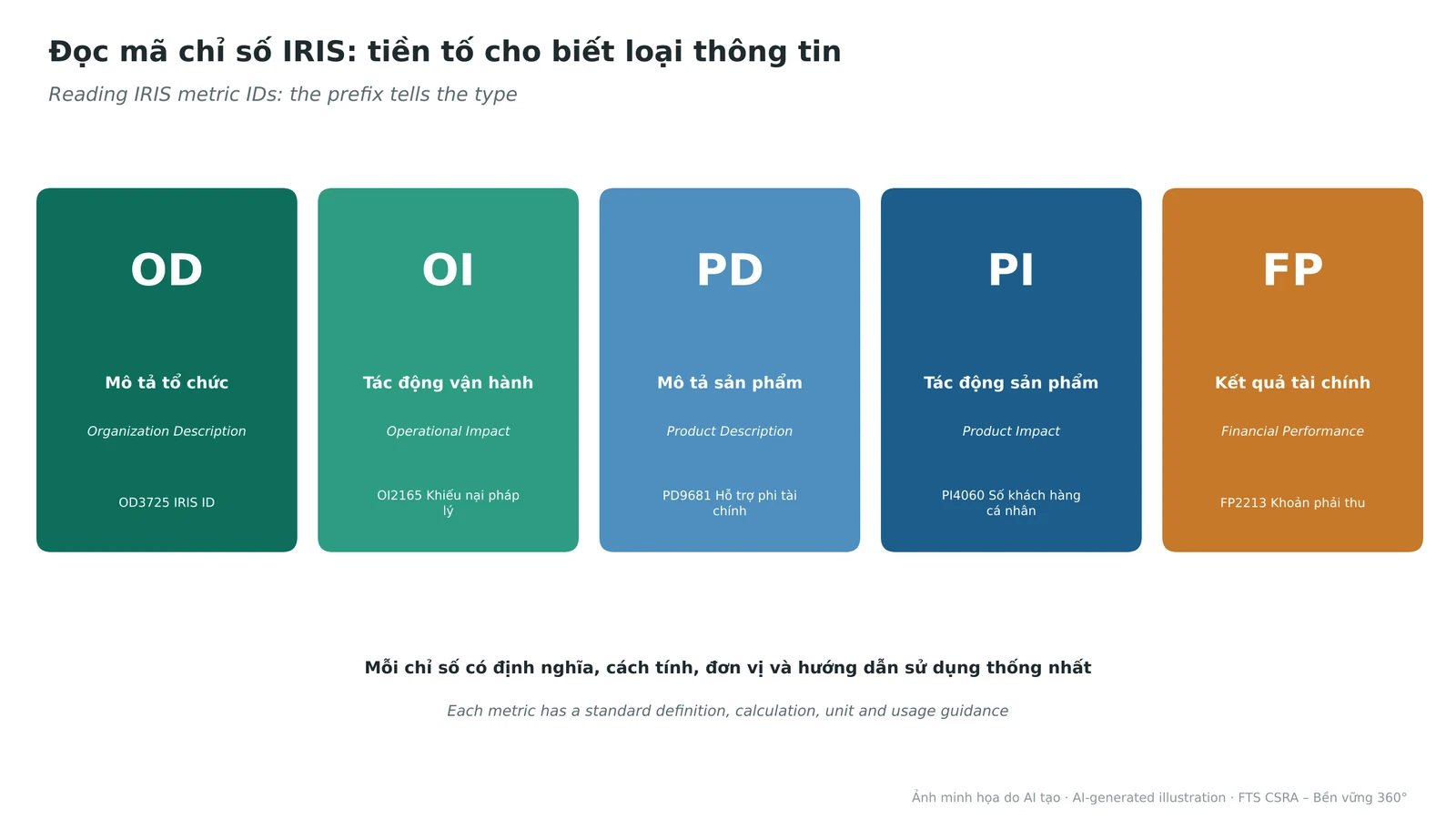
Every IRIS metric has an ID made of a two-letter prefix and four digits. The examples below come from the IRIS 5.3c catalogue:
| Prefix | Information type | Example metrics (ID – name) |
|---|---|---|
| OD | Organization Description | OD3725 – IRIS ID |
| OI | Operational Impact | OI9331 – Anti-Discrimination Policy; OI2165 – Number of Legal and Regulatory Complaints; OI7639 – Value of Fines and Settlements; OI1023 – Access to PPE; OI9101 – Adaptation Needs Assessment; OI4564 – Units/Volume Replaced |
| PD | Product Description | PD9681 – Non-financial Support Offered |
| PI | Product Impact | PI4060 – Client Individuals; PI7985 – Active Use; PI4180 – After-sale Client Support; PI9250 – Active Borrowers per Loan Officer; PI5750 – Area of Adjacent Protected Land; PI9170 – Area of Buildings Reused; PI4765 – Area of Community Facilities Financed; PI1653 – Account Value |
| FP | Financial Performance | FP2213 – Accounts Receivable; FP2852 – Accounts Payable |
Who uses it and how
Users: impact funds, microfinance institutions, social enterprises, companies receiving capital from international impact investors, and funders.
- Identify the impact categories and themes that fit the business model.
- Pick strategic goals and download the matching Core Metrics Sets from iris.thegiin.org.
- Prioritise core metrics; add catalogue metrics if needed, always citing the IRIS ID.
- Set baselines and targets; collect data exactly per the definitions and units.
- Analyse along the Five Dimensions of Impact; report to investors with IRIS IDs for comparability.
Practical example
Hypothetical case: Microfinance Company N in Thanh Hoa, 25,000 clients, mostly rural women, funded by a European impact fund.
| Information to report | IRIS ID | How to collect |
|---|---|---|
| Client individuals | PI4060 | From the loan management system, split by gender and area |
| Active borrowers per loan officer | PI9250 | Active borrowers / number of loan officers |
| Non-financial support offered (business training) | PD9681 | Service list, number of training sessions |
| Anti-discrimination policy | OI9331 | Issued policy document |
| Legal and regulatory complaints | OI2165 | Complaints log, together with OI7639 (fines) |
Using IRIS IDs lets the fund aggregate Company N's data with other portfolio investments without conversion.
Notes for use in Vietnam
- Cite the catalogue version (currently 5.3c), as definitions can change between versions.
- Do not freely translate metric names in investor reports: keep the English name and IRIS ID, adding Vietnamese notes only.
- Combine with domestic data: check baselines against Vietnam's SDG statistical indicator set.
- Not a disclosure standard: IRIS+ is for measurement; public disclosure should still follow GRI or ISSB standards.
- Small companies: start with 5–10 core metrics rather than trying to use many.
Method & scope
Content compiled and interpreted from FTS Impact Lab and documents of the issuing body; versions and sources should be verified before publication.
References
- IRIS+ Catalog of Metrics (GIIN) ↗ (accessed 2026-10-24)
- IRIS+ Core Metrics Sets (GIIN) ↗ (accessed 2026-10-24)
- GIIN (2025) – IRIS+ and the SDGs ↗ (accessed 2026-10-24)
- Cross-references: Five Dimensions of Impact (Impact Frontiers); SDGs; GRI (accessed 2026-10-24)