
Contents
##

Overview and origin
| Item | Details |
|---|---|
| Vietnamese name | Tỷ suất hoàn vốn xã hội (SROI) và các nguyên tắc giá trị xã hội |
| English name | Social Return on Investment (SROI); Principles of Social Value |
| Issuer / administrator | Social Value International (SVI) – the global social value network, which maintains the principles, practice standards and an SROI report assurance scheme. |
| Nature | A principles-based analysis method; not an organizational certification. SROI reports can be assured by SVI. |
| Reference scope | Social projects, social enterprises, CSR, public policy, social-value procurement; used as forecast (before) or evaluative (after) analysis. |
SROI was developed by REDF (USA) in the late 1990s and standardised in the UK through “A Guide to SROI” (Cabinet Office, 2009, updated 2012). The principles originally numbered seven; Social Value International later added an eighth – Be responsive – with a dedicated standard for applying it.
Purpose and main structure
Purpose: measure change that matters to stakeholders and express it in monetary value to compare with the resources invested. Formula:
SROI = Present value of net impact / Present value of investment. A 3 : 1 ratio means each 1 dong invested creates about 3 dong of social value.
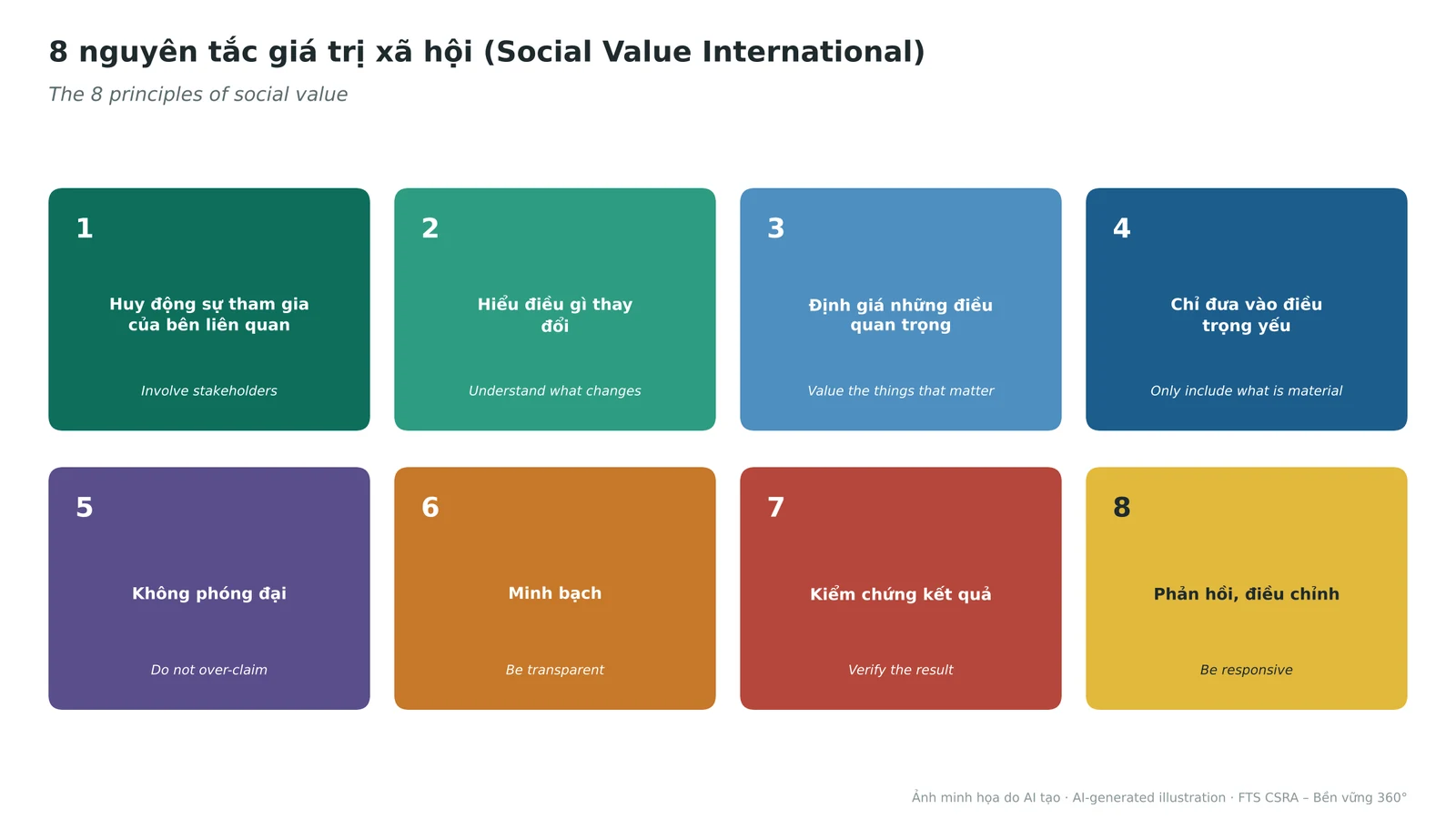
2.1. The eight principles of social value
| # | Principle | Content |
|---|---|---|
| 1 | Involve stakeholders | Stakeholders inform what gets measured and how it is valued |
| 2 | Understand what changes | Show how change happens, with evidence, positive and negative, intended and unintended |
| 3 | Value the things that matter | Use financial proxies to reflect how much outcomes matter to stakeholders |
| 4 | Only include what is material | Include only information and evidence that would affect decisions |
| 5 | Do not over-claim | Claim only the value the organization is responsible for creating |
| 6 | Be transparent | Disclose the basis of analysis, assumptions, data sources and stakeholder communication |
| 7 | Verify the result | Ensure appropriate independent assurance |
| 8 | Be responsive | Use the results to make decisions that optimise social value for stakeholders |
2.2. Four adjustments to reach net impact
| Adjustment | Meaning | Example |
|---|---|---|
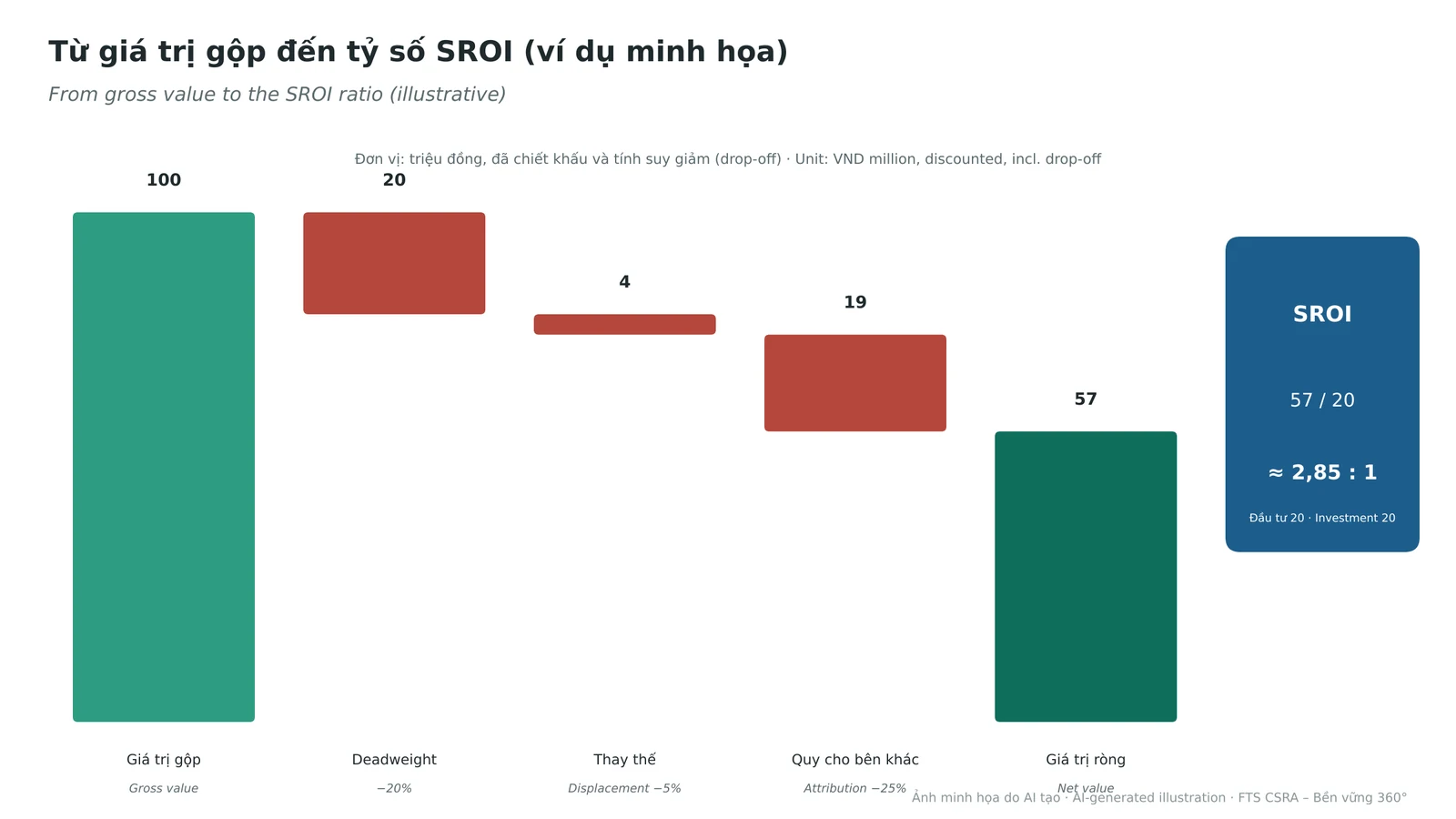
| Deadweight | Share of the outcome that would have happened anyway | 20% of trainees would have found jobs anyway |
| Thay thế (Displacement) | Share of the outcome that merely displaces outcomes elsewhere | 5% of jobs displace other workers |
| Quy cho bên khác (Attribution) | Share of the outcome due to other organizations or factors | 25% due to the district job programme |
| Suy giảm (Drop-off) | How much the outcome declines each year after the intervention | 30% decline per year from year two |
2.3. The six stages of an SROI analysis
| Stage | Content |
|---|---|
| 1 | Establish scope and identify key stakeholders |
| 2 | Map outcomes (the impact map) |
| 3 | Evidence outcomes and give them a value |
| 4 | Establish impact (deadweight, displacement, attribution, drop-off) |
| 5 | Calculate the SROI ratio and run sensitivity analysis |
| 6 | Report, use and embed |
Who uses it and how
Users: civil society organizations, social enterprises, CSR teams, funders, foundations and government agencies wanting to demonstrate programme value.
- Decide the type: forecast (before delivery) or evaluative (based on actual results).
- Interview and discuss with stakeholders to identify the changes that matter to them.
- Choose indicators and financial proxies with clear sources (market prices, cost savings, willingness-to-pay surveys).
- Apply the four adjustments and discount to present value.
- Run sensitivity analysis on key assumptions; tell the story of change, not just the number.
Practical example
Hypothetical case: a sewing-skills programme for 100 disadvantaged women in Hai Phong, VND 20 million per trainee; in units of VND 100 million, total investment is 20 (VND 2 billion).
| Outcome | Financial proxy | Gross value (VND 100 million) |
|---|---|---|
| Stable employment | Additional income over 3 years | 70 |
| Confidence and better mental health | Equivalent counselling cost | 18 |
| Children better cared for and schooled | Tutoring costs saved | 12 |
| Total gross value | 100 | |
| After deadweight 20%, displacement 5%, attribution 25% | 57 | |
| SROI = 57 / 20 | ≈ 2.85 : 1 |
Sensitivity analysis shows that with 35% deadweight the SROI falls to about 2.3 : 1 – still positive, but this must be stated in the report.
Notes for use in Vietnam
- Do not compare SROI across organizations with different scopes and assumptions – it is best for comparing options within one programme.
- Financial proxies: prefer Vietnamese data (regional incomes from the national statistics office, domestic health and education costs) over foreign figures.
- Avoid over-claiming: apply all four adjustments and publish assumptions so readers can check them.
- Stakeholders at the centre: consult beneficiaries directly, not only the project team.
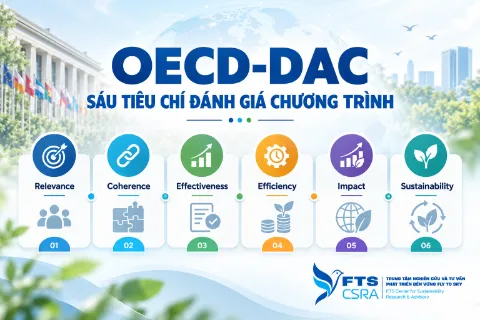
- Combine methods: Theory of Change to define outcomes; OECD-DAC for overall evaluation; B4SI for community-investment reporting.
Method & scope
Content compiled and interpreted from FTS Impact Lab and documents of the issuing body; versions and sources should be verified before publication.
References
- Social Value International – Standards and Principles ↗ (accessed 2026-10-24)
- Social Value International – Principle 8: Be Responsive ↗ (accessed 2026-10-24)
- Principles of Social Value (Social Value UK) ↗ (accessed 2026-10-24)
- Cross-references: A Guide to Social Return on Investment (Cabinet Office, 2012); Theory of Change; Five Dimensions of Impact (accessed 2026-10-24)