Contents
##
Overview and origin
| Item | Details |
|---|---|
| Vietnamese name | Hướng dẫn OECD cho doanh nghiệp đa quốc gia về kinh doanh có trách nhiệm |
| English name | OECD Guidelines for Multinational Enterprises on Responsible Business Conduct |
| Issuer/custodian | OECD; part of the OECD Declaration on International Investment and Multinational Enterprises (1976). 52 adhering countries (38 OECD members and 14 non-members); each must set up a National Contact Point (NCP). |
| Nature | Government recommendations to business – not legally binding on companies but binding on adhering governments to promote them and maintain NCPs; 11 chapters covering all areas of responsibility. |
| Reference scope | Enterprises operating in or from adhering countries, wherever they operate, and their supply chains and business relationships – including suppliers in Vietnam. |
First adopted in 1976, the Guidelines were updated in 1979, 1984, 1991, 2000, 2011 (adding the human rights chapter and risk-based due diligence) and on 8 June 2023 (renamed to add “on Responsible Business Conduct”). They are operationalised by the general Due Diligence Guidance (2018) and sector guidance. They are the only government-backed standard with a non-judicial grievance mechanism – hundreds of specific instances handled since 2000.
Purpose and main structure
Purpose: ensure business operations are in harmony with public policy, strengthen mutual confidence between enterprises and society, improve the investment climate and maximise positive contributions while minimising adverse impacts. Structure: preface, 11 chapters of recommendations with commentary, and Part II on implementation procedures (NCPs, Investment Committee).
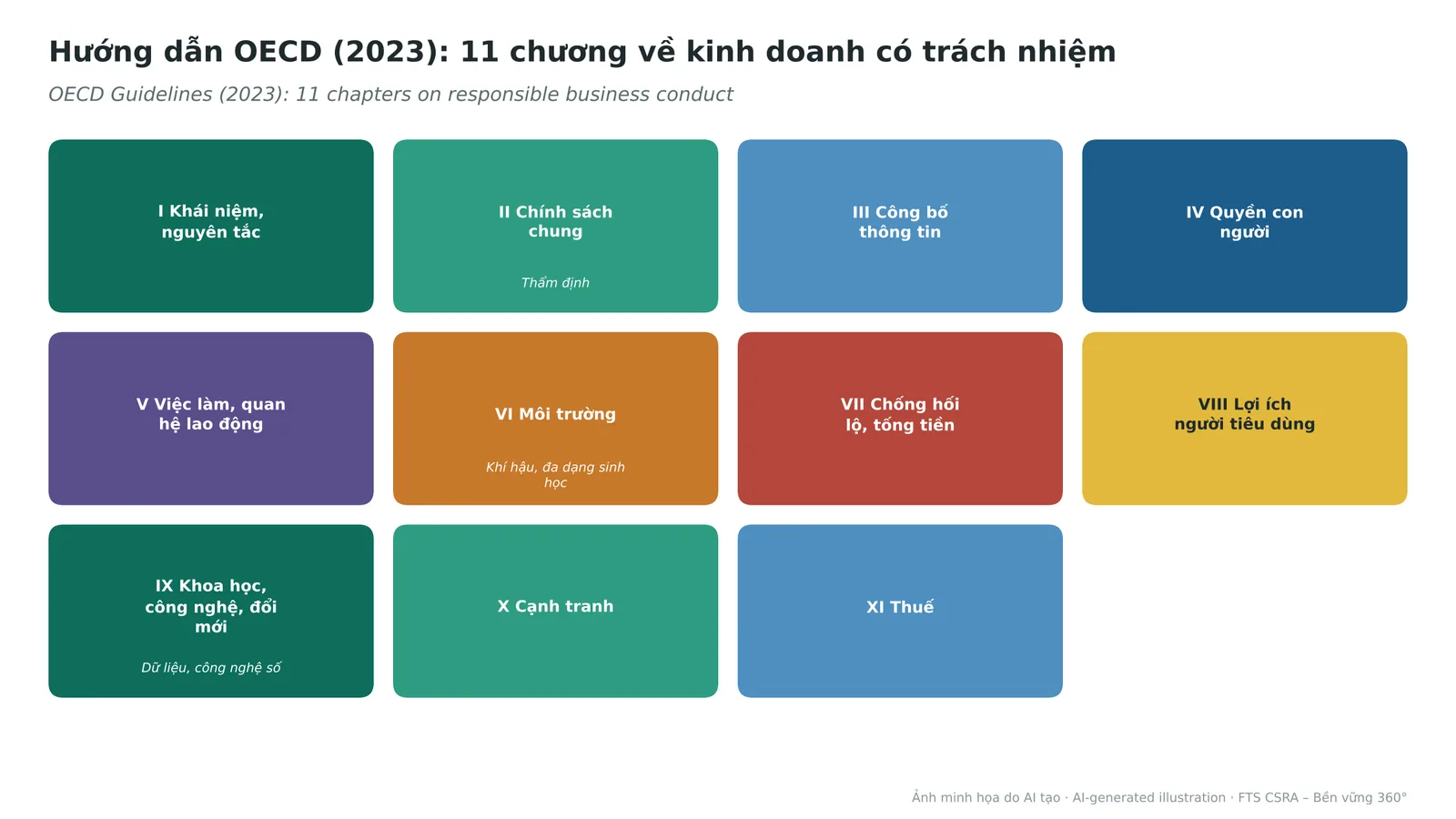
2.1. Eleven chapters and key recommendations
| Chapter | Title | Key recommendations for enterprises |
|---|---|---|
| I | Concepts and principles | Recommendations by governments, voluntary for enterprises; obeying domestic law is the first obligation; where law conflicts, honour the Guidelines to the fullest extent without breaching law; applies to all enterprises of adhering countries, including SMEs |
| II | General policies | Contribute to economic, environmental and social progress; respect human rights; carry out risk-based due diligence on adverse impacts in operations, supply chains and business relationships; avoid causing or contributing; seek to prevent directly linked impacts; meaningful stakeholder engagement; no reprisals against whistleblowers or human rights defenders; responsible lobbying; no exemptions not contemplated in law |
| III | Disclosure | Timely, accurate disclosure on financial situation, performance, ownership, governance, RBC policies, foreseeable material risks (including sustainability and climate) and due diligence; encouraged to use international standards and independent assurance |
| IV | Human rights | Respect internationally recognised human rights; avoid causing or contributing; prevent directly linked impacts; policy commitment; human rights due diligence; remediation – consistent with the UNGPs |
| V | Employment and industrial relations | Respect the right to form and join trade unions and bargain collectively; abolish child and forced labour; non-discrimination; information to workers' representatives; occupational safety and health; standards no less favourable than comparable employers; local hiring and training; reasonable notice of major changes |
| VI | Environment | Environmental management system; due diligence on environmental impacts (climate, biodiversity loss, land and water degradation, deforestation, pollution, waste); targets and plans consistent with international climate and biodiversity goals; life-cycle consideration; emergency preparedness; transparency and community consultation; worker training |
| VII | Combating bribery, bribe solicitation and extortion | No direct or indirect offering, promising or accepting of bribes or undue advantage; internal controls, ethics and compliance programmes; manage intermediaries; transparency; no illegal political contributions; address trading in influence and money laundering |
| VIII | Consumer interests | Safe products and services of stated quality; accurate, clear information (including environmental claims, no greenwashing); fair dispute resolution; no deceptive practices; privacy and personal data protection; attention to vulnerable consumers |
| IX | Science, technology and innovation | Diffuse technology and know-how appropriately; due diligence on risks from developing, financing, selling, licensing and using technology (including data collection and use); protect IP; local research cooperation |
| X | Competition | Comply with competition law; no price-fixing, market sharing, bid rigging or output restrictions; cooperate with competition authorities; train staff |
| XI | Taxation | Pay taxes on time; comply with both the letter and spirit of tax laws; arm's-length transfer pricing; treat tax governance as part of risk management |
2.2. What changed in 2023
| Area | Change |
|---|---|
| Climate and biodiversity | Expectation that targets and plans align with international climate (Paris) and biodiversity goals |
| Technology and data | Due diligence applies to developing, selling and using technology, data and AI |
| Downstream use | Clarifies due diligence on downstream use of products and services |
| At-risk persons | Protection of human rights defenders, whistleblowers and complainants from reprisals |
| Lobbying | Lobbying and political engagement must be consistent with RBC commitments |
| Disclosure | Updated expectations on sustainability and due diligence disclosure |
| NCPs | Strengthened visibility, effectiveness and functional equivalence of NCPs |
2.3. National Contact Points and “specific instances”
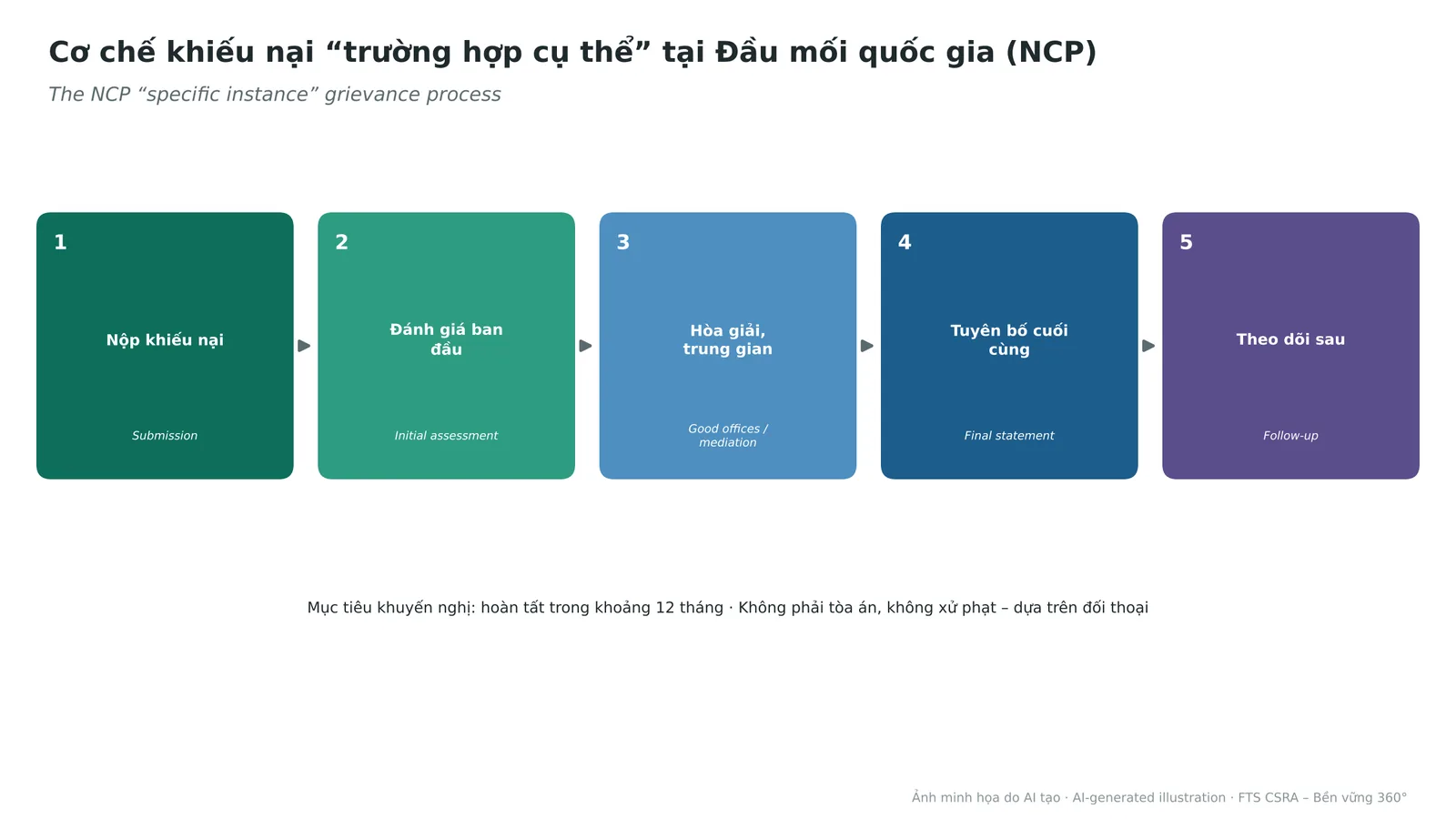
Anyone (workers, unions, communities, NGOs) can submit a “specific instance” to the NCP of the country where the company is headquartered, or where the issue arose if that country adheres. Process: (1) initial assessment (whether it merits further examination); (2) good offices or mediation between the parties; (3) a final statement, which may include recommendations and a determination on observance; (4) follow-up. The target is completion in about 12 months. NCPs are not courts and impose no penalties, but public statements strongly affect reputation and relations with banks and export credit agencies.
Users and how to apply it
Users: FDI companies from adhering countries (Japan, Korea, the EU, the US, Australia…), their Vietnamese suppliers, Vietnamese companies investing abroad, banks and investment funds.
- Compare existing policies with the 11 chapters; identify material chapters by sector (e.g. garments: V, VI; technology: VIII, IX).
- Carry out six-step due diligence under the 2018 OECD Due Diligence Guidance.
- Adopt policies on responsible lobbying and whistleblower protection.
- Set climate and biodiversity targets consistent with the 2023 Chapter VI.
- Disclose under Chapter III; set up operational-level grievance channels.
Quick self-assessment
| Chapter | Check question | Evidence |
|---|---|---|
| II | Is there a risk-based due diligence process for the supply chain? | Procedure, screening report |
| III | Are material sustainability risks and due diligence results disclosed? | Annual or sustainability report |
| IV–V | Are there human rights and labour policies and a worker grievance mechanism? | Policies, grievance log |
| VI | Are there emission reduction targets and a Paris-aligned plan? | Climate plan |
| VII | Is there an anti-bribery compliance programme covering intermediaries? | Code, partner due diligence |
| VIII–IX | Are customer data protected and technology risks assessed? | Data policy, impact assessment |
| XI | Are tax and transfer pricing policies board-approved? | Tax policy, TP documentation |
Practical example
Hypothetical case: Electronics components plant E (Korean-owned, Bắc Ninh, 6,000 workers) faces a specific instance filed by an NGO with the Korean NCP over overtime and chemical safety.
| Stage | What happened | Lesson |
|---|---|---|
| Initial assessment | The NCP accepts the case under Chapters II, IV and V | Ready due diligence records speed up the response |
| Mediation | Parent company, plant and NGO agree on an overtime reduction plan and independent chemical checks | Dialogue works better than public dispute |
| Final statement | The NCP records the agreement and recommends a progress report after 12 months | Cooperation protects reputation |
| Follow-up | Overtime falls below legal limits; results published | Built into routine due diligence |
Notes for use in Vietnam
- Vietnam has not adhered to the OECD Declaration on International Investment, so there is no Vietnamese NCP; however, companies from adhering countries operating in Vietnam can still face specific instances at their home NCP about activities in Vietnam, including through suppliers.
- Vietnam–OECD cooperation: Vietnam participates in the OECD Southeast Asia Regional Programme; Decision 843/QĐ-TTg (2023) on the National Action Plan for responsible business is a step towards OECD and UNGP standards.
- Cross-check domestic law: the 2018 Competition Law (Chapter X), the 2019 Tax Administration Law and Decree 132/2020/ND-CP on related-party transactions (Chapter XI), the 2023 Consumer Protection Law (Chapter VIII), the 2018 Anti-Corruption Law (Chapter VII).
- Competitive advantage: suppliers that proactively meet the OECD Guidelines reduce the risk of losing orders as buyers implement EU and Japanese due diligence rules.
Method & scope
Content compiled and interpreted from FTS Impact Lab and documents of the issuing body; versions and sources should be verified before publication.
References
- OECD Guidelines for Multinational Enterprises on Responsible Business Conduct (2023) ↗ (accessed 2026-10-25)
- OECD – National Contact Points for Responsible Business Conduct ↗ (accessed 2026-10-25)
- OECD Database of Specific Instances ↗ (accessed 2026-10-25)
- OECD Due Diligence Guidance for Responsible Business Conduct (2018) ↗ (accessed 2026-10-25)