From an international observance to a fundamental development question
The International Day for Biosphere Reserves is observed on 3 November following its proclamation by UNESCO in 2021. It is more than an occasion to celebrate remarkable landscapes. It invites governments, communities, researchers and businesses to reconsider how prosperity can be pursued without undermining the living systems on which it depends. [1]
Through its Man and the Biosphere (MAB) Programme, UNESCO brings natural and social sciences together with local knowledge. Biosphere reserves are often described as “living laboratories” because they help test and improve approaches that connect conservation, economic activity, culture and human well-being. [2]
A biosphere reserve is not simply a territory in which all human activity is prohibited. UNESCO identifies three complementary functions: conserving biological and cultural diversity; supporting environmentally and socially sustainable development; and providing logistical support for research, monitoring, education and training. These functions are pursued through core, buffer and transition areas, with levels of protection and permissible uses appropriate to each zone. [2]
MAB designation is distinct from UNESCO World Heritage status. Biosphere reserves remain within the sovereign jurisdiction and legal framework of their countries. International recognition matters, but the harder test is whether governance improves, ecological processes remain resilient and communities share in the benefits. [7]
Twelve reserves across Vietnam’s forests, wetlands, islands and karst landscapes
As of 3 November 2026, UNESCO’s official list includes 12 biosphere reserves in Vietnam. Phong Nha–Ke Bang joined the network in the round of designations announced on 5 June 2026. Dong Nai was first designated in 2001 under the name Cat Tien and was expanded and renamed in 2011; these are two milestones in the history of one reserve, not separate sites. [3] [4] [6]
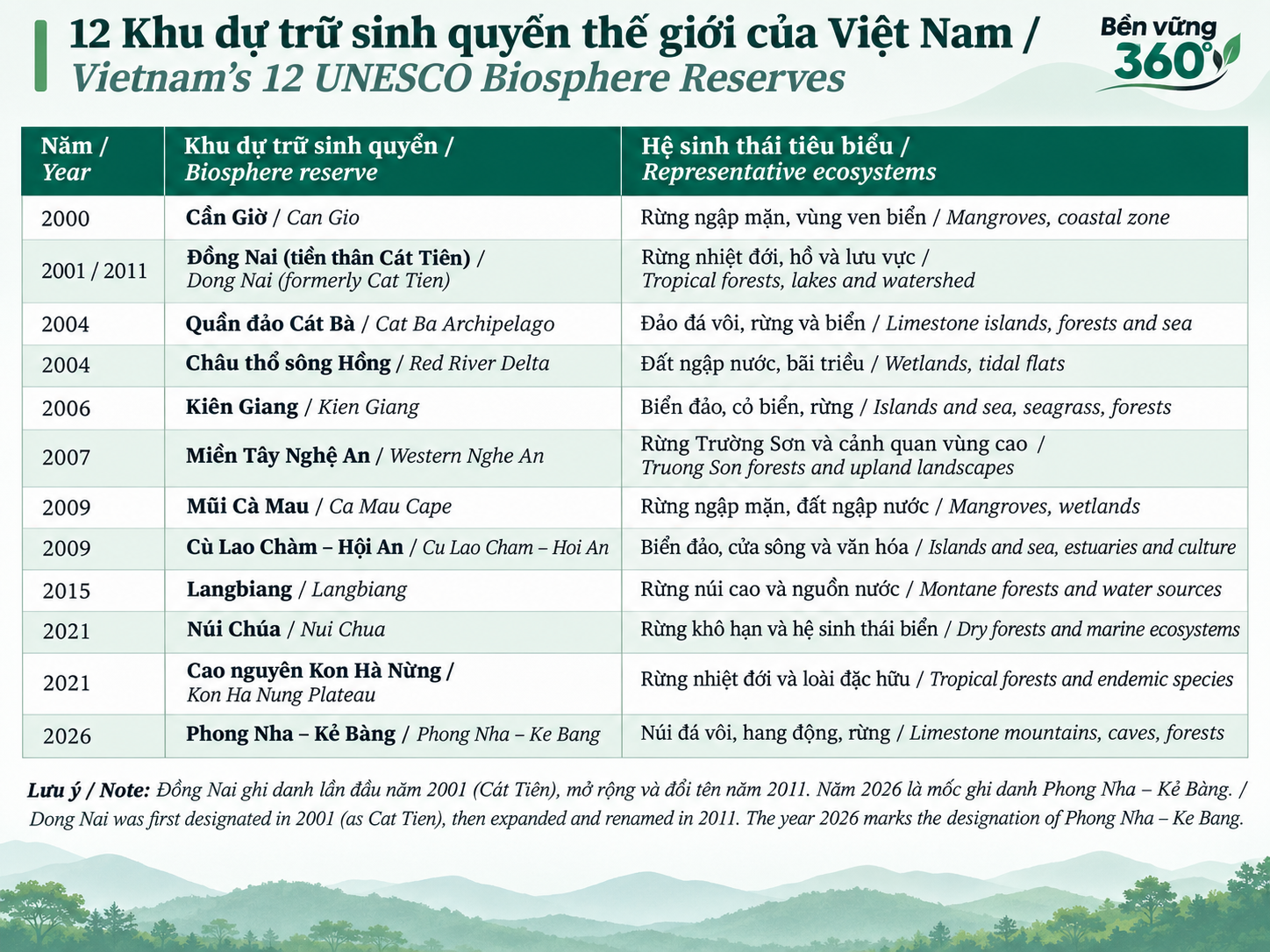
Together, the reserves span mangrove forests, coastal wetlands, estuaries, coral reefs, seagrass meadows, tropical rainforests, montane ecosystems and limestone karst. Their worth should not be reduced to a single number such as area or visitor arrivals: each landscape has distinct ecological functions, cultural relationships, livelihood patterns and pressures.
Exploring Vietnam’s 12 UNESCO biosphere reserves
1. Can Gio (2000): Ecological infrastructure for a coastal metropolis
Can Gio was Vietnam’s first UNESCO biosphere reserve. Its mangrove habitats support aquatic biodiversity, sediment dynamics and livelihoods linked to fisheries. UNESCO records an area of approximately 75,740 hectares. [12]
As urbanization and coastal development intensify, the site illustrates why infrastructure, tourism and resource-use decisions need to account for cumulative impacts. Coastal protection and carbon storage benefits depend on the continued extent, condition and connectivity of mangroves, not merely on their presence on a map.
2. Dong Nai (2001; expanded in 2011): Conservation at landscape scale
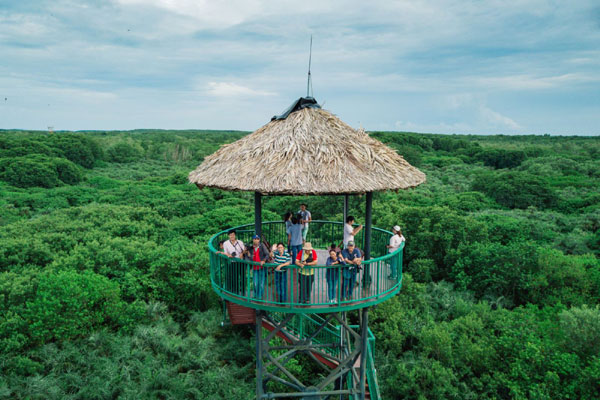
Originally designated Cat Tien in 2001, Dong Nai was expanded and renamed in 2011. The reserve is associated with the Cat Tien forest landscape, the Dong Nai Nature–Culture Reserve and the Tri An Lake ecosystem. UNESCO currently lists its area as 756,000 hectares. [6]
The site demonstrates the need to manage forests, water bodies, watersheds and surrounding livelihoods as one interconnected system. Biodiversity goals must be considered alongside water security, land-use planning and the impacts of production and infrastructure across the wider landscape.
3. Cat Ba (2004): Managing the tension between tourism and habitats
Cat Ba’s archipelago combines limestone islands, tropical forests, wetlands, mangroves and marine ecosystems. It is particularly important for the Critically Endangered Cat Ba langur. UNESCO designated the reserve in 2004. [13]
Tourism generates economic opportunities but also brings wastewater, solid waste, boat traffic and habitat disturbance. A sustainable destination requires carrying-capacity management, seasonal monitoring and protection of sensitive wildlife alongside traditional measures of tourism growth.
4. Red River Delta (2004): Coastal wetlands and migratory birds
Estuarine wetlands, mangroves and intertidal flats in the Red River Delta provide important feeding and resting habitats for migratory waterbirds. Xuan Thuy National Park is one of the landscape’s best-known conservation areas.
The same region supports agriculture, aquaculture and coastal livelihoods. Sea-level rise and changing hydrological conditions make it essential to align wetland restoration and land-use decisions with both biodiversity conservation and households’ capacity to adapt.
5. Kien Giang (2006): Ecological connections from land to sea
Kien Giang encompasses forests, wetlands, mangroves, seagrass beds and coral reefs. Seagrass habitats contribute to fisheries productivity and provide essential feeding grounds for species such as dugongs.
The conservation challenge extends beyond the management of individual protected sites. Pollution, unsustainable harvesting and habitat fragmentation can disrupt connections between river mouths, coastal waters and islands. Fisheries governance and marine habitat protection therefore need to work together.
6. Western Nghe An (2007): Forest ecosystems and living cultural knowledge
Covering approximately 1.3 million hectares in UNESCO’s records, Western Nghe An is the largest of Vietnam’s biosphere reserves by area. Its Annamite forests help sustain biodiversity and provide important soil and water regulation services.
The landscape is also intertwined with the cultural identities and traditional knowledge of local ethnic communities. Forest-based livelihoods, community tourism and non-timber forest products can support conservation only when local people can meaningfully participate in decisions and benefit-sharing.
7. Mui Ca Mau (2009): Climate adaptation built on mangrove ecosystems
At Vietnam’s southern tip, Mui Ca Mau brings together mangroves, wetlands, sedimentary flats and coastal waters. These ecosystems support fisheries and biodiversity while helping attenuate wave impacts and coastal erosion in suitable conditions.
Integrated mangrove–aquaculture approaches deserve careful attention in this climate-exposed landscape. Their success should be assessed through forest condition, water quality, resilience and stable livelihoods rather than production volume alone.
8. Cu Lao Cham–Hoi An (2009): Community behaviour and circularity
Cu Lao Cham–Hoi An connects island forests, coral reefs, seagrass habitats, estuaries and cultural heritage. Community efforts to reduce plastic-bag use have become a widely discussed example of environmental behaviour change.
The larger lesson is about collective governance: public authorities create enabling rules; businesses adjust services and products; communities act, monitor and share benefits. Replication requires credible measurement of avoided waste and ecological outcomes, not communication campaigns alone.
9. Langbiang (2015): Montane forests under land-use pressure
The Langbiang highlands include montane, coniferous and mixed forest ecosystems important for biodiversity and genetic resources. The landscape is associated with Bidoup–Nui Ba National Park and nearby communities involved in farming and tourism.
Maintaining habitat connectivity and water resources calls for careful scrutiny of infrastructure expansion and intensive production. A landscape-level approach brings biodiversity considerations into land-use planning and investment choices.
10. Nui Chua (2021): The importance of dry forests and marine habitats
Nui Chua combines dry and semi-arid terrestrial landscapes with coastal habitats, including coral reefs, seagrass beds and marine turtle nesting areas. It offers opportunities to study ecological responses to water stress, heat and other challenging environmental conditions.
Effective protection requires coordination between terrestrial and marine management, responsible tourism and controls on resource extraction and pollution. Local livelihoods and community knowledge should be considered integral to conservation planning.
11. Kon Ha Nung Highland (2021): Endemic biodiversity in the Central Highlands
Located in Gia Lai Province, Kon Ha Nung has core areas within Kon Ka Kinh National Park and Kon Chu Rang Nature Reserve. UNESCO highlights its tropical forest biodiversity and threatened species, including the endemic, Critically Endangered grey-shanked douc. [8]
Protection cannot stop at core-area boundaries. Habitat connectivity, locally viable livelihoods, reduced pressure on forests and respect for community knowledge all contribute to the long-term conservation of the highland landscape.
12. Phong Nha–Ke Bang (2026): The network’s newest Vietnamese member
On 5 June 2026, UNESCO announced Phong Nha–Ke Bang as Vietnam’s 12th biosphere reserve. Its profile records 515,830 hectares of karst mountains, caves and tropical forests, including 2,954 vascular plant species (172 endemic to Vietnam) and 1,399 animal species. [4] [5]
The landscape already holds UNESCO World Heritage recognition, while the biosphere reserve designation is a separate mechanism focused on connections among ecosystems, research, community development and livelihoods. Managing visitor pressure, safeguarding sensitive karst habitats and ensuring fair local benefits will be central challenges.
Five ways biosphere reserves contribute to sustainable development
1. Natural capital and livelihood security
Forests, wetlands, coral reefs and seagrass beds generate ecosystem services vital to society: water regulation, erosion control, pollination, fish nursery habitats and opportunities for nature-based tourism. When these functions deteriorate, costs may be shifted to households, businesses and the public sector.
Conservation should therefore be understood as sustaining natural capital, not simply financing environmental activities. Assessment must distinguish ecological functions, monetizable economic benefits and cultural or existence values that should not be reduced to a single monetary figure.
2. Climate resilience and nature-based solutions
Natural forests and mangroves can store carbon; coastal ecosystems can moderate some wave impacts; and headwater forests help regulate runoff and protect soils. Nature-based solutions can complement physical infrastructure and climate adaptation policies.
Yet the area of a UNESCO biosphere reserve cannot be converted automatically into tonnes of carbon removals or tradable carbon credits. Climate-related claims require appropriate baselines, accounting methods, independent assurance where relevant and consideration of long-term risks.
3. Community rights, participation and benefit-sharing
Local residents are partners who live with nature, not merely beneficiaries of external conservation projects. Meaningful consultation should address access to resources, tourism decisions, benefit-sharing, traditional knowledge and livelihood impacts.
Conservation is not socially sustainable if vulnerable groups bear disproportionate costs. Measures of income, job quality, access to resources, participation in decisions and functioning grievance channels should sit alongside ecological indicators.
4. Research, education and accessible evidence
One of the MAB network’s strengths is its capacity to connect long-term research, monitoring and peer learning. Data on species, water quality, forest cover and tourism pressure are most valuable when collected consistently, made usable and applied to improve management.
Biosphere reserves can also support experiential education for schools, civil society organizations and companies. Such activities should be scientifically sound and designed to minimize disturbance rather than turning ecosystems into mere backdrops for publicity.
5. Cross-sector coordination and accountability
Each reserve involves multiple authorities, communities and economic interests. Effective governance needs coordination across land use, water, tourism, agriculture, fisheries, infrastructure and environmental protection rather than isolated action by a conservation agency.
UNESCO’s ten-year periodic review offers a structured opportunity to examine zoning, governance and community engagement. Publicly available objectives, monitoring findings and corrective actions can turn international recognition into an incentive for continual improvement. [7]
CSR, ESG and impact investment: Measure outcomes, not just activities
Biosphere reserves can provide meaningful contexts for collaboration among governments, enterprises, civil society and scientists on habitat restoration, livelihoods, environmental education and responsible tourism. However, a CSR project should not be judged successful simply because it funded events, planted trees or collected waste.
A credible impact framework starts with a clearly defined problem and baseline, identifies affected stakeholders, and separates outputs (such as trees planted) from outcomes (survival rates and improved habitat condition) and longer-term impacts (restored ecosystem services, lower extraction pressure and more secure livelihoods). Unintended effects and maintenance obligations after project closure also matter.
In ESG terms, companies should examine both how their operations affect nature and how they depend on ecosystem services. GRI 101: Biodiversity 2024, effective from January 2026 for applicable GRI reporting, and the TNFD guidance, including its LEAP approach updated in October 2026, offer useful references for evaluating and disclosing nature-related issues. Neither substitutes for applicable law or UNESCO conservation recognition. [9] [10]
For example, tourism operators should review carrying capacity, wastewater, vessel traffic and habitat disturbance; agribusinesses should consider land, water and chemical inputs; fisheries should examine harvesting pressure and nursery habitat loss; and restoration sponsors should verify species suitability and multi-year plant survival.
Connections with the Sustainable Development Goals
Biosphere reserves are closely linked to SDG 15 (Life on Land), SDG 14 (Life Below Water) and SDG 13 (Climate Action). Protecting freshwater systems also supports SDG 6; resilient livelihoods link to SDG 8; responsible consumption and production to SDG 12; safer and more resilient communities to SDG 11; and education, research and partnerships to SDGs 4 and 17. [11]
However, the mere location of an activity inside a biosphere reserve does not prove meaningful SDG progress. Any contribution should be supported by a specific target, indicators, scope of beneficiaries, timeframe and verifiable evidence of change.
The message of 3 November is not that conservation and development must compete. Rather, development needs to change: ecological limits must inform planning; local people must be genuine partners; science and evidence should guide decisions; and public and private investment must demonstrate lasting results.
With 12 UNESCO-recognized biosphere reserves, Vietnam has valuable places to test and scale approaches that connect biodiversity, livelihoods and resilient economic activity. Success will not be measured by the number of labels alone, but by healthier ecosystems, recovering wildlife, community well-being and the natural heritage passed to the next generation.
Method & scope
Các mô tả về hệ sinh thái và mốc ghi danh dựa trên dữ liệu công khai từ UNESCO và các tài liệu tham khảo. Các phần diễn giải về CSR, ESG, SDGs, rủi ro và chỉ số quản trị là phân tích của Bền vững 360°, không phải kết luận chứng nhận hoặc bảng xếp hạng của UNESCO.
References
- UNESCO – International Day for Biosphere Reserves ↗ (accessed 2026-11-03)
- UNESCO – What are biosphere reserves? ↗ (accessed 2026-11-03)
- UNESCO – MAB: World Network of Biosphere Reserves, official list ↗ (accessed 2026-11-03)
- UNESCO – UNESCO designates 14 new biosphere reserves (5 June 2026) ↗ (accessed 2026-11-03)
- UNESCO – Phong Nha–Ke Bang biosphere reserve profile ↗ (accessed 2026-11-03)
- UNESCO – Dong Nai biosphere reserve profile ↗ (accessed 2026-11-03)
- UNESCO – Designation and ten-year periodic review process ↗ (accessed 2026-11-03)
- UNESCO – Kon Ha Nung Highland biosphere reserve profile ↗ (accessed 2026-11-03)
- Global Reporting Initiative – GRI 101: Biodiversity 2024 ↗ (accessed 2026-11-03)
- Taskforce on Nature-related Financial Disclosures – LEAP v2.0, October 2026 ↗ (accessed 2026-11-03)
- United Nations – Sustainable Development Goals ↗ (accessed 2026-11-03)
- UNESCO – Can Gio Mangrove biosphere reserve profile ↗ (accessed 2026-11-03)
- UNESCO – Cat Ba biosphere reserve profile ↗ (accessed 2026-11-03)