1. CSR Does Not Begin with a Communications Campaign
CSR emerged alongside an increasingly important question in society: Should a business be responsible only for its profits, or should it also be accountable for the impacts of its operations?
As businesses grow in scale, so does their impact. A factory may create jobs while also affecting the environment. A retail chain may serve millions of customers but must also consider working conditions and product origins. A technology company may develop convenient products while facing challenges related to data, privacy, and unequal access to technology.
Therefore, CSR is not simply about giving back. It begins with businesses asking themselves:
What impact are our operations having on the people and communities connected to our business?
ISO 26000, the international guidance standard on social responsibility, approaches the issue from this perspective. It does not limit social responsibility to businesses or charitable activities. Instead, it addresses how organizations identify their impacts, engage with stakeholders, and integrate responsible behavior into their policies, operations, and decision-making processes.
2. What Does CSR Include?
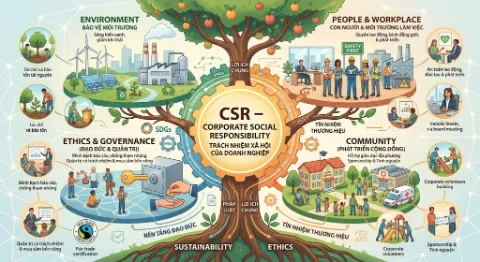
There is no single list that applies to every business. CSR depends on the industry, business size, market, and the impacts generated by its operations. However, CSR can be understood through several major areas of responsibility.
Responsibility Toward Employees
Businesses have a responsibility to create safe, fair working environments that respect employees' rights.
This may include policies on occupational safety, equality, career development opportunities, employee benefits, health, and working conditions.
A company that donates billions of Vietnamese dong to community initiatives while facing serious problems in its treatment of employees can hardly be considered socially responsible in a comprehensive sense.
Responsibility Toward Customers
CSR is also embedded in the products and services a company provides.
Are its products safe? Is its advertising truthful? Does the company protect customer data? Are its sales policies transparent?
This aspect of CSR is sometimes overlooked because it does not necessarily produce visually appealing stories for communications campaigns.
Environmental Responsibility
Reducing emissions, managing waste, conserving resources, improving energy efficiency, and transitioning toward sustainable production methods can all fall within the scope of CSR.
The important point is that businesses must examine the actual environmental impacts of their operations rather than simply carrying out a few symbolic environmental activities.
Responsibility Toward Communities
This is the aspect of CSR that the public most readily recognizes.
Businesses may support education, healthcare, livelihoods, skills development, infrastructure, disaster response, or vulnerable communities.
However, a successful community program is not necessarily the one with the largest budget.
A program that provides gifts to 1,000 students may create immediate value. Meanwhile, a program that equips teachers with the skills to organize life skills activities over several years may generate a deeper impact.
CSR should be evaluated by the impact it creates, not merely by the amount of money spent.
Ethical Responsibility and Governance
Businesses must also pay attention to transparency, anti-corruption, business ethics, human rights, and how they engage with partners, suppliers, and other stakeholders.
This is why CSR is increasingly connected to corporate governance and supply chain management rather than being confined to communications or marketing departments.
3. From Doing Good to Creating Impact
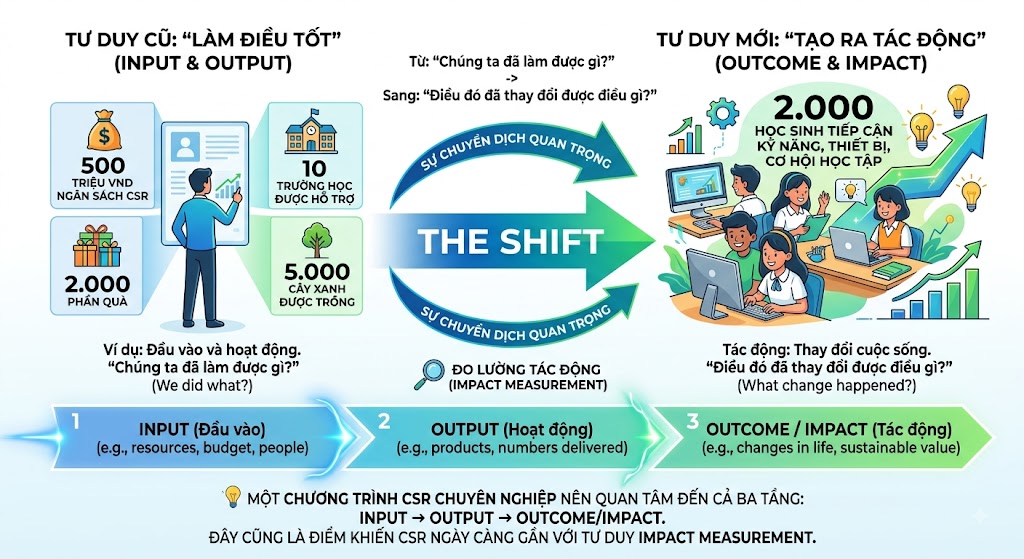
One of the most important shifts in CSR thinking is the transition from asking:
What have we done?
To asking:
What impact are our operations having on the people and communities connected to our business?
What difference has it made?
For example, a company may report: VND 500 million allocated to CSR; 2,000 gift packages distributed; 10 schools supported; 5,000 trees planted.
These figures describe inputs and activities, but they do not yet demonstrate impact.
If 2,000 gift packages only address immediate needs for a short period, their impact may be very different from that of a program enabling 2,000 students to access skills, equipment, or educational opportunities that were previously unavailable to them.
Therefore, a professionally designed CSR program should consider three levels:
Input → Output → Outcome/Impact
Input: How many resources has the company invested?
Output: What has the program delivered?
Outcome/Impact: What meaningful changes have occurred for the beneficiaries?
This is also why CSR is increasingly aligned with the concept of impact measurement.
4. CSR Does Not Necessarily Conflict with Profit
A common assumption is that engaging in CSR means businesses must sacrifice profits. International research suggests that this relationship is much more complex.
CSR can create business value through several mechanisms: reducing risks, improving relationships with customers and employees, strengthening reputation, supporting innovation, improving access to capital, and reinforcing stakeholder relationships. The European Commission has also recognized the potential benefits of CSR for risk management, cost savings, access to capital, customer relationships, human resource management, and innovation capacity.
A 2024 review published in Corporate Social Responsibility and Environmental Management examined 73 studies on the relationship between CSR, information asymmetry, and economic consequences. It showed that CSR is increasingly studied in relation to how markets and stakeholders evaluate businesses. However, an overly simplistic conclusion should be avoided: “Engaging in CSR will certainly increase corporate profits.”
There is no evidence to support that claim in every situation. Effectiveness depends on the industry, company size, market, type of CSR activity, implementation approach, and ability to align CSR with business strategy. An expensive CSR program that lacks clear objectives, measurement mechanisms, and relevance to actual social needs can easily become an inefficient expenditure.
5. Stakeholders: CSR Is Not Just for “the Community”
An important development in CSR research is the shift from focusing exclusively on shareholders to considering stakeholders. Stakeholders may include:
- Employees
- Customers
- Suppliers
- Partners
- Investors
- Government authorities
- Local communities
- Social organizations
- The environment and groups affected by business operations
Research on stakeholder theory and CSR indicates that businesses increasingly face the interests and expectations of multiple groups while still needing to maintain business performance. This represents a significant change.
A company should not begin its CSR efforts by asking:
“What activity do we want to sponsor?”
Instead, it should begin with:
“What problems exist, who is affected, and what capabilities does our company have to help address them?”
The second question often leads to more meaningful CSR programs.
6. Why Are Charity and CSR Not Exactly the Same?
Charity can be part of CSR, but the two concepts are not synonymous. A company distributing 1,000 gift packages to disadvantaged children is carrying out a community support activity. However, if it invests in education over the long term, develops skills programs, trains teachers, improves facilities, and measures students’ learning outcomes, the initiative moves closer to a strategic CSR program.
The difference lies in the approach.
Charity
- Usually focuses on immediate assistance
- May be a one-off activity
- Often evaluated by the amount of money or number of gifts donated
- May be separate from business operations
- Places greater emphasis on “giving”
Strategic CSR
- Focuses on social issues and long-term impact
- Has clear objectives and plans
- Is evaluated through outcomes and impact
- Can be linked to business capabilities and strategy
- Emphasizes “solving problems”
Charity should not be regarded as an “inferior form of CSR.” In many emergencies, direct assistance is necessary. The issue is that charitable activities should not be used to represent the entirety of a company's social responsibility.
7. CSR and ESG: Similar, but Not the Same
CSR and ESG are often mentioned together, but they are not interchangeable. Put simply:
CSR asks:
“How should a business act responsibly toward society and the impacts it creates?”
ESG focuses more on:
“How are a company's environmental, social, and governance factors managed and demonstrated, and how can they be assessed?”
VnExpress also distinguishes CSR as relating to corporate responsibility and action, while ESG is a framework of criteria used to assess and manage environmental, social, and governance factors.
Businesses should therefore avoid thinking of CSR as simply implementing community programs and ESG as simply preparing reports, as though the two were entirely separate. In practice, CSR can form part of how a company pursues broader social and sustainability objectives.
8. Where Should a Good CSR Program Begin?
Not with the budget. Nor with the search for an activity that “looks good in photographs.” A CSR process can begin with five questions.
1. What Is the Social Problem?
The problem needs to be clearly defined. “Education faces difficulties” is too broad. “Teachers in mountainous schools lack the resources to organize digital skills education activities” is much more specific.
2. Who Are the Beneficiaries?
Students? Teachers? Employees? Older people? Local communities? Beneficiary groups should be clearly identified rather than described using a vague term such as “the community.”
3. What Capabilities Does the Company Have?
A bank may have strengths in finance and financial education. A technology company may support digital transformation. A logistics company may contribute transportation and supply chain expertise. A manufacturer may support vocational skills, occupational safety, or community development around its facilities. Effective CSR often lies at the intersection of social needs and a company's actual capabilities.
4. How Will Impact Be Measured?
It is not just about the number of participants. Relevant indicators may include:
- Number of people reached
- Number of people completing the program
- Changes in knowledge or skills
- Rate at which results are sustained
- Number of schools or organizations able to continue operating the initiative
- Reduction in waste
- Number of employment opportunities created
- Other social indicators appropriate to the program
5. What Happens After the Company Withdraws from the Project?
This is an important but frequently overlooked question. If a program ends as soon as corporate sponsorship stops, its impact may be very limited. A good program should consider sustainability, handover, and scalability from the design stage.
9. The Future of CSR Will Not Simply Be About “Doing More”
Another misconception is that the more money a business spends on CSR, the more responsible it becomes. Not necessarily. Current research increasingly examines CSR through the lenses of strategy, stakeholders, innovation, and demonstrable impact. A 2024 systematic review on CSR and technological innovation synthesized 67 studies from 36 journals and highlighted the relationship between CSR and innovation as an increasingly significant research direction in sustainable development.
This opens up a different approach: companies do not necessarily have to rely solely on money to address social problems. They can use their technology, expertise, data, networks, products, workforce, and supply chains to create impact.
That might mean a digital education program instead of merely donating computers; a vocational training model instead of simply awarding scholarships; a waste management solution instead of organizing a single cleanup day; or a teacher capacity-building program that allows schools to continue activities independently after a project ends.
This is when CSR shifts from “giving” to “solving problems together.”
10. Good CSR Does Not Need to Be Loud
A successful CSR program is not necessarily the one that receives the most attention on social media. If a company develops a program that enables a community to operate independently, creates measurable change, and sustains its impact over many years, its value may be far greater than that of a communications campaign reaching millions of people but generating limited real-world impact.
CSR should therefore not be evaluated solely by asking:
“How much has the company done?”
We must also ask:
“What has society gained?”
“What changed as a result of the program?”
“Will that impact remain after the company leaves?”
And ultimately:
“Is the company addressing a real problem, or merely creating an appealing image of itself doing so?”
That is also the distinction between substantive CSR and CSR carried out primarily for appearances.
Corporate CSR Should Begin with Responsibility, Not Budget
CSR is changing. From isolated charitable activities, it is increasingly understood as part of the relationship between business and society. Frameworks such as ISO 26000 emphasize identifying impacts, engaging stakeholders, and integrating social responsibility into organizational operations.
International research has also expanded CSR into areas such as stakeholder management, innovation, information, governance, business performance, and corporate social irresponsibility. In other words, research examines not only how companies do good, but also their negative impacts and how they must take responsibility for them.
A company's CSR should therefore not begin with the question:
“How much money do we have for CSR this year?”
Instead, it should begin with a more difficult question:
“What positive change can our company create for society, and how can we demonstrate that this change has actually occurred?”
When businesses can answer that question, CSR is no longer merely a budget allocated to the community. It becomes part of how a company conducts business responsibly, creates value for stakeholders, and achieves long-term sustainable development.
References
VnExpress – What Is CSR? How Is CSR Different from ESG?
ISO 26000:2010 – Guidance on Social Responsibility
Zhao & Yin (2024) – Driving Corporate Social Responsibility to be Innovative
Do Corporate Social Responsibility and Technological Innovation Get Along? (2024)
FLY TO SKY – COMPREHENSIVE COMMUNITY IMPACT SOLUTIONS
As corporate social responsibility and sustainable development increasingly become part of business development strategies, building an effective CSR/ESG program requires more than allocating funds to the community. It also requires an appropriate implementation model, clearly identified beneficiaries, reliable local partners, effectively coordinated resources, and measurable, documented results.
Fly To Sky aims to partner with businesses in translating CSR/ESG objectives into concrete community programs, from consulting, program design, needs assessments, local connections, resource mobilization, activity organization, and product supply to impact documentation and reporting.
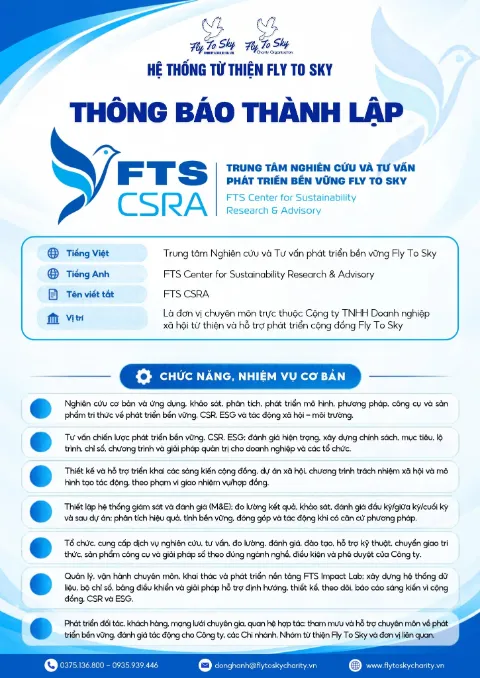
Fly To Sky is a charitable network operating on a not-for-profit basis, established on September 2, 2018, in Gia Lai. It comprises Fly To Sky Charity and Community Development Support Social Enterprise Co., Ltd. and The Fly To Sky Charity Organization, members of the National Volunteer Networks affiliated with the Vietnam National Volunteer Center under the Central Committee of the Ho Chi Minh Communist Youth Union, with nationwide operations. Recognized as an outstanding charitable network nationwide, Fly To Sky has received six national awards and one international award for volunteering and community service, and has been recognized nationally by the Central Youth Union for seven consecutive years.
After eight years of operation, Fly To Sky has developed an ecosystem of more than 200 community programs and 30 projects across various fields. In addition to programs directly organized by Fly To Sky, we have had opportunities to work with more than 200 businesses, companies, and organizations on social responsibility, community programs, volunteering, and initiatives related to CSR, ESG, and sustainable development in Vietnam.
On this foundation, Fly To Sky has developed its “Comprehensive Community Impact Solutions” system, aiming to serve as a consulting partner, implementing organization, service provider, product supplier, or partner throughout a program, depending on each partner's objectives and needs.
COMPREHENSIVE COMMUNITY IMPACT SOLUTIONS
1. STRATEGIC CONSULTING & SUSTAINABLE DEVELOPMENT
Providing consulting and developing strategies for community development, corporate social responsibility (CSR), environmental, social, and governance (ESG) practices, and programs aligned with sustainable development goals, tailored to each partner's direction and values.
2. PROGRAM DESIGN & IMPLEMENTATION
Designing, organizing, constructing, and comprehensively operating community, charitable, and CSR activities; internal programs; experiential activities; volunteer tourism; events; talk shows; and workshops according to the needs of businesses, organizations, and individuals nationwide.
3. RESOURCE MOBILIZATION & CONNECTIONS
Connecting, mobilizing, receiving, and managing financial resources, in-kind contributions, products, personnel, and expertise from individuals, businesses, and organizations in Vietnam and abroad, directing resources toward genuine needs and impact-oriented projects.
4. FUNDRAISING CAMPAIGNS & BUSINESS FOR COMMUNITY IMPACT
Developing and implementing fundraising campaigns, socially impactful business initiatives, trade promotion, and sustainable livelihood support models to create development opportunities for communities and disadvantaged groups.
5. TRAINING, WORKSHOPS & CAPACITY BUILDING
Designing and delivering thematic training programs, workshops, and experiential activities to strengthen community program management and coordination, life skills, leadership, volunteering, and initiative development among young people, organizations, and businesses.
6. CUSTOMIZED GIFTS, GOODS & PRODUCTS
Supplying gifts, souvenirs, essential goods, and merchandise for community programs; designing, producing, and printing customized branded products such as uniforms, backpacks, fabric bags, event merchandise, gift sets, and communications materials.
Fly To Sky can provide end-to-end supply services through a single point of contact, from product consultation, design, production and printing, and quantity control to packaging, transportation, and delivery according to program requirements.
7. EMPLOYMENT & LIVELIHOODS FOR DISADVANTAGED GROUPS
Connecting disadvantaged groups with jobs, livelihood opportunities, resources, and markets; supporting product development, trade promotion, and the creation of sustainable livelihood opportunities.
8. SOCIAL IMPACT MEASUREMENT & ENHANCEMENT
Monitoring, consolidating, and evaluating program results; developing impact indicators, reports, and documentation mechanisms to help partners understand the social value created and continue developing initiatives with long-term impact.
Fly To Sky can support field surveys, local data collection, beneficiary documentation, activity results, photographs, and on-site information gathering for program evaluation, reporting, and impact documentation.
FLY TO SKY – YOUR CSR/ESG IMPLEMENTATION PARTNER IN VIETNAM
Fly To Sky has the legal status and legal foundation to mobilize, receive, and manage resources and sponsorships from domestic and international sources, while providing and implementing comprehensive community development and social responsibility solutions in Vietnam.
Building on this foundation, Fly To Sky has developed the “Comprehensive Community Impact Solutions” model, providing businesses, organizations, and partners with an integrated range of solutions from strategic direction and design to implementation and impact measurement. We can directly survey and identify community needs; connect and coordinate with local authorities, schools, educational institutions, healthcare facilities, and social organizations; mobilize, manage, and coordinate volunteers, corporate personnel, and community members; organize core, supporting, and related activities; and manage logistics, field operations, product and gift supply, materials, and other services required for the program.
Through a single-point-of-contact model, Fly To Sky can manage the entire implementation process or flexibly participate in individual components according to partner needs, from a single product or activity to a complete program. This model enables businesses and organizations to focus on their objectives, expertise, and intended impact while Fly To Sky handles implementation, connections, and community operations.
In particular, Fly To Sky operates under a social enterprise model, where providing services and products not only creates value for partners but also helps generate resources to sustain, reinvest in, and expand community initiatives in accordance with the law. Each collaboration is therefore part of an impact ecosystem in which corporate resources are transformed into tangible programs, products, and value for communities.
For companies with multiple CSR programs throughout the year, activities across many locations, or product supply needs for numerous events, Fly To Sky can serve as a centralized implementation and supply partner, reducing the coordination burden of working with multiple vendors and partners for each component.
Fly To Sky does not aim to apply the same model to every company. Each program is developed based on the company's CSR/ESG objectives, budget, target beneficiaries, locations, personnel resources, and brand direction.
We believe that combining corporate resources, CSR/ESG direction, and business capabilities with Fly To Sky's practical implementation experience, local networks, volunteers, and supply capabilities can create programs that are meaningful for communities and valuable to businesses.
Fly To Sky welcomes opportunities to meet and introduce our capabilities, program ecosystem, operational network, and representative projects, and to discuss potential CSR/ESG and community program partnerships with businesses.
References
- Website Fly To Sky Charity ↗ (accessed 2026-10-26)