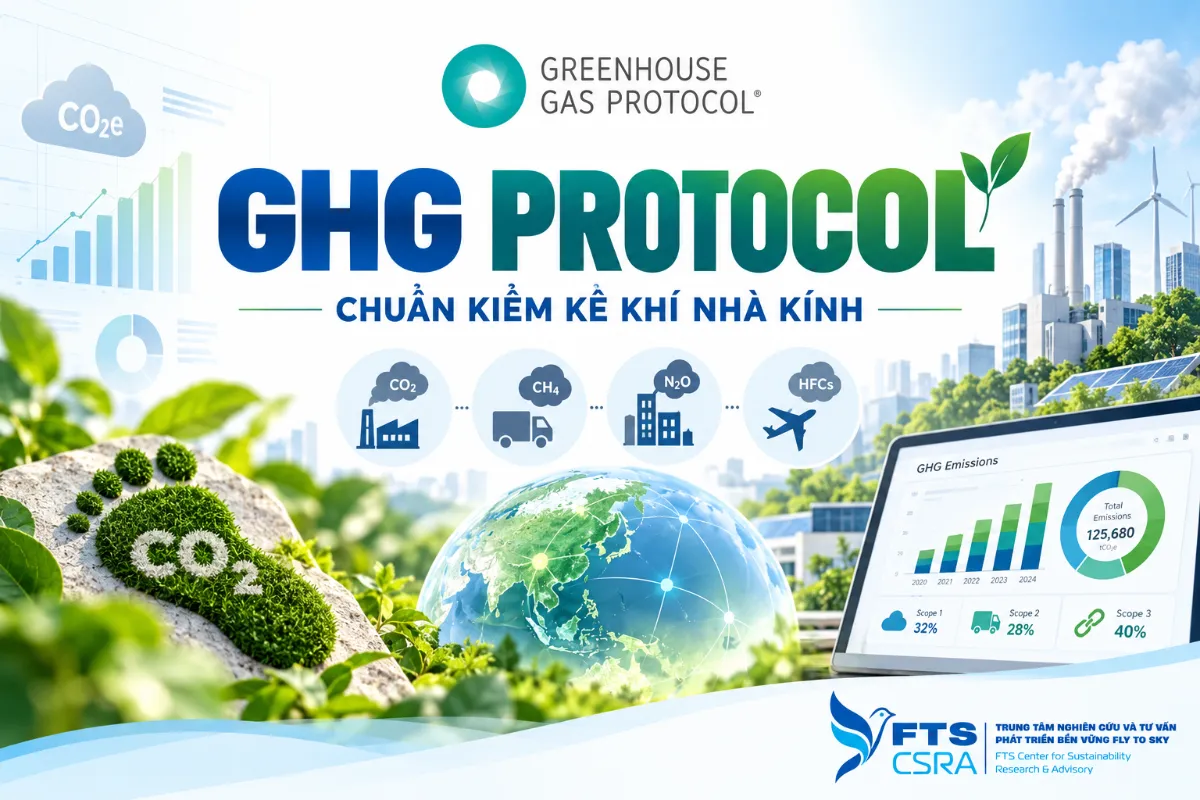
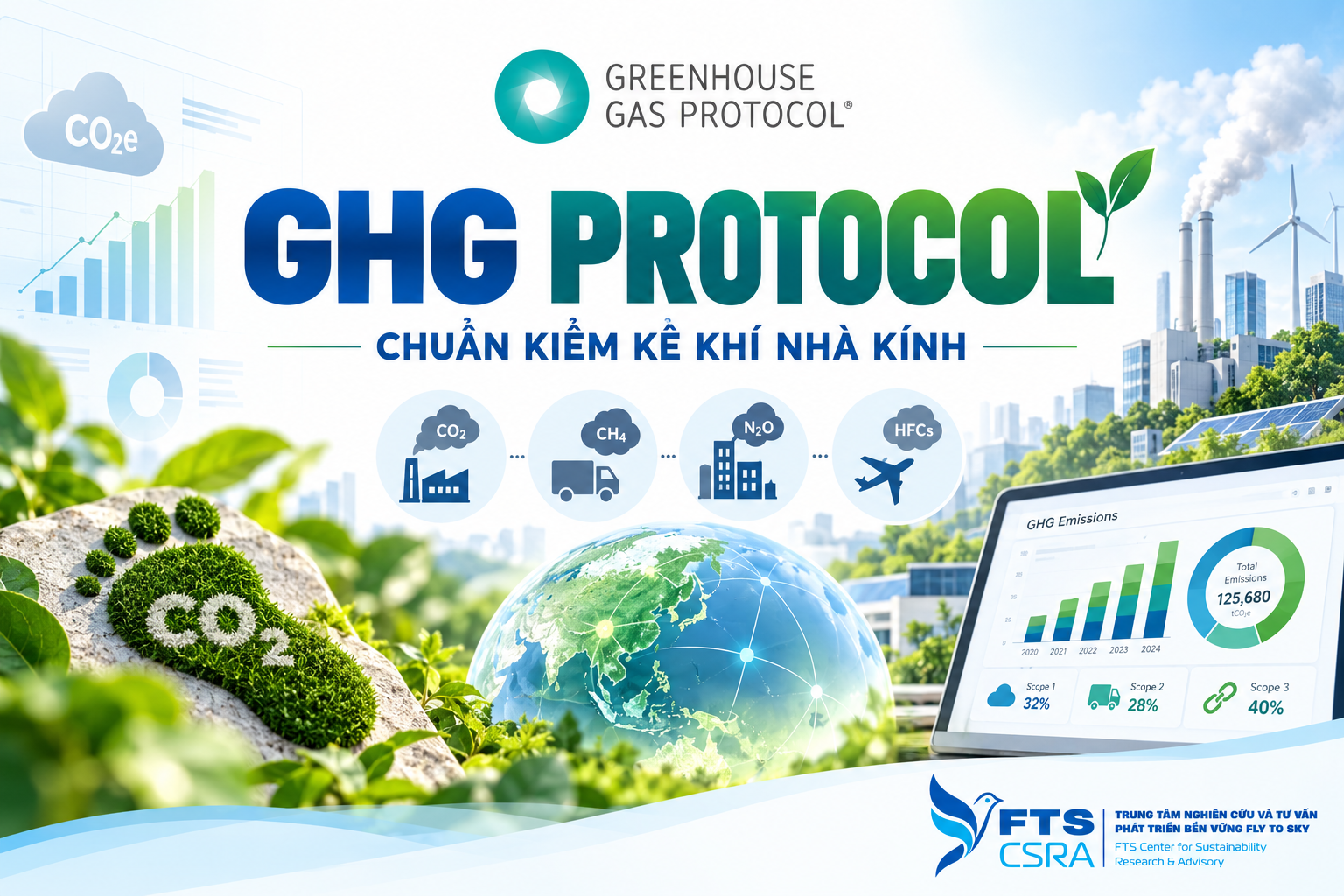
Every “tonne of CO₂ equivalent” in a sustainability report needs a common method, and that method is the GHG Protocol. On Sustainability 360° (Bền vững 360°), FTS CSRA experts present the five accounting principles, the three emission scopes, all 15 Scope 3 categories, the mandatory reporting elements, the status of the standards revision and how it links to Vietnam's GHG inventory obligations.
Nghị định thư Khí nhà kính – Chuẩn kế toán và báo cáo khí nhà kính doanh nghiệp
English name
Greenhouse Gas Protocol – Corporate Accounting and Reporting Standard (and Scope 2 Guidance, Corporate Value Chain (Scope 3) Standard)
Issuer/custodian
World Resources Institute (WRI) and World Business Council for Sustainable Development (WBCSD); since 2024 an Independent Standards Board (ISB) oversees standard-setting.
Nature
The world's most widely used GHG accounting and reporting standards; the basis of ISO 14064-1, IFRS S2, ESRS E1, CDP and many national rules.
Reference scope
Companies and organisations of any type; the seven Kyoto Protocol gases: CO₂, CH₄, N₂O, HFCs, PFCs, SF₆, NF₃.
The GHG Protocol began in 1998; the Corporate Standard was published in 2001 and revised in 2004. It was followed by the Scope 3 Standard (2011), the Product Life Cycle Standard (2011), the Scope 2 Guidance (2015) and sector calculation tools. The suite is under comprehensive revision: the process started in late 2022; in July 2025 the Independent Standards Board approved a Scope 2 public consultation (hourly and geographic matching for clean-energy claims, a hierarchy of location-based emission factors, relief for small organisations). Revised corporate standards are expected around end-2027; current editions apply until then.
Purpose: help companies prepare a true and fair, complete GHG inventory as a basis for managing reductions, joining voluntary and mandatory programmes and carbon markets, and improving consistency and transparency across companies.
2.1. Five accounting principles
Principle
Requirement
Relevance
The inventory boundary reflects emissions and serves users' decision-making
Completeness
Account for all sources and activities within the boundary; disclose and justify exclusions
Consistency
Consistent methods over time; document changes in data, boundary and methods
Transparency
Disclose assumptions, methods and data sources in an auditable way
Accuracy
Neither systematically over nor under actual emissions; reduce uncertainty as far as practicable
2.2. Organisational and operational boundaries
Consolidation approach
What it means
Equity share
Account for emissions according to the economic share in each operation
Financial control
Account for 100% of emissions from operations whose financial and operating policies the company can direct to gain benefits
Operational control
Account for 100% of emissions from operations where the company has full authority to introduce and implement operating policies – the most common approach
Scope
Content
Scope 1
Direct emissions from sources owned or controlled: on-site fuel combustion (boilers, generators), owned vehicles, process emissions (cement, chemicals), fugitive emissions (refrigerants, SF₆)
Scope 2
Indirect emissions from purchased electricity, steam, heat and cooling consumed. Dual reporting: location-based (grid-average factors) and market-based (contracts, renewable energy certificates, PPAs meeting eight quality criteria)
Scope 3
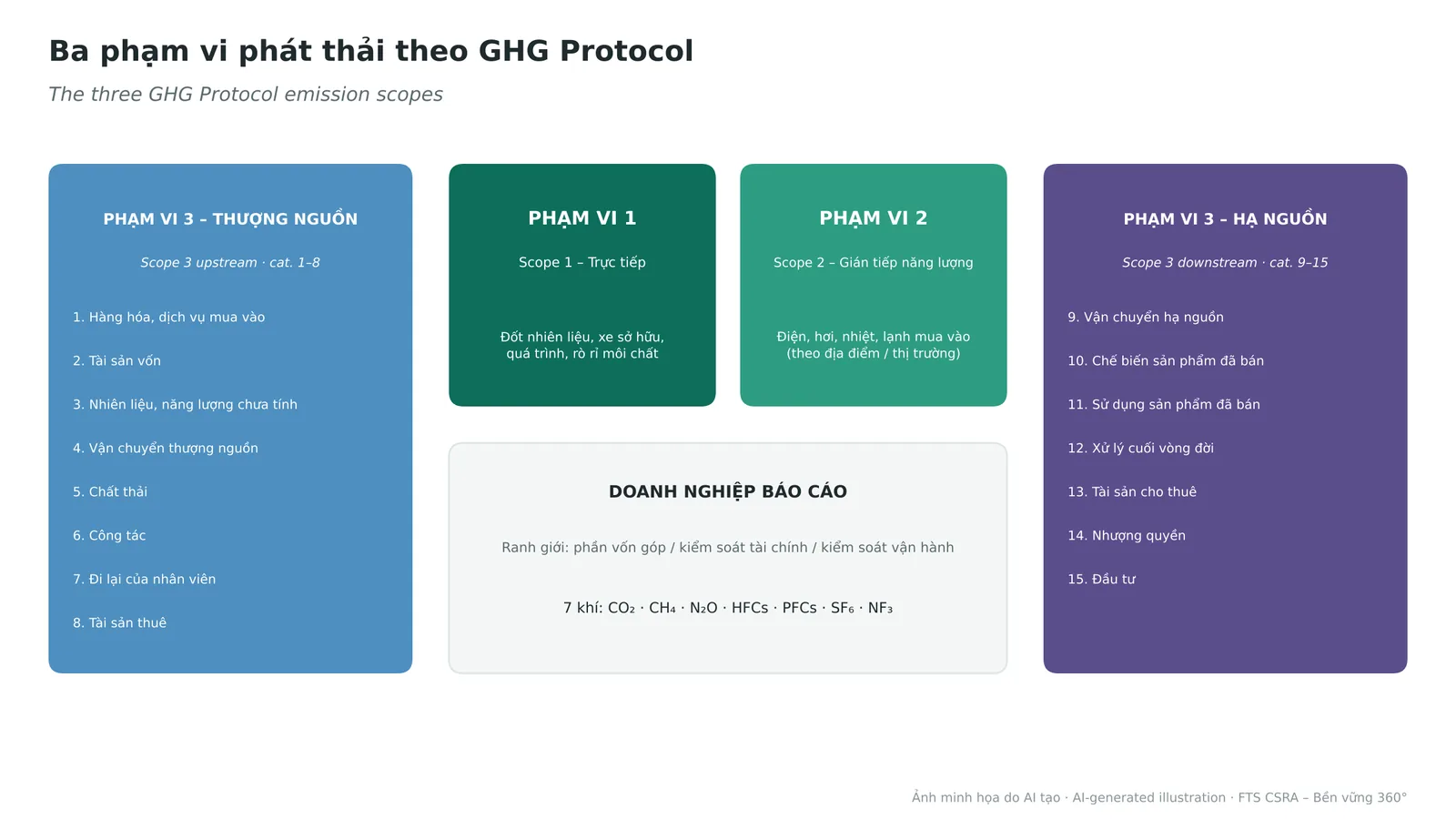
All other indirect value-chain emissions, in 15 categories (8 upstream, 7 downstream); under the Scope 3 Standard companies choose what to report but must justify exclusions
Figure 1. Scopes 1, 2 and the 15 Scope 3 categories under the GHG Protocol. (AI-generated image) / Hình 1. Scopes 1, 2 and the 15 Scope 3 categories under the GHG Protocol. (Ảnh do AI tạo)
2.3. All 15 Scope 3 categories
Cat.
Name
Scope
Calculation methods
1
Purchased goods and services
Extraction, production and transport of goods and services purchased in the year (cradle-to-gate)
Users: facilities listed for mandatory GHG inventories, exporters (especially to the EU under CBAM), listed companies, banks, and any organisation setting reduction or carbon-neutral targets.
Choose a consolidation approach and list facilities and emission sources.
Choose emission factors: national factors first (the officially published grid factor), then IPCC; use one consistent set of GWP values (IPCC AR5 or AR6, stated).
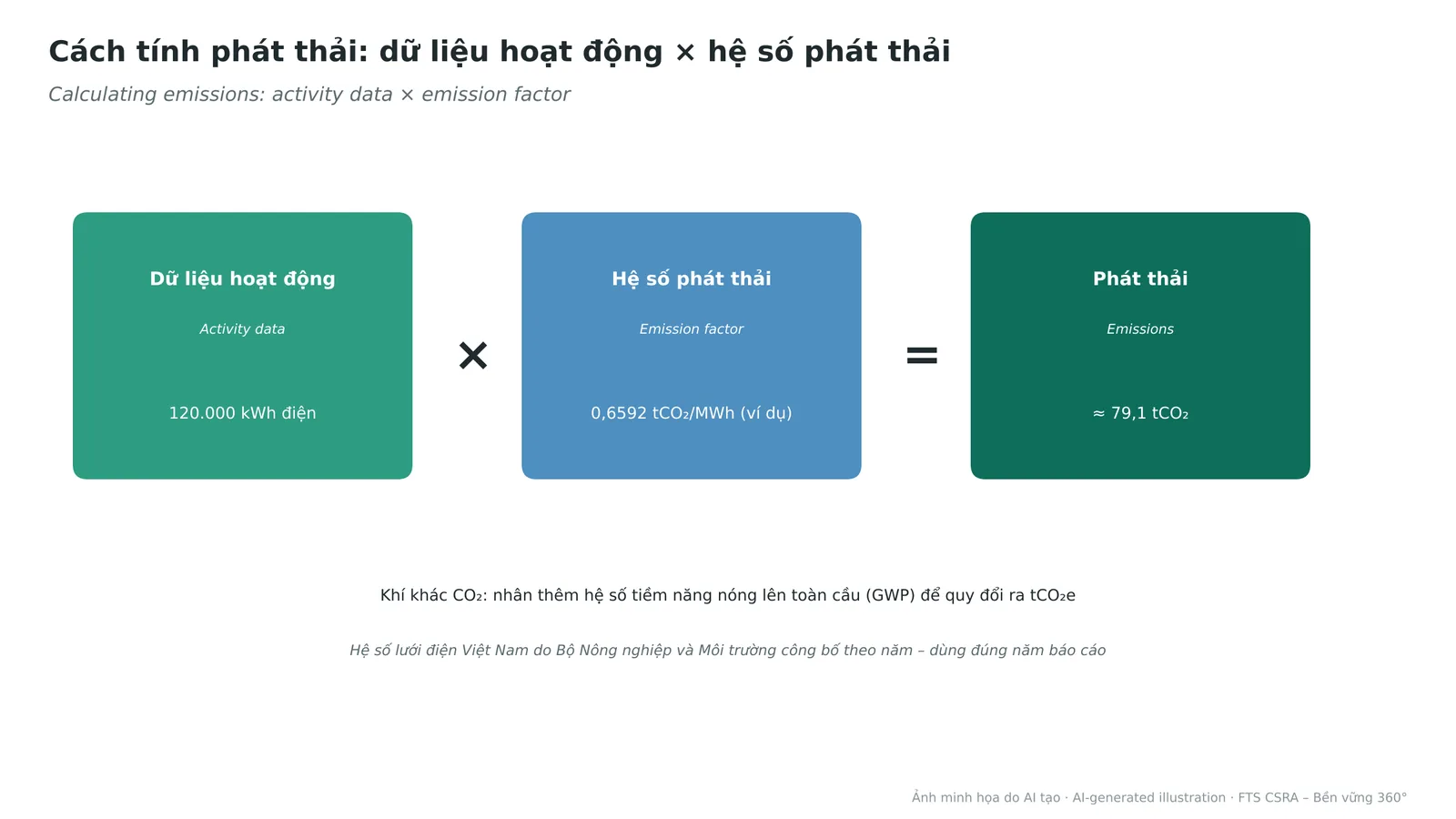
Calculate: activity data × emission factor × GWP.
Screen the 15 Scope 3 categories by size, influence, risk and stakeholder expectations; prioritise the largest.
Choose a base year and a recalculation policy for structural changes (acquisitions, divestments) above a significance threshold.
Run quality control and uncertainty assessment; consider verification under ISO 14064-3.
Figure 2. The basic formula: activity data multiplied by an emission factor. (AI-generated image) / Hình 2. The basic formula: activity data multiplied by an emission factor. (Ảnh do AI tạo)
Practical example
Hypothetical case: Paper packaging plant P (Bình Dương) prepares its first inventory using the operational control approach.
Source
Data and method
Result (tCO₂e)
Scope 1 – coal boiler
850 tonnes coal × IPCC factor
≈ 1,950
Scope 1 – forklifts, trucks
42,000 litres diesel
≈ 113
Scope 1 – refrigerants
25 kg R-410A top-up × GWP
≈ 52
Scope 2 – electricity (location-based)
3,200 MWh × national grid factor for the year (e.g. 2023: 0.6592 tCO₂/MWh)
≈ 2,109
Scope 3 – cat. 1 pulp
12,000 tonnes × average factor
≈ 9,600 (largest)
Scope 3 – cat. 4, 9 transport
t·km from freight invoices
≈ 640
Conclusion: Scope 3 is about 70% of the total; the plant prioritises engagement with pulp suppliers, switches the boiler to biomass (biogenic CO₂ reported separately) and installs rooftop solar.
Notes for use in Vietnam
Legal duties: Decree 06/2022/ND-CP (amended by Decree 119/2025/ND-CP) regulates GHG mitigation; facilities on the Prime Minister's list (Decision 13/2024/QĐ-TTg) must prepare annual facility-level inventories. Vietnam's inventory methods follow IPCC guidance and are compatible with the GHG Protocol for Scopes 1 and 2.
Grid emission factor: use the factor published by the Ministry of Agriculture and Environment (formerly the Ministry of Natural Resources and Environment) for the reporting year.
EU CBAM: iron and steel, aluminium, cement, fertilisers, hydrogen and electricity exported to the EU require embedded-emissions declarations under EU-specific methods – prepare batch-level product data.
Domestic carbon market: the pilot carbon credit exchange roadmap under Decision 232/QĐ-TTg (2025) relies on accurate inventories for allowance allocation.
Renewable energy certificates (I-REC) and DPPAs count for market-based Scope 2 only if they meet the eight quality criteria; watch the upcoming Scope 2 revision on hourly matching.
Method & scope
Content compiled and interpreted from FTS Impact Lab and documents of the issuing body; versions and sources should be verified before publication.
European and Japanese buyers increasingly ask Vietnamese companies one question: “Have you carried out due diligence on your supply chain?” On Sustainability 360° (Bền vững 360°), FTS CSRA experts break down the OECD Due Diligence Guidance: the six steps and their specific actions, the eight characteristics of due diligence, the cause–contribute–linked logic and how Vietnamese suppliers can apply it.
ISO 14001:2026 has formally replaced the 2015 edition, placing climate change, biodiversity and a life-cycle perspective at the heart of environmental management. On Sustainability 360° (Bền vững 360°), FTS CSRA experts walk through clauses 4–10, highlight what is new, list the mandatory documented information, suggest environmental indicators and set out a transition path for Vietnamese companies.
After climate, nature is the next “asset” investors want companies to measure. On Sustainability 360° (Bền vững 360°), FTS CSRA experts explain the TNFD recommendations: 14 recommended disclosures, the 16 components of the LEAP approach, the core global disclosure metrics and how Vietnamese agriculture, seafood and extractive companies can get started.
In 2026 Europe narrowed the scope of the CSRD and adopted a leaner revised ESRS, yet EU groups still need data from Vietnamese suppliers. On Sustainability 360° (Bền vững 360°), FTS CSRA experts present the 12-standard ESRS architecture, every disclosure requirement by code, double materiality, the Omnibus and 2026 revision changes and how Vietnamese companies can prepare.
A bank does not need to report wastewater like a dye house, and SASB is the standard that answers “what should my industry disclose?”. On Sustainability 360° (Bền vững 360°), FTS CSRA experts list all 77 industries across 11 sectors, the 26 general issue categories, how to read metric codes and the full metric sets for two industries key to Vietnam: apparel and footwear, and commercial banks.
IFRS S1 and IFRS S2 are becoming the “common language” of investor-focused sustainability disclosure in more than 40 jurisdictions. On Sustainability 360° (Bền vững 360°), FTS CSRA experts set out the full requirements of the four pillars, eight general requirements, seven cross-industry climate metric categories, first-year reliefs, the December 2025 IFRS S2 amendments and how Vietnamese companies can prepare before any mandatory roadmap.
B Corp certification has changed the rules: no more scoring 80 points on a questionnaire; companies must now meet mandatory requirements in each impact topic. On Sustainability 360° (Bền vững 360°), FTS CSRA experts analyse B Lab Standards V2: the Foundation Requirements, seven Impact Topics with specific requirements, the Year 0 – Year 3 – Year 5 pathway and what Vietnamese companies and social enterprises should know before applying.
Every supply chain due diligence rule today, from the OECD to Germany's Supply Chain Act and the EU CSDDD, traces back to 31 concise UN principles. On Sustainability 360° (Bền vững 360°), FTS CSRA experts present all 31 Guiding Principles on Business and Human Rights under the three “Protect, Respect and Remedy” pillars, the eight effectiveness criteria for grievance mechanisms and how Vietnamese companies can apply them.