Contents
Overview and origin
| Item | Details |
|---|---|
| Vietnamese name | Hệ thống quản lý môi trường – Các yêu cầu và hướng dẫn sử dụng |
| English name | ISO 14001:2026 Environmental management systems – Requirements with guidance for use |
| Issuer/custodian | International Organization for Standardization (ISO), Technical Committee ISO/TC 207/SC 1. In Vietnam the 2015 edition was adopted as TCVN ISO 14001:2015; a national adoption of the 2026 edition should be monitored. |
| Nature | A certifiable management system standard following ISO's Harmonized Structure of 10 clauses; requirements sit in clauses 4–10. |
| Reference scope | Any organization of any size, type or sector seeking to manage its environmental responsibilities systematically. The standard does not set specific performance levels. |
ISO 14001 was first published in 1996 and revised in 2004 and 2015. ISO 14001:2026 was published on 15 April 2026, replacing ISO 14001:2015. It is a moderate revision: the PDCA cycle stays, but global environmental issues, the life-cycle perspective and supply chains are clarified, and the text is aligned with ISO 9001, ISO 45001 and ISO 50001. In line with IAF practice, certified organizations have roughly three years to transition (expected to around April 2029); confirm exact dates with your certification body.
Purpose and main structure
Purpose: provide a framework for organizations to protect the environment and respond to changing environmental conditions in balance with socio-economic needs. Intended outcomes are enhanced environmental performance, fulfilment of compliance obligations and achievement of environmental objectives.
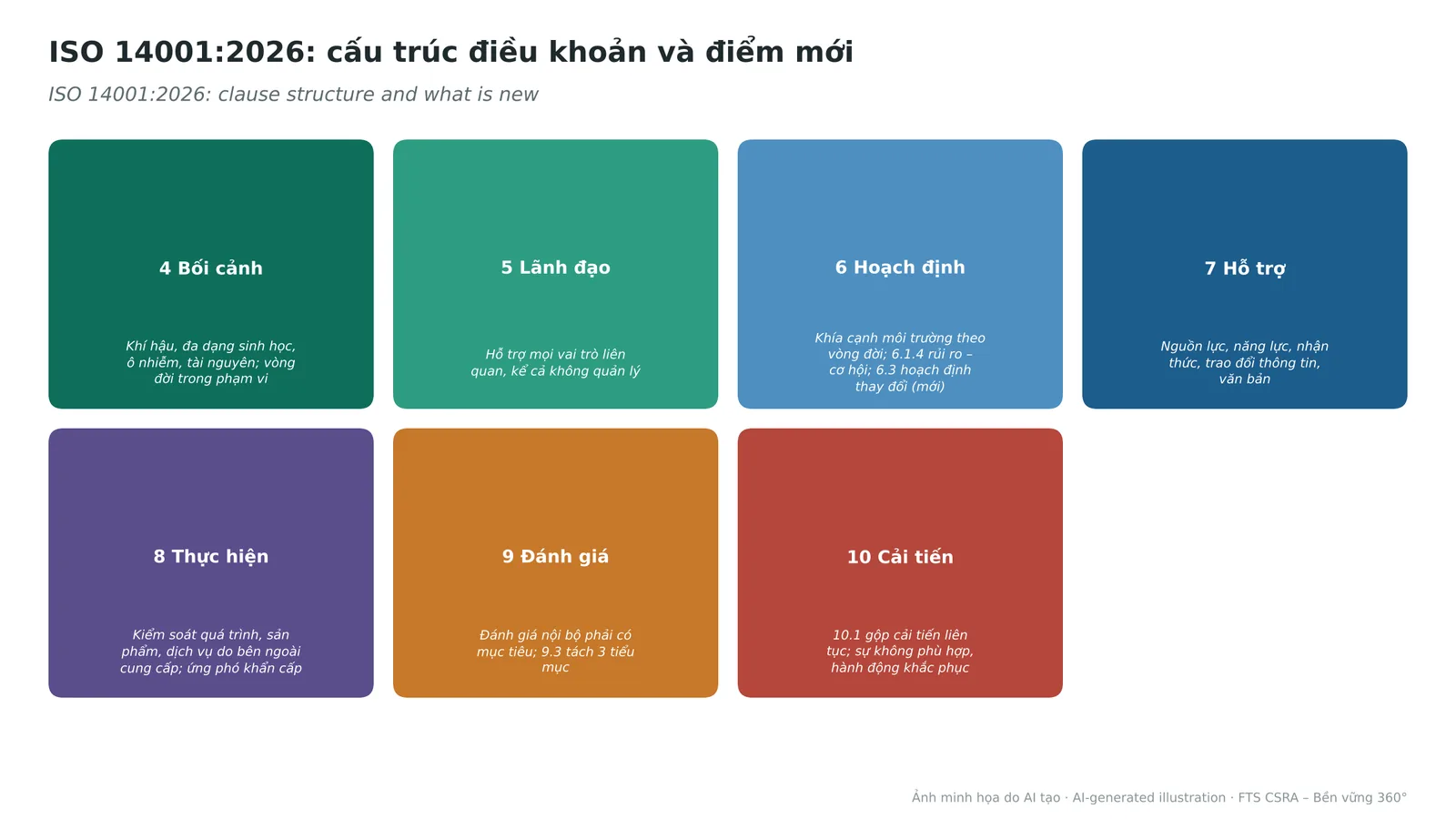
2.1. Clause-by-clause requirements and changes
| Clause | Title | Main requirements | What changed in 2026 |
|---|---|---|---|
| 4.1 | Understanding the organization and its context | Determine external and internal issues relevant to the purpose and intended outcomes, including environmental conditions affecting or affected by the organization | Explicitly lists climate change, biodiversity, ecosystem health, pollution, resource availability |
| 4.2 | Needs and expectations of interested parties | Determine relevant interested parties, their needs and expectations, and which become compliance obligations | Clarifies that environmental expectations become compliance obligations once adopted |
| 4.3 | Scope of the EMS | Determine boundaries and applicability considering activities, products, services, control and influence; documented | Emphasises life-cycle considerations in scoping |
| 4.4 | Environmental management system | Establish, implement, maintain and continually improve the EMS and its processes | No substantive change |
| 5.1 | Leadership and commitment | Top management is accountable for effectiveness; integrates EMS into business processes; ensures resources; communicates; supports other roles | Supports all relevant roles, not only management roles |
| 5.2 | Environmental policy | Appropriate to context; framework for objectives; commitments to protect the environment (incl. pollution prevention), fulfil compliance obligations, continually improve | Keeps the three core commitments |
| 5.3 | Roles, responsibilities and authorities | Assign and communicate responsibility for conformity and reporting on performance | No substantive change |
| 6.1.1 | General (planning) | Establish processes needed to meet 6.1.2–6.1.4 | Becomes an introductory clause |
| 6.1.2 | Environmental aspects | Determine aspects and impacts the organization can control and influence, including abnormal and emergency conditions; determine significant aspects | Clearer life-cycle perspective; link to 8.2 |
| 6.1.3 | Compliance obligations | Determine and access compliance obligations and how they apply; documented | Linked to 4.2 |
| 6.1.4 | Risks and opportunities | Determine risks and opportunities related to aspects, compliance obligations and context; plan actions and evaluate effectiveness | Renamed (formerly “Planning action”); consolidates risk and opportunity requirements |
| 6.2 | Environmental objectives and planning to achieve them | Objectives consistent with policy, measurable, monitored, communicated, updated; define what, resources, who, when, how evaluated | No substantive change |
| 6.3 | Planning of changes | Changes to the EMS are carried out in a planned manner: purpose, consequences, resources, responsibilities | New clause, aligned with ISO 9001 and ISO 45001 |
| 7.1–7.3 | Resources, competence, awareness | Provide resources; ensure competence of persons affecting performance; awareness of policy, significant aspects, implications of nonconformity | No substantive change |
| 7.4 | Communication | Internal and external communication processes: what, when, with whom, how; reliable and consistent information | No substantive change |
| 7.5 | Documented information | Create, update and control documented information required by the standard and the organization | No substantive change |
| 8.1 | Operational planning and control | Operating criteria; control changes; control outsourced processes; environmental requirements in design and procurement; information on transport, use and end-of-life impacts | Broadened to “externally provided processes, products and services” |
| 8.2 | Emergency preparedness and response | Prepare, respond, periodically test, review after events, train | Linked to emergency aspects in 6.1.2 |
| 9.1 | Monitoring, measurement, analysis, evaluation; evaluation of compliance | Determine what, methods, criteria, timing; calibrated equipment; periodic evaluation of compliance | No substantive change |
| 9.2 | Internal audit | Planned audit programme; criteria and scope; objective auditors | 9.2.2 requires audit objectives |
| 9.3 | Management review | Periodic review of suitability, adequacy and effectiveness | Split into 9.3.1 General, 9.3.2 Inputs, 9.3.3 Results |
| 10.1 | Continual improvement | Continually improve suitability, adequacy and effectiveness to enhance environmental performance | Merges former “General” and “Continual improvement” |
| 10.2 | Nonconformity and corrective action | Control and correct, deal with consequences, find causes, prevent recurrence; retain records | No substantive change |
2.2. Mandatory documented information
| Information to maintain/retain | Clause |
|---|---|
| EMS scope | 4.3 |
| Environmental policy | 5.2 |
| Risks and opportunities and related processes | 6.1.1 |
| Aspects, impacts, significance criteria, significant aspects | 6.1.2 |
| Compliance obligations | 6.1.3 |
| Environmental objectives | 6.2 |
| Evidence of competence | 7.2 |
| Evidence of communication | 7.4 |
| Information to show processes are carried out as planned | 8.1 |
| Emergency response | 8.2 |
| Monitoring, measurement and evaluation results | 9.1.1 |
| Compliance evaluation results | 9.1.2 |
| Audit programme and results | 9.2 |
| Management review results | 9.3 |
| Nonconformities and corrective actions | 10.2 |
2.3. The life-cycle perspective
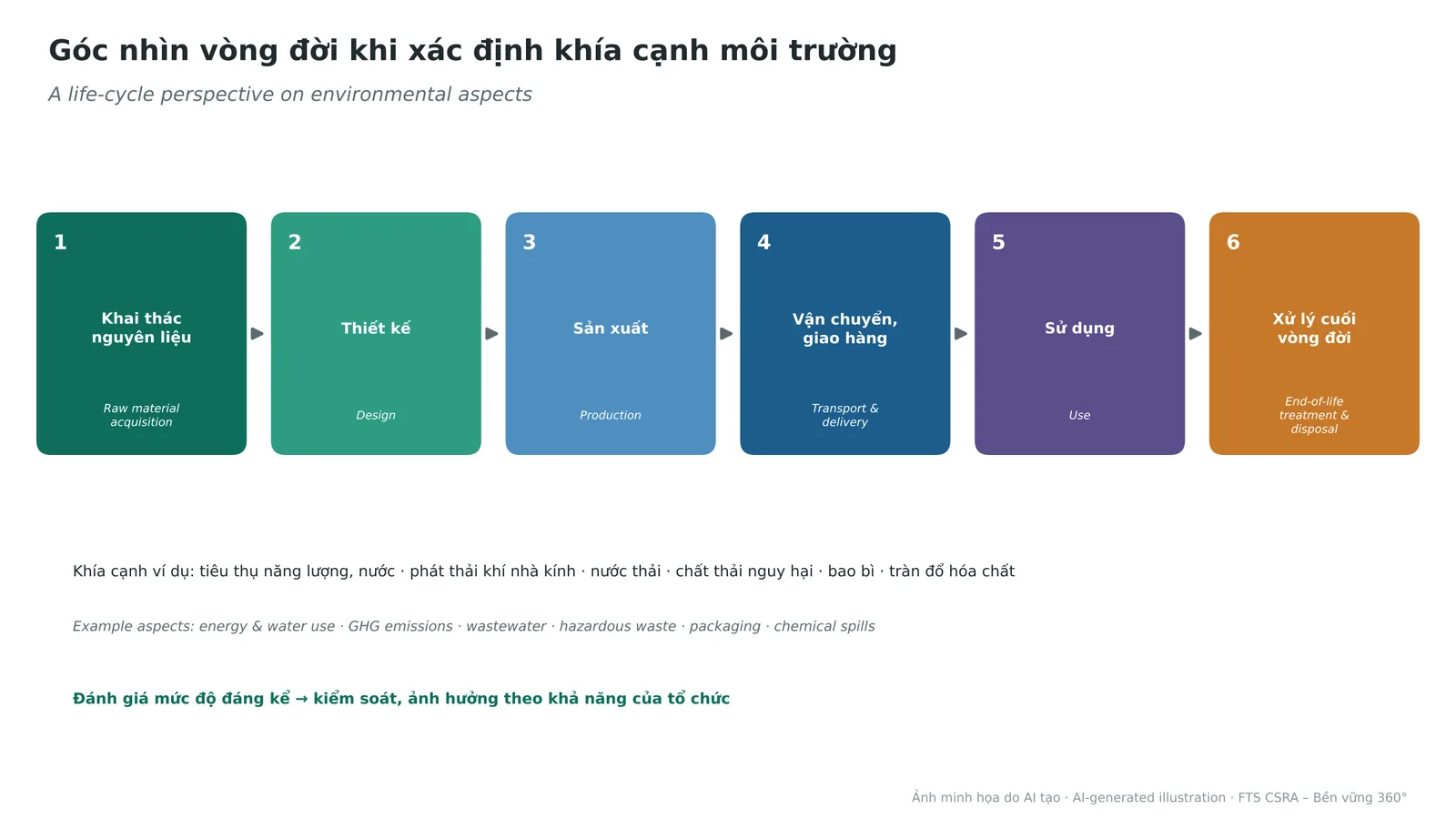
The standard does not require a detailed life-cycle assessment (LCA), but it does require organizations to consider the stages they control or influence: raw material acquisition, design, production, transport, use and end-of-life treatment. In the 2026 edition this perspective is explicit in scope (4.3), environmental aspects (6.1.2) and operational control (8.1).
Users and how to apply it
Users: manufacturers, industrial parks, hotels, hospitals, schools and service providers, especially exporters and suppliers to multinationals.
Transition path from 2015 to 2026
- Buy the new standard and train internal auditors on the changes.
- Gap analysis: update context (4.1) with climate, biodiversity, pollution and resources; revisit interested parties (4.2).
- Update the aspects register with a life-cycle perspective; consolidate risks and opportunities in 6.1.4.
- Set up a planning-of-changes procedure (6.3); extend control to externally provided processes, products and services (8.1).
- Add objectives to the internal audit programme; restructure management review records under 9.3.1–9.3.3.
- Run an internal audit and management review, then book a transition audit with the certification body.
Suggested environmental indicators (clause 9.1)
| Area | Indicator | Unit |
|---|---|---|
| Energy | Electricity and fuel use; energy intensity | kWh, GJ; kWh/tonne |
| GHG | Scope 1, 2 (and 3) emissions | tCO₂e; tCO₂e/revenue |
| Water | Withdrawal, reuse; compliant wastewater | m³; % recycled; % samples meeting QCVN |
| Waste | General and hazardous waste; recycling rate | tonnes; % recycled |
| Air, noise | Monitoring of dust, SO₂, NOx, noise | % parameters meeting QCVN |
| Chemicals | Hazardous chemicals used; spills | kg; number of incidents |
| Compliance | Environmental violations and fines | cases; VND |
| System | Objectives achieved; NCs closed on time | % |
Practical example
Hypothetical case: Seafood processor T in Cà Mau (800 workers) holds ISO 14001:2015 and is preparing to move to the 2026 edition.
| Clause | Before | After the update |
|---|---|---|
| 4.1 Context | Only legal wastewater requirements | Adds saline intrusion, sea-level rise and mangrove loss risks |
| 6.1.2 Aspects | Factory only | Adds shrimp farming by supplier households (feed, antibiotics), foam packaging, cold-chain transport |
| 6.1.4 Risks and opportunities | Separate risk table | Consolidated: freshwater shortage risk; opportunity to sell to buyers requiring ASC certification |
| 6.3 Changes | No procedure | Every line change is screened for environmental impact before roll-out |
| 9.1 Indicators | Wastewater meets QCVN 11-MT:2015/BTNMT | Adds m³ water/tonne, tCO₂e/tonne, % recyclable packaging |
Notes for use in Vietnam
- ISO 14001 does not replace legal duties: the 2020 Law on Environmental Protection, Decree 08/2022/ND-CP (as amended), environmental permits, periodic monitoring and annual environmental protection reports still apply; ISO 14001 helps manage compliance systematically.
- GHG inventories: companies listed under Decree 06/2022/ND-CP (amended by Decree 119/2025/ND-CP) should feed inventory data into clause 9.1 to avoid duplicate work.
- National standard: TCVN ISO 14001:2015 is still in use; update normative references once Vietnam adopts the 2026 edition.
- Choose an accredited certification body (accredited by BoA or another IAF member) so certificates are accepted by international buyers.
- Avoid a “paper system”: buyers and banks increasingly ask for real results (how much energy, water and waste were reduced), not just the certificate.
Method & scope
Content compiled and interpreted from FTS Impact Lab and documents of the issuing body; versions and sources should be verified before publication.
References
- ISO – ISO 14001 Environmental management systems (overview) ↗ (accessed 2026-10-25)
- TCVN ISO 14001:2015 (Vietnamese national standard) (accessed 2026-10-25)
- Law on Environmental Protection No. 72/2020/QH14; Decree 08/2022/ND-CP (accessed 2026-10-25)