OECD Due Diligence – Responsible business due diligence
European and Japanese buyers increasingly ask Vietnamese companies one question: “Have you carried out due diligence on your supply chain?” On Sustainability 360° (Bền vững 360°), FTS CSRA experts break down the OECD Due Diligence Guidance: the six steps and their specific actions, the eight characteristics of due diligence, the cause–contribute–linked logic and how Vietnamese suppliers can apply it.
Hướng dẫn Thẩm định của OECD về Kinh doanh có trách nhiệm
English name
OECD Due Diligence Guidance for Responsible Business Conduct
Issuer/custodian
Organisation for Economic Co-operation and Development (OECD), Working Party on Responsible Business Conduct; adopted through a Recommendation of the OECD Council in 2018.
Nature
Non-binding practical guidance explaining risk-based due diligence in six steps, with an annex of detailed explanations and FAQs.
Reference scope
All enterprises, sectors and sizes; covers the topics of the OECD Guidelines for Multinational Enterprises: human rights, labour, environment, bribery, consumers and disclosure.
Due diligence is the process through which enterprises identify, prevent, mitigate and account for how they address actual and potential adverse impacts in their own operations, supply chains and business relationships. The concept appeared in the UN Guiding Principles on Business and Human Rights (2011), was built into the OECD Guidelines for Multinational Enterprises in 2011 and turned into general guidance in 2018. The 2023 OECD Guidelines update extends due diligence expectations to climate, biodiversity, technology and data.
The guidance now underpins many regulations: the EU Conflict Minerals Regulation (2017/821), the EU Deforestation Regulation, Germany's Supply Chain Act (LkSG), Norway's Transparency Act, the EU Corporate Sustainability Due Diligence Directive (CSDDD) and Japan's Guidelines on Respecting Human Rights in Responsible Supply Chains (2022).
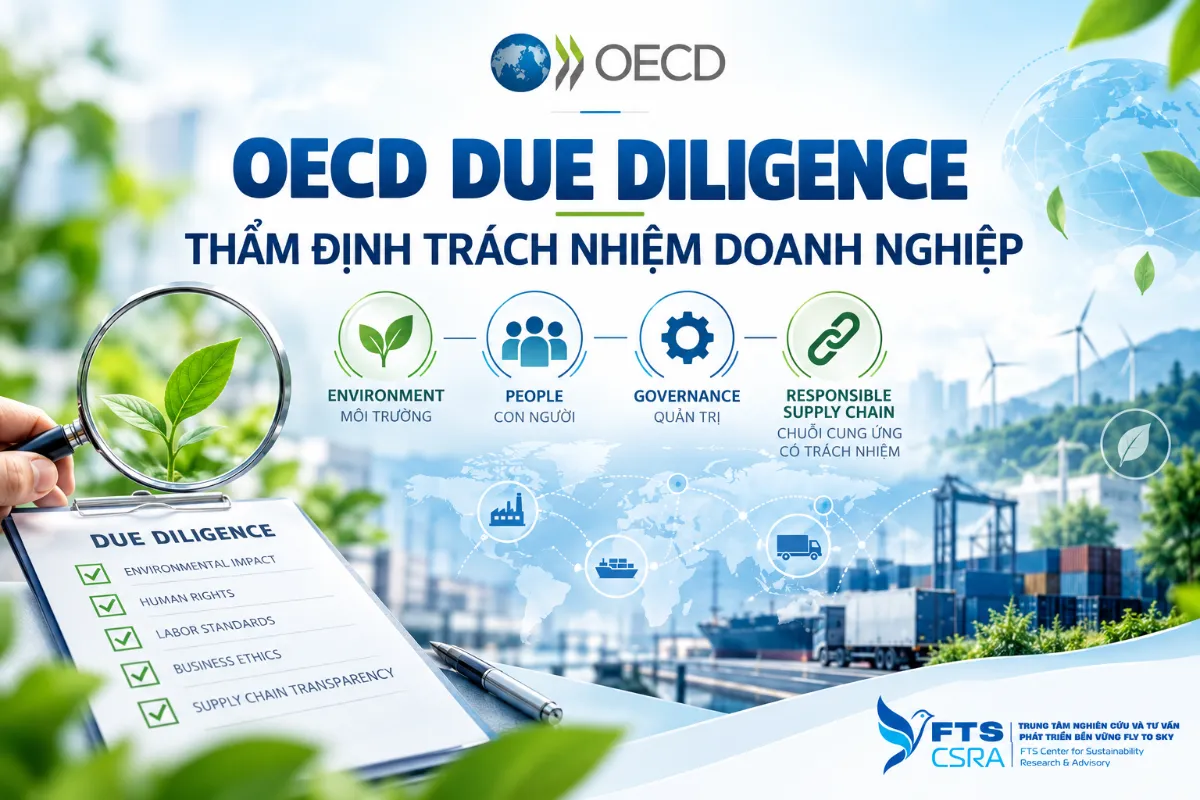
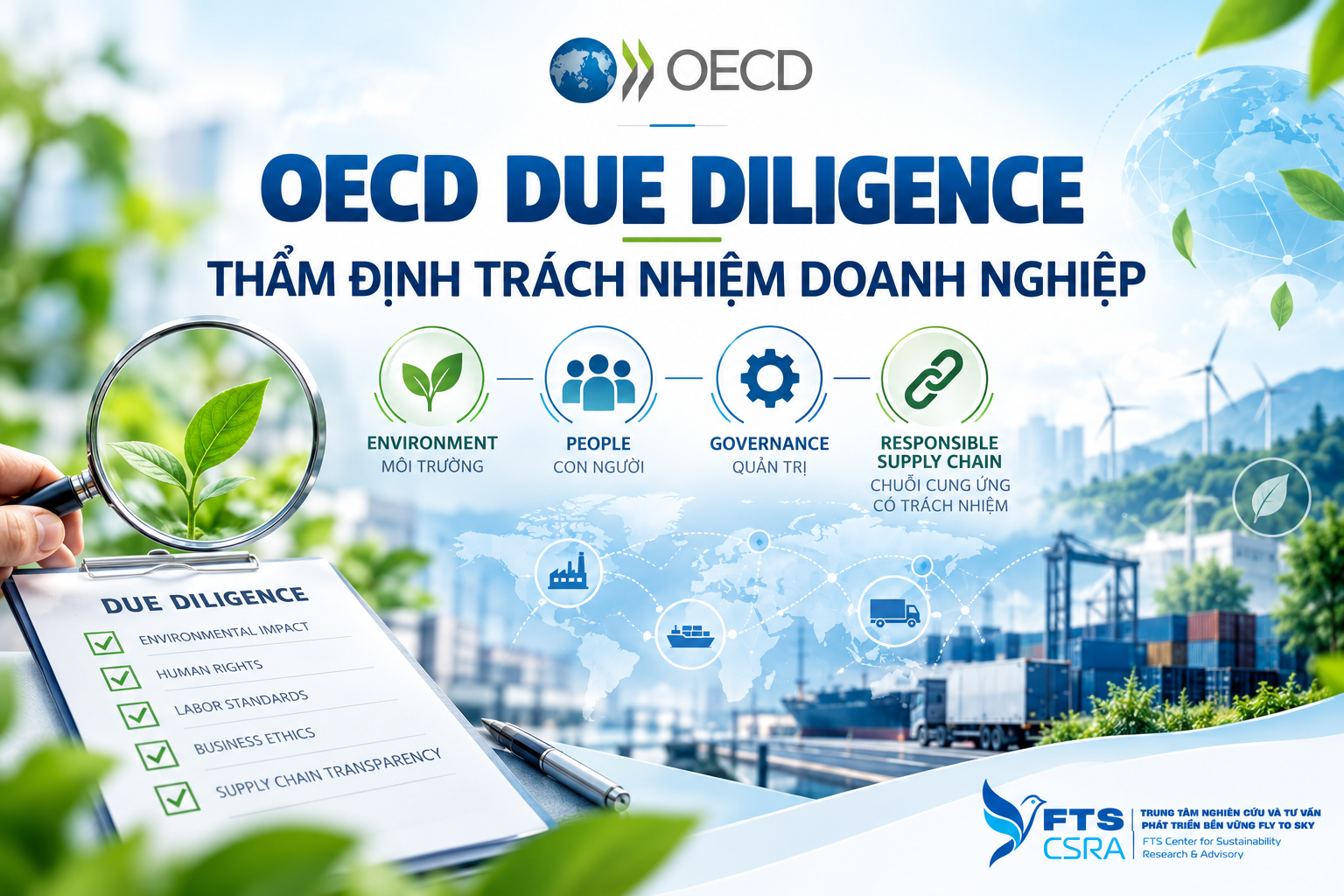
OECD Due Diligence – Thẩm định trách nhiệm doanh nghiệp · Ảnh: FTS CSRA
Purpose and main structure
Purpose: help enterprises avoid causing or contributing to adverse impacts, address impacts directly linked to their products and services through business relationships, and create a common language among business, investors and governments. The guidance has two parts: (I) the six-step framework and (II) an annex explaining and illustrating each action.
2.1. Six steps and specific actions
Step
Element
Specific actions in the Guidance
Evidence to keep
1
Embed responsible business conduct into policies and management systems
1.1 Devise, adopt and disseminate RBC policies (human rights, labour, environment, bribery, consumers, disclosure) and plans for implementing due diligence · 1.2 Embed policies in the oversight bodies (board), assign responsibility to senior management, functions and staff; align incentives · 1.3 Incorporate RBC expectations into engagement with suppliers and business relationships (codes, contract terms, selection criteria, capacity building).
Board-approved public policy; responsibility matrix; supplier code; contract clauses
2
Identify and assess actual and potential adverse impacts
2.1 Carry out a broad scoping exercise across operations and business relationships to identify high-risk areas (sector, geography, product, enterprise) · 2.2 Carry out iterative in-depth assessments of prioritised areas, starting where impacts are most severe and likely · 2.3 Assess involvement: cause, contribute or directly linked · 2.4 Prioritise by severity (scale, scope, irremediable character) and likelihood.
3.1 Stop activities that cause or contribute to impacts; develop and implement plans to prevent and mitigate potential impacts · 3.2 For impacts linked through business relationships: corrective action plans, use or build leverage, including collaborative approaches · 3.3 Consider temporary suspension or disengagement as a last resort after failed mitigation or where impacts are too severe; weigh the social and economic effects of responsible exit.
4.1 Track implementation and effectiveness with qualitative and quantitative indicators; periodic reviews and independent verification where appropriate · 4.2 Consult affected stakeholders and rightsholders to confirm results · 4.3 Feed lessons learned into future due diligence.
5.1 Publicly communicate policies, due diligence processes, identified impacts and risks, actions and outcomes, updated regularly (at least annually) · 5.2 Communicate with affected stakeholders in an accessible way, especially when they raise concerns · 5.3 Take into account commercial confidentiality and the safety of informants.
Annual sustainability/due diligence report; written responses to complainants
6
Provide for or cooperate in remediation when appropriate
6.1 Where the enterprise caused or contributed: provide for or cooperate in remediation (apology, compensation, restitution, guarantees of non-repetition…) commensurate with the impact · 6.2 Establish or participate in legitimate operational-level grievance mechanisms; cooperate with state-based and non-state mechanisms (e.g. National Contact Points).
Grievance mechanism and case log; remediation agreements
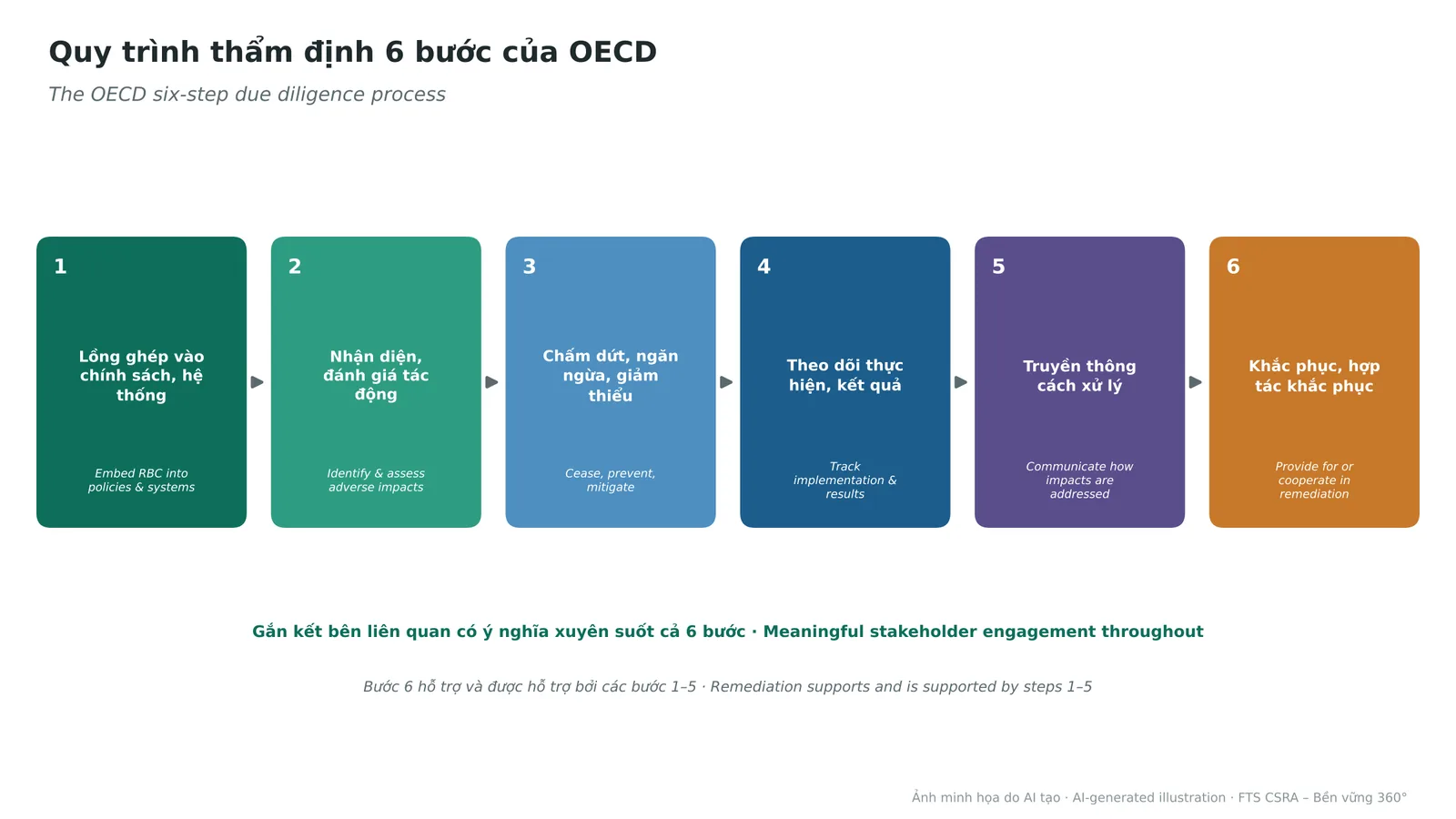
Figure 1. The six OECD due diligence steps; stakeholder engagement runs throughout and remediation supports the rest. (AI-generated image) / Hình 1. The six OECD due diligence steps; stakeholder engagement runs throughout and remediation supports the rest. (Ảnh do AI tạo)
2.2. Eight characteristics of due diligence
Characteristic
What it requires
Risk-based
Effort is commensurate with the severity and likelihood of the impact
Preventive
The primary aim is to avoid causing or contributing; remediation complements it
Informed by meaningful stakeholder engagement
Two-way, good-faith, timely engagement with workers, communities, unions and rightsholders
Ongoing, iterative
Not a one-off; repeated when circumstances change (new markets, products, partners)
Tailored
Adapted to size, sector and context; SMEs may apply it more simply
Does not shift responsibilities
Each enterprise retains responsibility even when using industry schemes or third parties
Concerns internationally recognised standards
Refers to international standards where domestic law is weaker or absent
Prioritisation
Where all risks cannot be addressed at once, prioritise the most severe
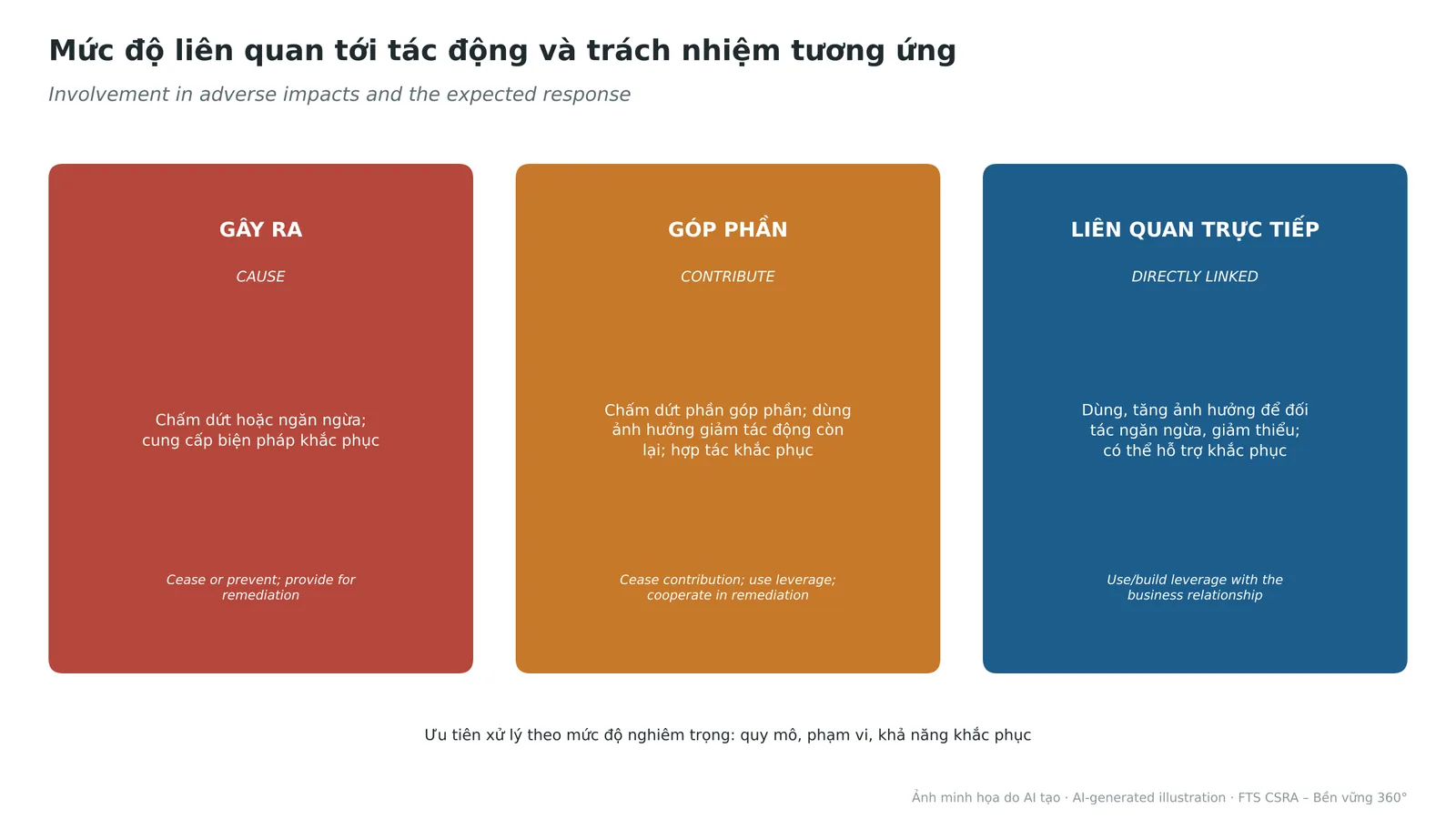
2.3. Involvement in impacts
Involvement
Definition
What the enterprise should do
Cause
The enterprise's activities on their own are sufficient to result in the impact
Cease or prevent; provide for remediation
Contribute
The enterprise's activities, together with those of others, cause the impact, or facilitate or incentivise another entity to cause it (e.g. last-minute orders or price pressure forcing excessive overtime)
Cease the contribution; use leverage to mitigate the rest; cooperate in remediation
Directly linked
The impact is caused by a business relationship but linked to the enterprise's products, services or operations
Use or build leverage so the relationship prevents or mitigates; remediation not required but may be supported
Figure 2. Three levels of involvement in adverse impacts and the corresponding responsibility. (AI-generated image) / Hình 2. Three levels of involvement in adverse impacts and the corresponding responsibility. (Ảnh do AI tạo)
2.4. Impact topics to screen
Topic (OECD Guidelines chapter)
Adverse impacts to screen
Human rights (IV)
Discrimination, privacy, rights of communities and indigenous peoples, human rights defenders, security and use of force
Employment and industrial relations (V)
Child labour, forced labour, freedom of association and collective bargaining, living wage, working time, OSH, harassment
Users: exporters (garments, footwear, furniture, agri-food, seafood, electronics), FDI companies, banks, investment funds, and SMEs in multinational supply chains.
Adopt a responsible business conduct policy and assign a senior executive to own it (step 1).
Map the supply chain at least to tier-1 suppliers, then extend to high-risk raw materials (cotton, timber, coffee, minerals).
Screen sector and country risks using public data (OECD, ILO, industry reports), then assess priority suppliers in depth (step 2).
Build time-bound action plans and support supplier capacity rather than simply cutting contracts (step 3).
Track with indicators and re-assessments; publish an annual report (steps 4–5).
Set up grievance channels for workers and communities, including in the supply chain (step 6).
Suggested tracking indicators
Step
Indicator
Unit
1
Share of tier-1 suppliers that have signed the code of conduct
% by number and spend
2
Share of procurement spend screened for risk
%
2
Number of severe risks identified, by topic
count
3
Share of corrective action plans completed on time
%
4
Share of priority suppliers re-assessed in the year
%
5
Due diligence report published
yes/no, date
6
Grievances received and share resolved within the committed timeframe
count, %
Practical example
Hypothetical case: Garment company M (1,200 workers, exporting to the EU) is asked by a brand to demonstrate due diligence on its fabric and cotton supply chain.
Step
Action taken
Result
1
Board adopts a policy; compliance director in charge; labour and environmental clauses added to 45 supplier contracts
100% of tier-1 suppliers sign the code
2
Screening with the garment sector guidance: high risk at subcontracted embroidery units (overtime) and cotton sources with forced-labour risk
3 priority risks
3
Order planning adjusted to reduce rush orders (ending the contribution); cotton traceability documents required; embroidery unit helped to set up time recording
Overtime at the unit falls from 80 to 40 hours/month
4–5
Re-assessment after 6 months; due diligence report published online
First report issued
6
Multilingual hotline for subcontractor workers
12 cases raised, 11 resolved
Notes for use in Vietnam
Vietnam has not adhered to the OECD Declaration on International Investment, so there is no National Contact Point; companies still face due diligence requirements through buyer contracts and import-market regulations.
National Action Plan: Decision 843/QĐ-TTg of 14 July 2023 approved the National Action Plan on improving policy and law to promote responsible business practices for 2023–2027, directly referencing the UN Guiding Principles.
Cross-check with domestic law: the 2019 Labour Code, the 2015 Law on Occupational Safety and Health, the 2020 Law on Environmental Protection, the 2018 Anti-Corruption Law and Decree 13/2023/ND-CP on personal data protection set the minimum; the OECD guidance also asks companies to refer to international standards.
EU pressure: the CSDDD has been narrowed by the Omnibus I Directive (EU) 2026/470 (companies with over 5,000 employees and €1.5 billion turnover), but those groups still request data from Vietnamese suppliers.
SMEs: prioritise the most severe risks and use shared industry tools and assessments to cut costs, without shifting responsibility.
Method & scope
Content compiled and interpreted from FTS Impact Lab and documents of the issuing body; versions and sources should be verified before publication.
ISO 14001:2026 has formally replaced the 2015 edition, placing climate change, biodiversity and a life-cycle perspective at the heart of environmental management. On Sustainability 360° (Bền vững 360°), FTS CSRA experts walk through clauses 4–10, highlight what is new, list the mandatory documented information, suggest environmental indicators and set out a transition path for Vietnamese companies.
After climate, nature is the next “asset” investors want companies to measure. On Sustainability 360° (Bền vững 360°), FTS CSRA experts explain the TNFD recommendations: 14 recommended disclosures, the 16 components of the LEAP approach, the core global disclosure metrics and how Vietnamese agriculture, seafood and extractive companies can get started.
Every “tonne of CO₂ equivalent” in a sustainability report needs a common method, and that method is the GHG Protocol. On Sustainability 360° (Bền vững 360°), FTS CSRA experts present the five accounting principles, the three emission scopes, all 15 Scope 3 categories, the mandatory reporting elements, the status of the standards revision and how it links to Vietnam's GHG inventory obligations.
In 2026 Europe narrowed the scope of the CSRD and adopted a leaner revised ESRS, yet EU groups still need data from Vietnamese suppliers. On Sustainability 360° (Bền vững 360°), FTS CSRA experts present the 12-standard ESRS architecture, every disclosure requirement by code, double materiality, the Omnibus and 2026 revision changes and how Vietnamese companies can prepare.
A bank does not need to report wastewater like a dye house, and SASB is the standard that answers “what should my industry disclose?”. On Sustainability 360° (Bền vững 360°), FTS CSRA experts list all 77 industries across 11 sectors, the 26 general issue categories, how to read metric codes and the full metric sets for two industries key to Vietnam: apparel and footwear, and commercial banks.
IFRS S1 and IFRS S2 are becoming the “common language” of investor-focused sustainability disclosure in more than 40 jurisdictions. On Sustainability 360° (Bền vững 360°), FTS CSRA experts set out the full requirements of the four pillars, eight general requirements, seven cross-industry climate metric categories, first-year reliefs, the December 2025 IFRS S2 amendments and how Vietnamese companies can prepare before any mandatory roadmap.
B Corp certification has changed the rules: no more scoring 80 points on a questionnaire; companies must now meet mandatory requirements in each impact topic. On Sustainability 360° (Bền vững 360°), FTS CSRA experts analyse B Lab Standards V2: the Foundation Requirements, seven Impact Topics with specific requirements, the Year 0 – Year 3 – Year 5 pathway and what Vietnamese companies and social enterprises should know before applying.
Every supply chain due diligence rule today, from the OECD to Germany's Supply Chain Act and the EU CSDDD, traces back to 31 concise UN principles. On Sustainability 360° (Bền vững 360°), FTS CSRA experts present all 31 Guiding Principles on Business and Human Rights under the three “Protect, Respect and Remedy” pillars, the eight effectiveness criteria for grievance mechanisms and how Vietnamese companies can apply them.