Every supply chain due diligence rule today, from the OECD to Germany's Supply Chain Act and the EU CSDDD, traces back to 31 concise UN principles. On Sustainability 360° (Bền vững 360°), FTS CSRA experts present all 31 Guiding Principles on Business and Human Rights under the three “Protect, Respect and Remedy” pillars, the eight effectiveness criteria for grievance mechanisms and how Vietnamese companies can apply them.
Các Nguyên tắc hướng dẫn của Liên Hợp Quốc về kinh doanh và quyền con người
English name
UN Guiding Principles on Business and Human Rights (UNGPs)
Issuer/custodian
Unanimously endorsed by the UN Human Rights Council on 16 June 2011 (Resolution 17/4); promoted by the UN Working Group on Business and Human Rights; guidance from the Office of the High Commissioner for Human Rights (OHCHR).
Nature
31 principles that create no new legal obligations but form the globally recognised standard of conduct; the basis of the OECD Guidelines, ISO 26000, GRI, ESRS and many due diligence laws.
Reference scope
All States and all business enterprises, transnational or domestic, regardless of size, sector, location, ownership and structure.
The UNGPs result from six years of work by Professor John Ruggie, UN Special Representative of the Secretary-General (2005–2011), building on the “Protect, Respect and Remedy” framework welcomed by the Human Rights Council in 2008. Since 2011 they have been integrated into the OECD Guidelines, World Bank and IFC policies, and binding laws such as France's Duty of Vigilance Law (2017), Germany's Supply Chain Act (2023) and the EU CSDDD (2024, narrowed in 2026). The “UNGPs 10+” project (2021) set a roadmap for the second decade.
UNGP – Doanh nghiệp và quyền con người · Ảnh: FTS CSRA
Purpose and main structure
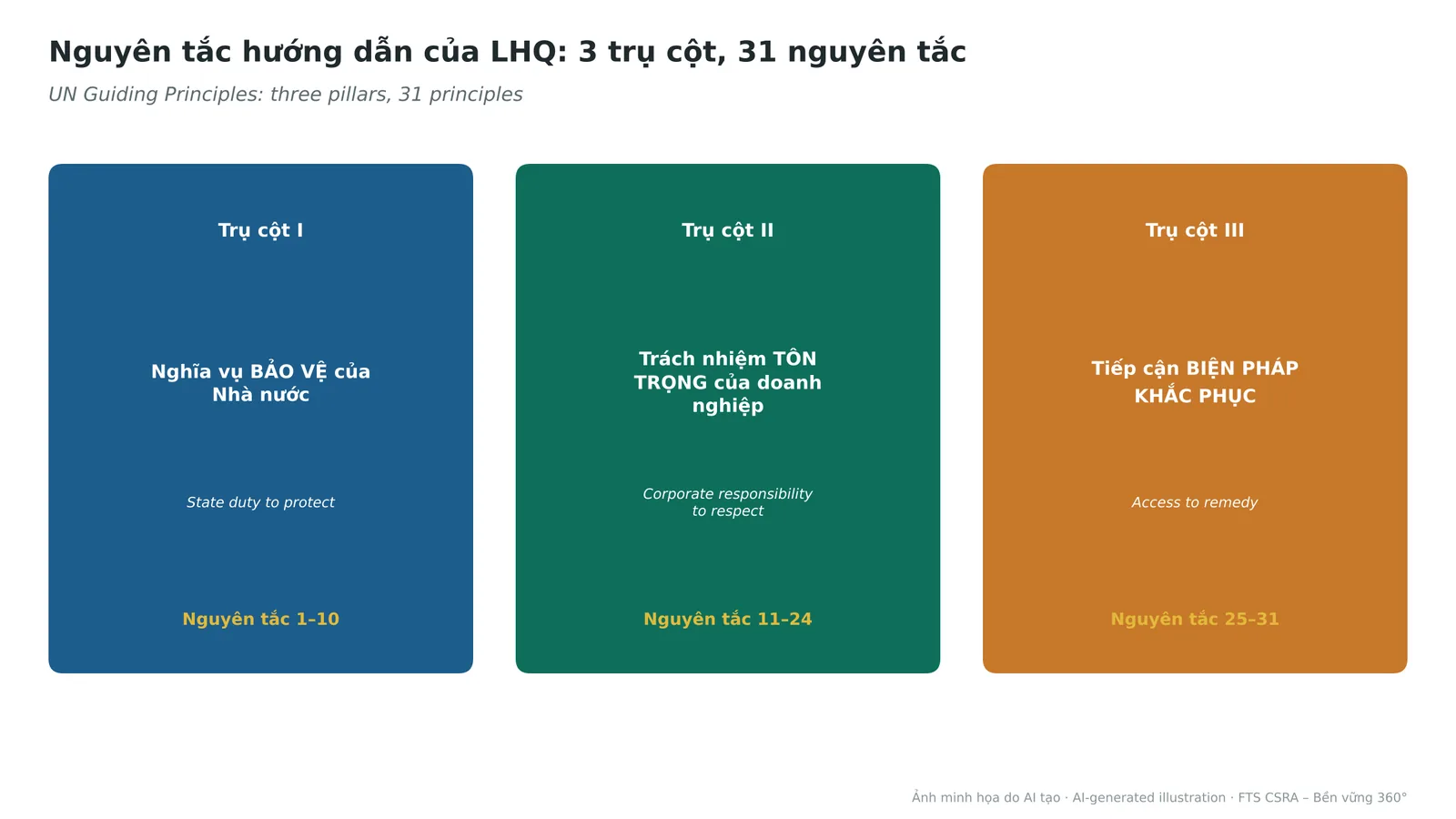
Purpose: enhance standards and practices on business and human rights to achieve tangible results for affected individuals and communities. The 31 principles are grouped into three pillars, each with foundational and operational principles and official commentary.
Figure 1. The three UNGP pillars: state duty to protect, corporate responsibility to respect, access to remedy. (AI-generated image) / Hình 1. The three UNGP pillars: state duty to protect, corporate responsibility to respect, access to remedy. (Ảnh do AI tạo)
2.1. Pillar I – The state duty to protect human rights (Principles 1–10)
No.
Group
Content
1
Foundational
States must protect against human rights abuse within their territory and/or jurisdiction by third parties, including business, through effective policies, legislation, regulation and adjudication
2
Foundational
States should set out clearly the expectation that businesses domiciled in their territory respect human rights throughout their operations
3
Operational
Enforce laws requiring business to respect human rights; assess gaps; provide guidance; encourage business to communicate how they address impacts
4
Operational
Additional steps for state-owned or state-controlled businesses or those receiving substantial state support, including requiring human rights due diligence
5
Operational
Exercise adequate oversight when contracting with or legislating for businesses providing services that may impact human rights
6
Operational
Promote respect for human rights by businesses with which they conduct commercial transactions
7
Operational
Help ensure businesses operating in conflict-affected areas do not commit abuses
8
Operational
Ensure policy coherence across government departments that shape business practices
9
Operational
Maintain adequate domestic policy space when pursuing investment treaties or contracts
10
Operational
As members of multilateral institutions, promote business respect for human rights
2.2. Pillar II – The corporate responsibility to respect human rights (Principles 11–24)
No.
Group
Content
11
Foundational
Business enterprises should respect human rights: avoid infringing on the rights of others and address adverse impacts with which they are involved
12
Foundational
Refers to internationally recognised human rights – at a minimum the International Bill of Human Rights and the ILO Declaration on Fundamental Principles and Rights at Work
13
Foundational
Avoid causing or contributing to impacts through own activities; seek to prevent or mitigate impacts directly linked through business relationships
14
Foundational
Applies to all enterprises regardless of size, sector, context, ownership and structure; the scale of means varies with size and severity
15
Foundational
Enterprises should have: (a) a policy commitment; (b) a human rights due diligence process; (c) processes to enable remediation
16
Operational
Policy commitment: approved at the most senior level; informed by expertise; states expectations of personnel and partners; publicly available; embedded in policies and procedures
17
Operational
Human rights due diligence: assess actual and potential impacts, integrate and act, track, communicate. Covers impacts caused, contributed to or directly linked; varies with size and risk; ongoing
18
Operational
Assess impacts drawing on internal and/or independent human rights expertise and meaningful consultation with potentially affected groups
19
Operational
Integrate findings across functions and processes; assign responsibility, budget and oversight; act according to involvement and leverage
20
Operational
Track effectiveness using qualitative and quantitative indicators and feedback from internal and external sources, including affected stakeholders
21
Operational
Communicate externally how impacts are addressed, especially when concerns are raised; enterprises with severe risks should report formally
22
Operational
Where enterprises have caused or contributed to adverse impacts, they should provide for or cooperate in remediation through legitimate processes
23
Issues of context
Comply with laws and respect international human rights wherever operating; seek ways to honour principles when facing conflicting requirements; treat the risk of gross abuses as a legal compliance issue
24
Issues of context
Where prioritisation is necessary, address first the most severe impacts or those where delayed response would make them irremediable
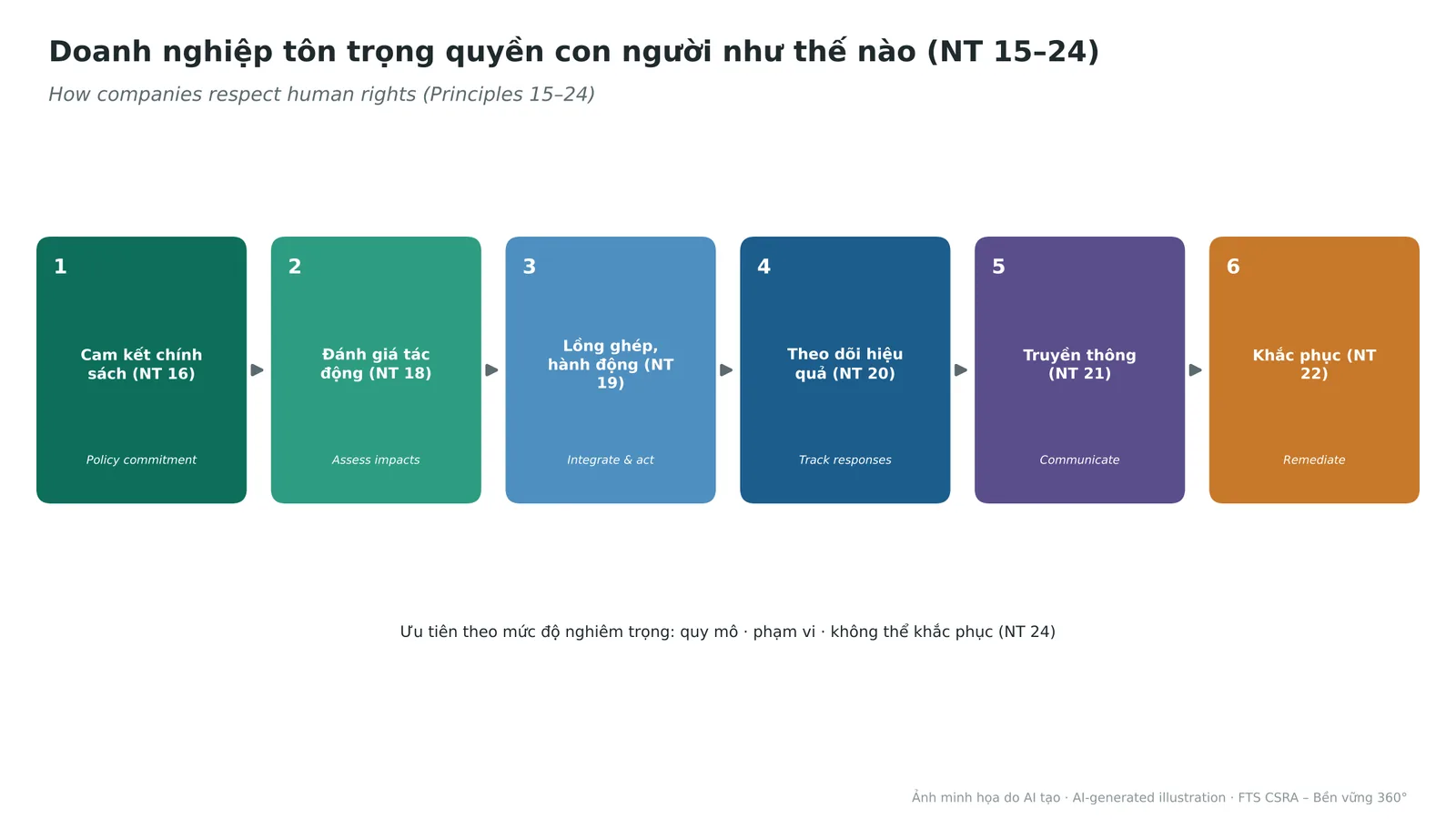
Figure 2. How companies respect human rights under Principles 15–24. (AI-generated image) / Hình 2. How companies respect human rights under Principles 15–24. (Ảnh do AI tạo)
2.3. Pillar III – Access to remedy (Principles 25–31)
No.
Group
Content
25
Foundational
States must ensure access to effective remedy through judicial, administrative, legislative or other appropriate means
26
State-based mechanisms
State-based judicial mechanisms: ensure effectiveness and reduce legal, practical and other barriers
27
State-based mechanisms
Effective and appropriate non-judicial state-based grievance mechanisms (labour inspection, mediation, national human rights institutions, OECD NCPs)
28
Non-state / operational-level
States should facilitate access to effective non-state-based grievance mechanisms
29
Non-state / operational-level
Business enterprises should establish or participate in operational-level grievance mechanisms for individuals and communities who may be adversely impacted
30
Non-state / operational-level
Industry and multi-stakeholder initiatives based on human rights standards should ensure effective grievance mechanisms
31
Non-state / operational-level
Non-judicial grievance mechanisms should meet eight effectiveness criteria (see table below)
2.4. Eight effectiveness criteria for grievance mechanisms (Principle 31)
Criterion
Meaning
Legitimate
Enables trust of users; accountable for fair conduct
Accessible
Known to all intended users; assistance for those facing barriers (language, literacy, cost, location, fear of reprisal)
Predictable
Clear procedure with indicative timeframes, types of outcome and means of monitoring
Equitable
Aggrieved parties have reasonable access to information, advice and expertise
Transparent
Keep parties informed of progress; provide sufficient information to build confidence
Rights-compatible
Outcomes and remedies accord with internationally recognised human rights
Source of continuous learning
Draw lessons to improve the mechanism and prevent future harm
Based on engagement and dialogue (operational level)
Consult user groups on design and performance; focus on dialogue to resolve grievances
2.5. Minimum rights to consider
Under Principle 12: the International Bill of Human Rights (the 1948 Universal Declaration, the Covenant on Civil and Political Rights and the Covenant on Economic, Social and Cultural Rights) and the eight ILO core conventions under the 1998 Declaration (freedom of association and collective bargaining; elimination of forced labour; abolition of child labour; non-discrimination in employment). Since 2022 the ILO has added a safe and healthy working environment as a fifth fundamental principle (C155, C187).
Users and how to apply it
Users: all companies; especially exporters, FDI companies, banks, and real estate, energy, mining and agriculture companies affecting land and communities.
Adopt a board-approved, public human rights policy commitment (Principle 16).
Identify salient human rights issues: rights at risk of the most severe impact, prioritised by scale, scope and remediability (Principle 24).
Assess impacts with worker and community consultation (Principle 18); integrate findings into procurement, HR and operations (Principle 19).
Track with indicators and feedback (Principle 20); report using the UNGP Reporting Framework, GRI or ESRS (Principle 21).
Set up operational-level grievance mechanisms meeting the eight criteria (Principles 29, 31); remediate where you caused or contributed (Principle 22).
Suggested tracking indicators
Indicator
Related principles
Board-approved, public human rights policy in place
Principle 16
Number of salient issues identified; date of last review
Principles 17, 18, 24
% of high-risk suppliers assessed on human rights
Principles 17–19
% of procurement staff and managers trained on human rights
Principles 16, 19
Grievances received, % resolved on time, % of complainants satisfied
Principles 20, 29, 31
Number of cases remediated and forms of remedy
Principle 22
Practical example
Hypothetical case: Solar developer S builds a 200 MW project in Ninh Thuận, on land farmed by Cham communities.
Step
Action
Result
Commitment (P16)
Human rights policy referencing the UNGPs, applied to EPC contractors
Included in 5 contractor agreements
Assessment (P18)
Consultation with 320 households, with interpreters and separate women's meetings
Salient issues: livelihoods, water access, construction site safety
Action (P19)
Livelihood support, preserved access to spiritual sites, subcontractor working-hour checks
100% of households losing land have livelihood plans
Grievance (P29, P31)
Channels via village heads and a hotline in Vietnamese and Cham
28 cases, 26 resolved within 30 days
Notes for use in Vietnam
National Action Plan: Decision 843/QĐ-TTg of 14 July 2023 approved the National Action Plan on improving policy and law to promote responsible business practices for 2023–2027 – Vietnam is the seventh Asian country with such a plan; the Ministry of Justice is the focal point.
Related legal framework: the 2013 Constitution (Chapter II), the 2019 Labour Code, the 2024 Land Law (recovery, compensation, resettlement), the 2020 Law on Environmental Protection and Decree 13/2023/ND-CP on personal data protection.
Vietnam has ratified seven of the eight original ILO core conventions (most recently Convention 98 in 2019 and Convention 105 in 2020) plus Conventions 155 and 187 on occupational safety and health; Convention 87 on freedom of association is not yet ratified – relevant when buyers ask about worker representation.
Cultural context: grievance mechanisms should fit the languages and customs of ethnic minority communities; coordinate with commune authorities while protecting complainants from reprisal.
Method & scope
Content compiled and interpreted from FTS Impact Lab and documents of the issuing body; versions and sources should be verified before publication.
European and Japanese buyers increasingly ask Vietnamese companies one question: “Have you carried out due diligence on your supply chain?” On Sustainability 360° (Bền vững 360°), FTS CSRA experts break down the OECD Due Diligence Guidance: the six steps and their specific actions, the eight characteristics of due diligence, the cause–contribute–linked logic and how Vietnamese suppliers can apply it.
ISO 14001:2026 has formally replaced the 2015 edition, placing climate change, biodiversity and a life-cycle perspective at the heart of environmental management. On Sustainability 360° (Bền vững 360°), FTS CSRA experts walk through clauses 4–10, highlight what is new, list the mandatory documented information, suggest environmental indicators and set out a transition path for Vietnamese companies.
After climate, nature is the next “asset” investors want companies to measure. On Sustainability 360° (Bền vững 360°), FTS CSRA experts explain the TNFD recommendations: 14 recommended disclosures, the 16 components of the LEAP approach, the core global disclosure metrics and how Vietnamese agriculture, seafood and extractive companies can get started.
Every “tonne of CO₂ equivalent” in a sustainability report needs a common method, and that method is the GHG Protocol. On Sustainability 360° (Bền vững 360°), FTS CSRA experts present the five accounting principles, the three emission scopes, all 15 Scope 3 categories, the mandatory reporting elements, the status of the standards revision and how it links to Vietnam's GHG inventory obligations.
In 2026 Europe narrowed the scope of the CSRD and adopted a leaner revised ESRS, yet EU groups still need data from Vietnamese suppliers. On Sustainability 360° (Bền vững 360°), FTS CSRA experts present the 12-standard ESRS architecture, every disclosure requirement by code, double materiality, the Omnibus and 2026 revision changes and how Vietnamese companies can prepare.
A bank does not need to report wastewater like a dye house, and SASB is the standard that answers “what should my industry disclose?”. On Sustainability 360° (Bền vững 360°), FTS CSRA experts list all 77 industries across 11 sectors, the 26 general issue categories, how to read metric codes and the full metric sets for two industries key to Vietnam: apparel and footwear, and commercial banks.
IFRS S1 and IFRS S2 are becoming the “common language” of investor-focused sustainability disclosure in more than 40 jurisdictions. On Sustainability 360° (Bền vững 360°), FTS CSRA experts set out the full requirements of the four pillars, eight general requirements, seven cross-industry climate metric categories, first-year reliefs, the December 2025 IFRS S2 amendments and how Vietnamese companies can prepare before any mandatory roadmap.
B Corp certification has changed the rules: no more scoring 80 points on a questionnaire; companies must now meet mandatory requirements in each impact topic. On Sustainability 360° (Bền vững 360°), FTS CSRA experts analyse B Lab Standards V2: the Foundation Requirements, seven Impact Topics with specific requirements, the Year 0 – Year 3 – Year 5 pathway and what Vietnamese companies and social enterprises should know before applying.