Contents
Overview and origin
| Item | Details |
|---|---|
| Vietnamese name | Bộ tiêu chuẩn B Lab phiên bản 2 cho chứng nhận B Corp |
| English name | B Lab Standards V2 for B Corp Certification |
| Issuer/custodian | B Lab Global – a non-profit founded in 2006 in the US, with regional B Lab networks; standards overseen by an independent Standards Board. |
| Nature | A set of mandatory requirements for B Corp certification: Foundation Requirements + seven Impact Topics, differentiated by size and sector and met over a pathway. |
| Reference scope | For-profit companies of any size, sector and country. The network has more than 9,000 B Corps in over 100 countries. |
Previously, B Corp relied on the B Impact Assessment (BIA) – a scored questionnaire across five areas (Governance, Workers, Community, Environment, Customers) requiring at least 80 of 200 points. Critics noted that companies could “offset” weak areas with strong ones. After two consultations (2022 and 2024), B Lab published Standards V2 in 2025: mandatory minimum requirements in every topic, with no point offsetting. From 2026, new certifications use V2; existing B Corps move to V2 at recertification under B Lab's timeline. The BIA remains available as a free self-assessment and impact management tool.
Purpose and main structure
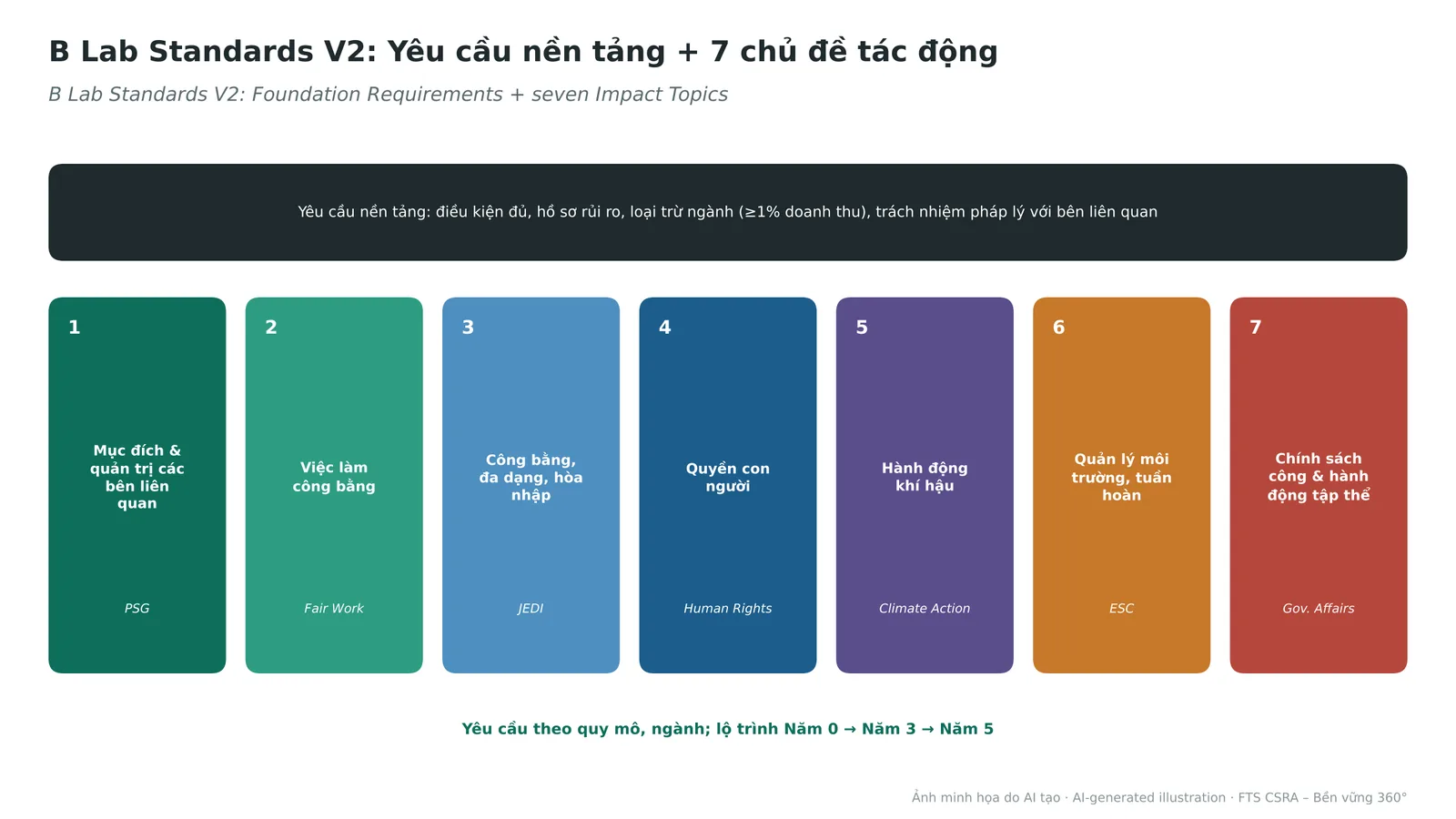
Purpose: verify that companies meet high standards of social and environmental performance, transparency and accountability, making the commitment to “business for all stakeholders” concrete. Two layers: Foundation Requirements (entry conditions) and seven Impact Topics (performance requirements).
2.1. Foundation Requirements
| Requirement | Content |
|---|---|
| Eligibility | For-profit company with at least 12 months of operations (new companies may use Pending B Corp) |
| Risk profile | Screen for sensitive industries, controversial practices, violations and public complaints; may trigger extra requirements or ineligibility |
| Industry exclusions | Companies with 1% or more of revenue from certain restricted industries (e.g. fossil fuels, weapons, tobacco) are ineligible or face specific conditions – check the official list |
| Legal requirement | Embed stakeholder accountability in governing documents using a form suitable for the jurisdiction |
| Transparency | Public profile in the B Corp directory; impact reporting |
| Verification | B Lab or authorised bodies verify evidence; recertification every three years |
2.2. Seven Impact Topics and key requirements
| Impact Topic | Intended outcome | Key requirements |
|---|---|---|
| 1. Purpose & Stakeholder Governance | A clear purpose and decisions that consider all stakeholders | Define and publish the company purpose; identify key stakeholders and impacts on them; regular engagement mechanisms; embed stakeholder interests in board decision-making; legal requirement: amend governing documents to recognise stakeholder accountability |
| 2. Fair Work | Workers are paid and treated fairly and have a voice | Assess and pay a living wage; transparent and fair pay structures; appropriate benefits and insurance; worker surveys and voice mechanisms; act on feedback; stable employment conditions and reasonable hours |
| 3. Justice, Equity, Diversity & Inclusion (JEDI) | Advance equity within the company and its communities | Collect workforce diversity data (gender, age, context-relevant underrepresented groups); pay equity analysis; anti-discrimination and anti-harassment policies; a JEDI action plan with targets; extend to suppliers and communities |
| 4. Human Rights | Respect human rights in operations and the value chain | Human rights policy commitment; human rights due diligence in line with the UN Guiding Principles: identify salient issues, assess supply-chain risks, prevent, track; accessible grievance mechanisms; remediation |
| 5. Climate Action | Reduce emissions in line with 1.5°C | Measure Scope 1, 2 and relevant Scope 3 emissions; a climate action plan; larger companies set science-based targets; implement and report progress; carbon credits do not replace real reductions |
| 6. Environmental Stewardship & Circularity | Reduce environmental impacts beyond climate and move to circular models | Assess material environmental impacts (water, waste, pollution, biodiversity, materials); action plans with targets; circular practices in product design, packaging and procurement; track indicators |
| 7. Government Affairs & Collective Action | Use influence to advance a fair and sustainable system | Policies on advocacy and political contributions consistent with purpose; transparency of lobbying; no lobbying against positive social and environmental policy; join industry and community collective action |
2.3. Requirements by size, sector and timeline
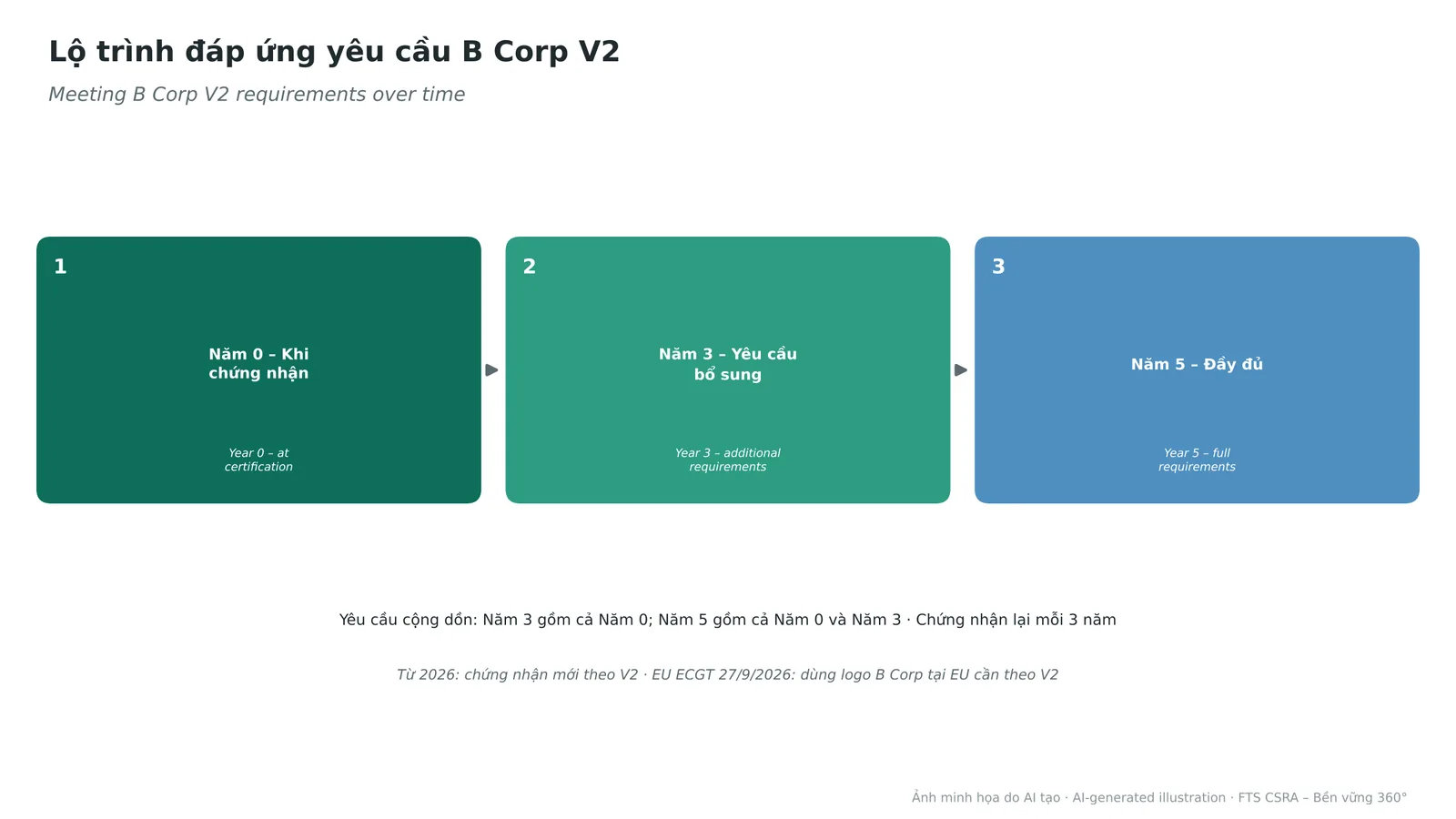
Each requirement applies according to size (micro, small, medium, large – the larger the company, the deeper the requirement) and sector and location. Requirements are staged: Year 0 (at certification), Year 3 and Year 5; they are cumulative, so by Year 3 a company keeps Year 0 requirements and meets the Year 3 ones. For example, a medium company measures Scopes 1 and 2 at Year 0, then builds a reduction plan and targets over later years.
2.4. Old BIA versus V2
| Criterion | BIA (version 6) | Standards V2 |
|---|---|---|
| How to qualify | At least 80/200 points | Meet every mandatory requirement |
| Offsetting | Points can offset across areas | No offsetting; each topic must be met |
| Structure | Five impact areas | Foundation Requirements + seven topics |
| Timing | Score at the time of certification | Year 0, 3, 5 pathway |
| Climate, human rights | Optional questions earning points | Mandatory requirements (HRDD, emissions measurement) |
Users and how to apply it
Users: social enterprises, impact-driven SMEs, subsidiaries of B Corp groups, and exporters of consumer goods, food and fashion seeking to demonstrate commitment.
- Check eligibility and the risk profile; review the excluded industries list.
- Use B Lab's self-assessment tools to identify gaps across the seven topics for your size.
- Prioritise Year 0 requirements: amend governing documents (legal requirement), measure emissions, adopt a human rights policy, run a living wage check.
- Gather evidence (policies, data, minutes) and submit for verification.
- After certification: plan for Year 3 and Year 5 requirements; recertify every three years.
Practical example
Hypothetical case: Natural cosmetics company N (Ho Chi Minh City, 85 workers, exporting to Australia and Singapore) prepares for B Corp certification under V2.
| Topic | Gap identified | Year 0 action |
|---|---|---|
| Purpose and governance | Charter lacks stakeholder accountability | Shareholders amend the charter |
| Fair Work | Wages not benchmarked against a living wage | Use a living wage reference for HCMC; adjust 6 positions |
| Human Rights | Herbal ingredient suppliers not assessed | Assess child labour and safety risks at 12 cooperatives |
| Climate Action | No emissions measured | Inventory Scopes 1, 2 and transport (Scope 3) |
| Environment, circularity | Virgin plastic packaging | Plan to switch to recycled packaging and a bottle take-back scheme |
Notes for use in Vietnam
- Legal requirement in the charter: the 2020 Enterprise Law lets companies set charter content that does not contravene the law, so purpose and stakeholder clauses can be added. Social enterprises under Article 10 of the 2020 Enterprise Law have an advantage, as they already commit to social objectives.
- Living wage: regional minimum wages set by government decree are not living wages; refer to Global Living Wage Coalition (Anker) benchmarks or labour research.
- Cost and time: verification can take several months and fees depend on revenue; small companies should start with the free self-assessment tools.
- EU market: from 27 September 2026 the Empowering Consumers for the Green Transition Directive (ECGT) tightens sustainability labels in the EU; B Lab has adapted certification to meet it – exporters to the EU should check logo-use rules.
- Avoid greenwashing: use the B Corp logo only after certification; “Pending B Corp” has its own rules.
Method & scope
Content compiled and interpreted from FTS Impact Lab and documents of the issuing body; versions and sources should be verified before publication.
References
- B Lab – Standards for B Corp Certification (V2) ↗ (accessed 2026-10-25)
- B Lab publishes new B Corp standards (press release, 2025) ↗ (accessed 2026-10-25)
- Enterprise Law No. 59/2020/QH14 (Article 10 – social enterprises) (accessed 2026-10-25)