Contents
Overview and origin
| Item | Details |
|---|---|
| Vietnamese name | Bộ chuẩn mực SASB (Hội đồng Chuẩn mực Kế toán Bền vững) |
| English name | SASB Standards (Sustainability Accounting Standards Board) |
| Issuer/custodian | Originally SASB (US, founded 2011); merged into the Value Reporting Foundation in 2021 and consolidated into the IFRS Foundation in 2022. The ISSB now maintains and updates them. |
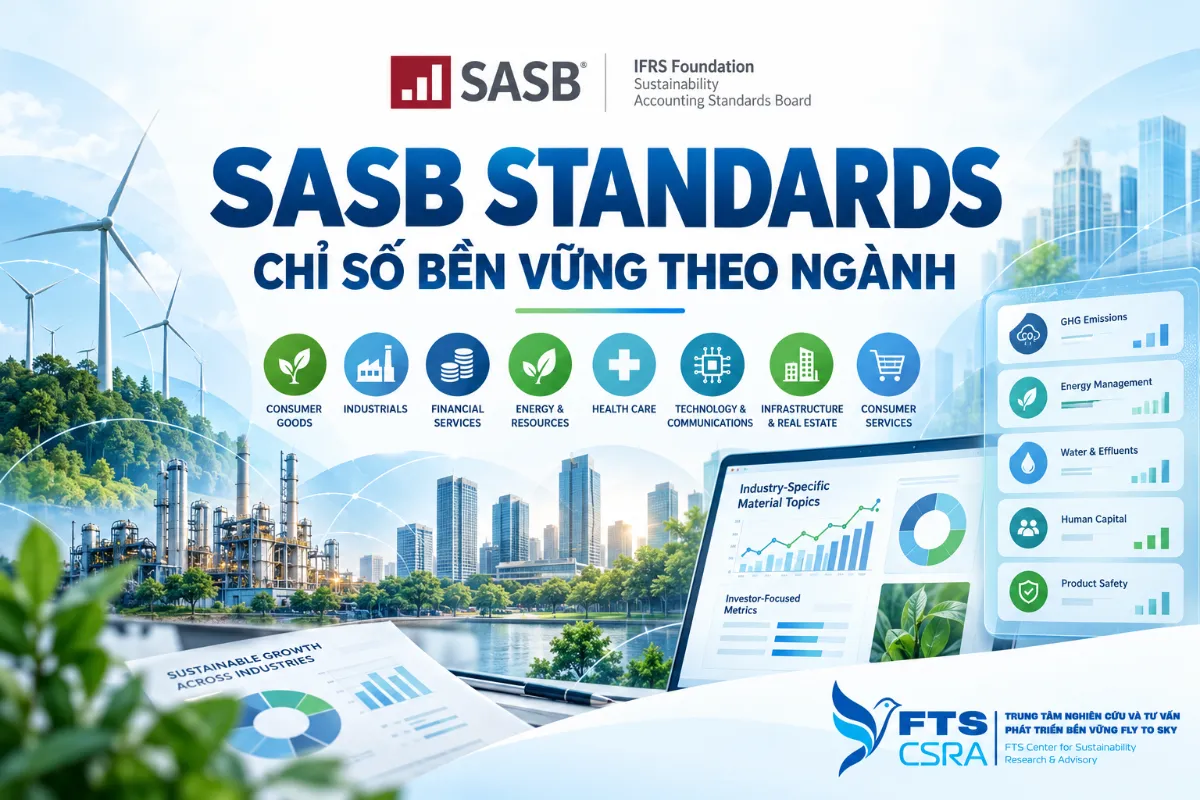
| Nature | 77 industry standards, each with disclosure topics, accounting metrics (quantitative and qualitative) and activity metrics; focused on sustainability matters that are financially material to investors. |
| Reference scope | Companies of any size, classified under the Sustainable Industry Classification System (SICS®). A source companies must consider under IFRS S1 and the basis of IFRS S2's industry-based guidance. |
SASB published its codified standards in 2018. In December 2023 the ISSB amended them to enhance international applicability (replacing US-specific references with general definitions). Under IFRS S1 companies shall refer to and consider SASB when identifying risks, opportunities and information to disclose; under IFRS S2 they consider the industry-based guidance (derived from SASB) for climate metrics. The ISSB continues to review and upgrade priority industries.
Purpose and main structure
Purpose: help companies disclose sustainability information that is concise, comparable within an industry and decision-useful for investors. Each industry standard has on average about 6 disclosure topics and 13 metrics, with a uniform coding system (e.g. CG-AA-430b.1).
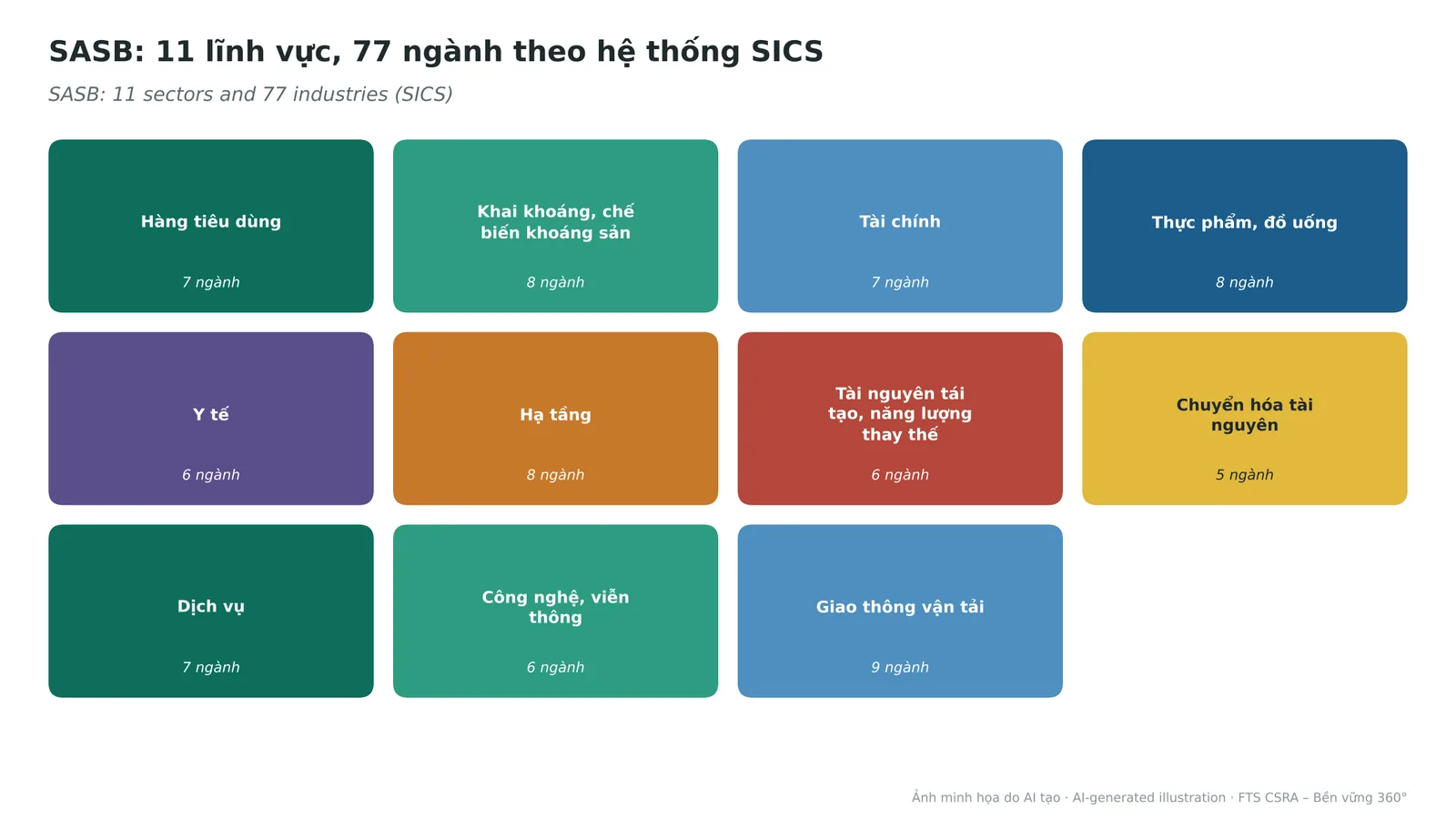
2.1. All 77 industries in 11 sectors (SICS)
| Sector | Industries | Industry codes and names |
|---|---|---|
| Consumer Goods | 7 | CG-AA Apparel, Accessories & Footwear · CG-AM Appliance Manufacturing · CG-BF Building Products & Furnishings · CG-EC E-Commerce · CG-HP Household & Personal Products · CG-MR Multiline and Specialty Retailers & Distributors · CG-TS Toys & Sporting Goods |
| Extractives & Minerals Processing | 8 | EM-CO Coal Operations · EM-CM Construction Materials · EM-IS Iron & Steel Producers · EM-MM Metals & Mining · EM-EP Oil & Gas – Exploration & Production · EM-MD Oil & Gas – Midstream · EM-RM Oil & Gas – Refining & Marketing · EM-SV Oil & Gas – Services |
| Financials | 7 | FN-AC Asset Management & Custody Activities · FN-CB Commercial Banks · FN-CF Consumer Finance · FN-IN Insurance · FN-IB Investment Banking & Brokerage · FN-MF Mortgage Finance · FN-EX Security & Commodity Exchanges |
| Food & Beverage | 8 | FB-AG Agricultural Products · FB-AB Alcoholic Beverages · FB-FR Food Retailers & Distributors · FB-MP Meat, Poultry & Dairy · FB-NB Non-Alcoholic Beverages · FB-PF Processed Foods · FB-RN Restaurants · FB-TB Tobacco |
| Health Care | 6 | HC-BP Biotechnology & Pharmaceuticals · HC-DR Drug Retailers · HC-DY Health Care Delivery · HC-DI Health Care Distributors · HC-MC Managed Care · HC-MS Medical Equipment & Supplies |
| Infrastructure | 8 | IF-EU Electric Utilities & Power Generators · IF-EN Engineering & Construction Services · IF-GU Gas Utilities & Distributors · IF-HB Home Builders · IF-RE Real Estate · IF-RS Real Estate Services · IF-WM Waste Management · IF-WU Water Utilities & Services |
| Renewable Resources & Alternative Energy | 6 | RR-BI Biofuels · RR-FM Forestry Management · RR-FC Fuel Cells & Industrial Batteries · RR-PP Pulp & Paper Products · RR-ST Solar Technology & Project Developers · RR-WT Wind Technology & Project Developers |
| Resource Transformation | 5 | RT-AE Aerospace & Defence · RT-CH Chemicals · RT-CP Containers & Packaging · RT-EE Electrical & Electronic Equipment · RT-IG Industrial Machinery & Goods |
| Services | 7 | SV-AD Advertising & Marketing · SV-CA Casinos & Gaming · SV-ED Education · SV-HL Hotels & Lodging · SV-LF Leisure Facilities · SV-ME Media & Entertainment · SV-PS Professional & Commercial Services |
| Technology & Communications | 6 | TC-ES Electronic Manufacturing Services & ODM · TC-HW Hardware · TC-IM Internet Media & Services · TC-SC Semiconductors · TC-SI Software & IT Services · TC-TL Telecommunication Services |
| Transportation | 9 | TR-AF Air Freight & Logistics · TR-AL Airlines · TR-AP Auto Parts · TR-AU Automobiles · TR-CR Car Rental & Leasing · TR-CL Cruise Lines · TR-MT Marine Transportation · TR-RA Rail Transportation · TR-RO Road Transportation |
2.2. 26 general issue categories in five dimensions
Each industry disclosure topic maps to one of 26 general issue categories, allowing cross-industry comparison:
| Dimension | Count | General issue categories |
|---|---|---|
| Environment | 6 | GHG Emissions; Air Quality; Energy Management; Water & Wastewater Management; Waste & Hazardous Materials Management; Ecological Impacts |
| Social Capital | 7 | Human Rights & Community Relations; Customer Privacy; Data Security; Access & Affordability; Product Quality & Safety; Customer Welfare; Selling Practices & Product Labeling |
| Human Capital | 3 | Labor Practices; Employee Health & Safety; Employee Engagement, Diversity & Inclusion |
| Business Model & Innovation | 5 | Product Design & Lifecycle Management; Business Model Resilience; Supply Chain Management; Materials Sourcing & Efficiency; Physical Impacts of Climate Change |
| Leadership & Governance | 5 | Business Ethics; Competitive Behavior; Management of the Legal & Regulatory Environment; Critical Incident Risk Management; Systemic Risk Management |
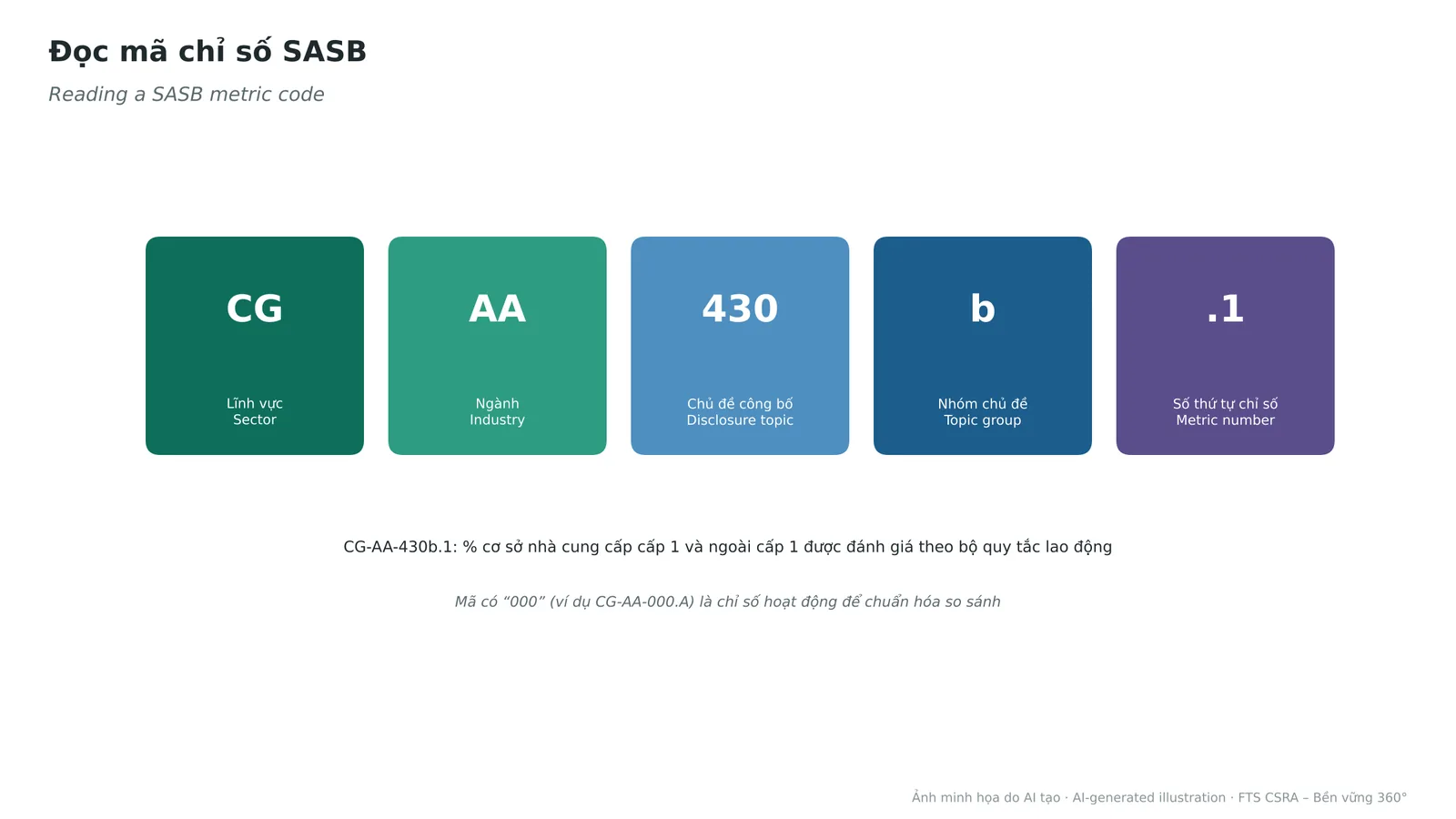
2.3. Reading a metric code
A code combines sector (CG) – industry (AA) – topic code (430, linked to an issue category) + group letter (b) + number (.1). Codes containing “000” are activity metrics (production volume, number of customers…) used to normalise comparisons. Each metric has a technical protocol defining scope and units.
2.4. Apparel, Accessories & Footwear metrics (CG-AA)
| Disclosure topic | Code | Metric |
|---|---|---|
| Management of Chemicals in Products | CG-AA-250a.1 | Discussion of processes to maintain compliance with restricted substances regulations |
| Management of Chemicals in Products | CG-AA-250a.2 | Discussion of processes to assess and manage risks and/or hazards associated with chemicals in products |
| Environmental Impacts in the Supply Chain | CG-AA-430a.1 | % of (1) Tier 1 and (2) beyond-Tier-1 supplier facilities in compliance with wastewater discharge permits and/or contractual agreement |
| Environmental Impacts in the Supply Chain | CG-AA-430a.2 | % of (1) Tier 1 and (2) beyond-Tier-1 facilities that have completed the Higg FEM assessment or an equivalent |
| Labour Conditions in the Supply Chain | CG-AA-430b.1 | % of (1) Tier 1 and (2) beyond-Tier-1 facilities audited to a labour code of conduct, (3) % of audits by a third party |
| Labour Conditions in the Supply Chain | CG-AA-430b.2 | Priority non-conformance rate and associated corrective action rate for suppliers' labour code audits |
| Labour Conditions in the Supply Chain | CG-AA-430b.3 | Description of the greatest (1) labour and (2) environmental, health and safety risks in the supply chain |
| Raw Materials Sourcing | CG-AA-440a.1 | Description of environmental and social risks associated with sourcing priority raw materials |
| Raw Materials Sourcing | CG-AA-440a.2 | % of raw materials third-party certified to an environmental or social sustainability standard, by standard |
| Activity metric | CG-AA-000.A | Number of (1) Tier 1 suppliers and (2) suppliers beyond Tier 1 |
2.5. Commercial Banks metrics (FN-CB)
| Disclosure topic | Code | Metric |
|---|---|---|
| Data Security | FN-CB-230a.1 | (1) Number of data breaches, (2) % involving personal data, (3) number of account holders affected |
| Data Security | FN-CB-230a.2 | Description of approach to identifying and addressing data security risks |
| Financial Inclusion & Capacity Building | FN-CB-240a.1 | (1) Number and (2) amount of loans outstanding qualified to small business and community development programmes |
| Financial Inclusion & Capacity Building | FN-CB-240a.4 | Number of participants in financial literacy initiatives for unbanked, underbanked or underserved customers |
| Incorporation of ESG Factors in Credit Analysis | FN-CB-410a.1 | Commercial and industrial credit exposure, by industry |
| Incorporation of ESG Factors in Credit Analysis | FN-CB-410a.2 | Description of approach to incorporating ESG factors in credit analysis |
| Business Ethics | FN-CB-510a.1 | Total monetary losses from legal proceedings on fraud, insider trading, anti-trust, market manipulation, malpractice |
| Business Ethics | FN-CB-510a.2 | Description of whistleblower policies and procedures |
| Systemic Risk Management | FN-CB-550a.1 | Global Systemically Important Bank (G-SIB) score, by category |
| Systemic Risk Management | FN-CB-550a.2 | Description of how stress test results are used in capital adequacy planning and strategy |
| Activity metrics | FN-CB-000.A/B | Number and value of checking and savings accounts (personal, small business); number and value of loans (personal, small business, corporate) |
Users and how to apply it
Users: listed companies, companies preparing for IFRS S1/S2, companies raising international capital, and banks and funds using SASB for portfolio screening.
- Identify the primary industry under SICS (the “Find your industry” tool); diversified groups use several standards.
- Download the industry standard and review each disclosure topic: is it material for the company?
- Map available data to each metric and identify gaps.
- Disclose in a SASB index (code, metric, data, location in the report); explain omitted metrics.
- Combine with GRI (impacts) and IFRS S1/S2 (financial disclosure framework).
Practical example
Hypothetical case: Garment company V, listed on HOSE with 8,000 workers, prepares its first SASB CG-AA index in the annual report.
| Code | Disclosed data | Note |
|---|---|---|
| CG-AA-000.A | 45 Tier 1 suppliers; 120 suppliers beyond Tier 1 | Tier 2 list compiled for the first time |
| CG-AA-430a.2 | Tier 1: 80% completed Higg FEM; beyond Tier 1: 25% | Target 50% next year |
| CG-AA-430b.1 | Tier 1: 100% labour-audited; beyond Tier 1: 30%; 70% by third parties | Against brand codes of conduct |
| CG-AA-430b.2 | Priority non-conformance rate 0.4 per facility; 90% corrected | Mainly overtime |
| CG-AA-440a.2 | BCI cotton 35%; GRS recycled polyester 12% | By certification standard |
Notes for use in Vietnam
- ISSB roadmap: Vietnam has no official roadmap for IFRS S1/S2; once adopted, SASB will be a source companies must consider – getting familiar early pays off.
- Industry classification: Vietnam's VSIC codes do not match SICS; map by the main revenue-generating activity.
- Legacy US definitions: the 2023 amendments internationalised most metrics; where a metric still references foreign rules, use the equivalent Vietnamese technical regulation and note it.
- Combine with Circular 96/2020/TT-BTC: use SASB metrics to deepen the environmental and social sections of listed companies' annual reports.
Method & scope
Content compiled and interpreted from FTS Impact Lab and documents of the issuing body; versions and sources should be verified before publication.
References
- SASB Standards – Download Standards / Find your industry (IFRS Foundation) ↗ (accessed 2026-10-25)
- SASB Sustainable Industry Classification System (SICS) ↗ (accessed 2026-10-25)
- ISSB – Amendments to the SASB Standards to enhance international applicability (December 2023) ↗ (accessed 2026-10-25)
- SASB Apparel, Accessories & Footwear Standard; SASB Commercial Banks Standard ↗ (accessed 2026-10-25)