Contents
Overview and origin
| Item | Details |
|---|---|
| Vietnamese name | Bộ Chuẩn mực Báo cáo Bền vững châu Âu |
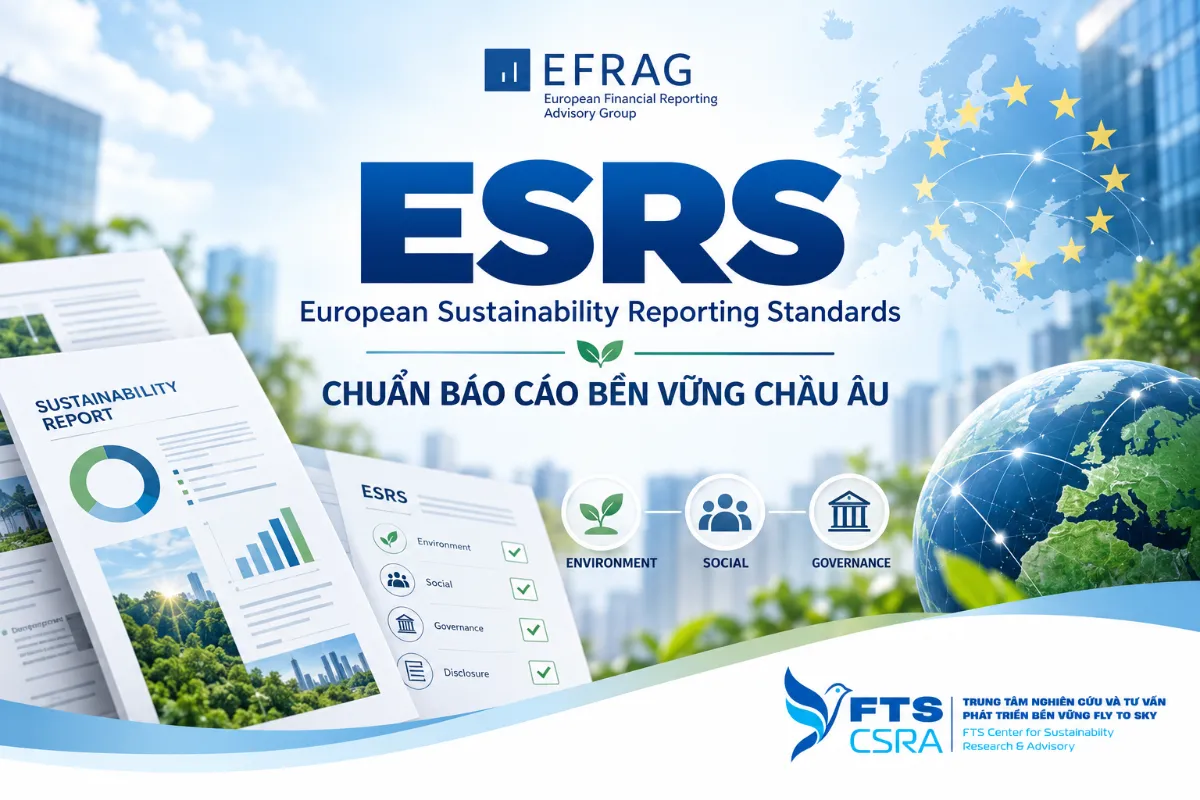
| English name | European Sustainability Reporting Standards (ESRS) |
| Issuer/custodian | European Commission, by delegated act, based on technical advice from EFRAG; implements the Corporate Sustainability Reporting Directive (CSRD). |
| Nature | Mandatory standards for companies in CSRD scope; apply double materiality; reported in the management report, digitally tagged and subject to limited assurance. |
| Reference scope | After Omnibus I: EU companies with more than 1,000 employees and over €450 million turnover; non-EU parents with over €450 million EU turnover and an EU subsidiary or branch above €200 million. |
The first ESRS set (Set 1) of 12 standards was adopted in July 2023 and applied from FY2024 to “wave one”. In 2025–2026 the EU carried out the Omnibus simplification: “stop-the-clock” delays, narrower CSRD and CSDDD scope through Directive (EU) 2026/470, in force from 18 March 2026 (CSRD transposition by 19 March 2027), and removal of the CSDDD climate transition plan obligation. On 3 July 2026 the revised ESRS were adopted, mandatory from FY2027.
Purpose and main structure
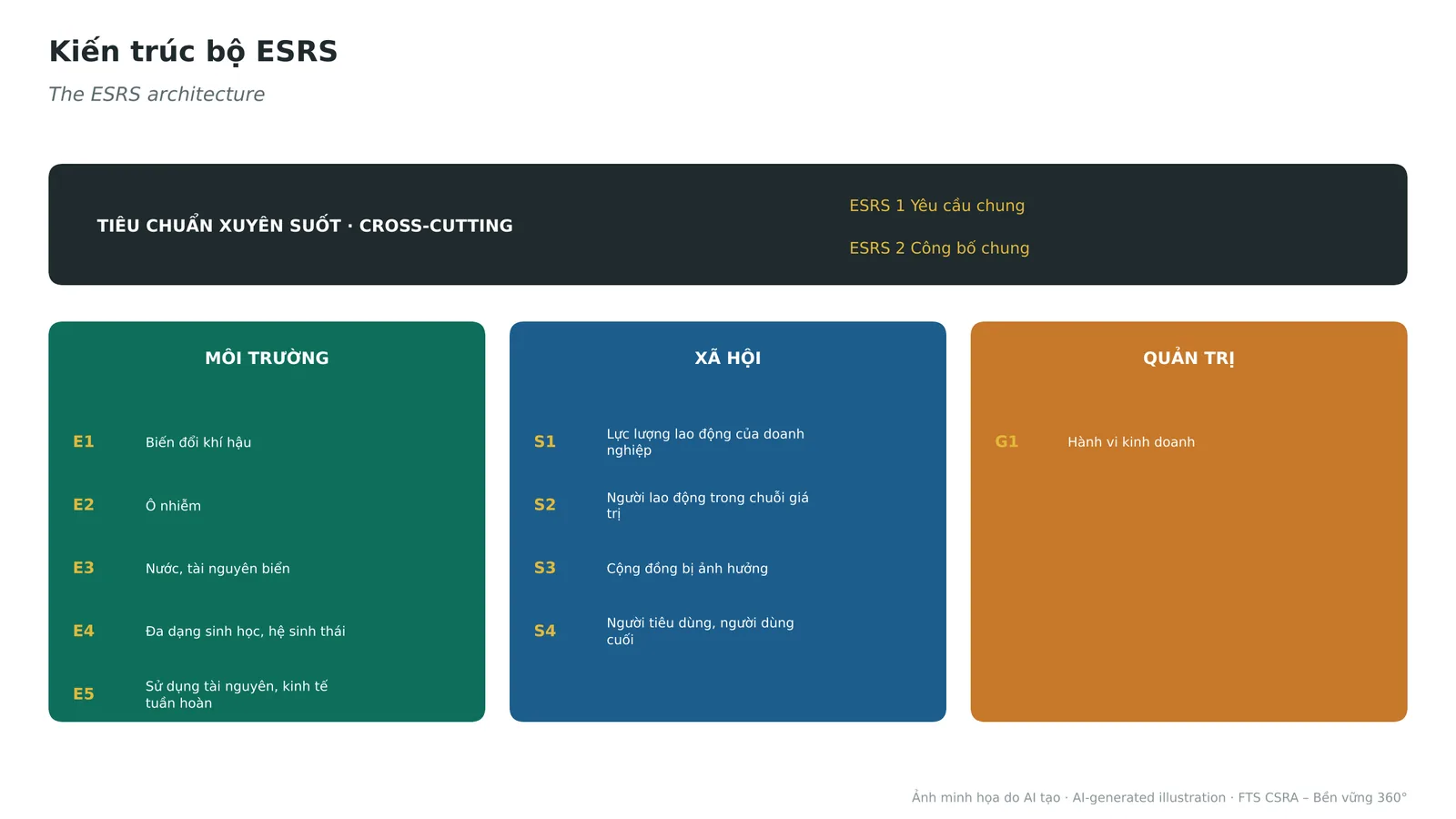
Purpose: produce comparable, reliable sustainability information for investors and stakeholders, on a par with financial reporting. The architecture has 2 cross-cutting standards and 10 topical standards (5 environmental, 4 social, 1 governance); sector-specific standards have been postponed indefinitely.
2.1. Disclosure requirements by code
The table lists the disclosure requirements (DRs) of ESRS Set 1 (2023) – the basis for understanding the content. The 2026 revised ESRS keep the topical architecture but sharply cut datapoints and merge some requirements; companies should check the official text when reporting from 2027.
| Standard | DR codes | Disclosure requirements (ESRS Set 1, 2023) |
|---|---|---|
| ESRS 2 | BP-1, BP-2 | Basis for preparation; disclosures in relation to specific circumstances (consolidation, value chain, estimates, errors) |
| ESRS 2 | GOV-1 → GOV-5 | Role of governance bodies; information provided to them; sustainability in incentive schemes; statement on due diligence; risk management and internal controls over reporting |
| ESRS 2 | SBM-1 → SBM-3 | Strategy, business model and value chain; interests and views of stakeholders; material impacts, risks and opportunities and their interaction with strategy |
| ESRS 2 | IRO-1, IRO-2 | Process to identify and assess material IROs; disclosure requirements covered |
| ESRS 2 | MDR-P, A, M, T | Minimum disclosure requirements for any topic: policies, actions, metrics, targets |
| E1 Climate | E1-1 → E1-4 | Transition plan for climate mitigation; policies; actions and resources; targets |
| E1 Climate | E1-5 | Energy consumption and mix (fossil, nuclear, renewable); energy intensity in high climate impact sectors |
| E1 Climate | E1-6 | Gross Scope 1, 2 (location- and market-based), 3 and total GHG emissions; GHG intensity per net revenue |
| E1 Climate | E1-7 → E1-9 | GHG removals and mitigation financed through carbon credits; internal carbon pricing; anticipated financial effects |
| E2 Pollution | E2-1 → E2-6 | Policies; actions; targets; pollution of air, water and soil; substances of concern and SVHCs; anticipated financial effects |
| E3 Water and marine | E3-1 → E3-5 | Policies; actions; targets; water consumption (total, in water-risk areas, recycled, stored, intensity); anticipated financial effects |
| E4 Biodiversity | E4-1 → E4-6 | Transition plan and biodiversity in strategy; policies; actions; targets; impact metrics (sites near sensitive areas, land-use change, threatened species); financial effects |
| E5 Circular economy | E5-1 → E5-6 | Policies; actions; targets; resource inflows (materials, recycled share, sustainable biological); outflows (circular products, waste by type and treatment); financial effects |
| S1 Own workforce | S1-1 → S1-5 | Policies; engagement with workers and representatives; remediation channels; actions; targets |
| S1 Own workforce | S1-6 → S1-9 | Employee characteristics (gender, country, contract type, turnover); non-employees; collective bargaining coverage and social dialogue; diversity (gender in top management, age) |
| S1 Own workforce | S1-10 → S1-13 | Adequate wages; social protection; persons with disabilities; training and skills (average training hours, share with performance reviews) |
| S1 Own workforce | S1-14 → S1-17 | Health and safety (coverage, fatalities, recordable accidents, days lost); work-life balance; remuneration (gender pay gap, total remuneration ratio); incidents, complaints and severe human rights impacts |
| S2 Value chain workers | S2-1 → S2-5 | Policies; engagement; grievance channels; actions on material impacts (forced and child labour, safety, wages); targets |
| S3 Affected communities | S3-1 → S3-5 | Policies; engagement; grievance channels; actions (land, water, security, indigenous peoples, FPIC); targets |
| S4 Consumers and end-users | S4-1 → S4-5 | Policies; engagement; grievance channels; actions (privacy, product safety, responsible marketing, access); targets |
| G1 Business conduct | G1-1 → G1-6 | Business conduct policies, corporate culture, whistleblower protection; supplier relationships; prevention of corruption and bribery; confirmed incidents; political influence and lobbying; payment practices (average days, share paid on time) |
2.2. Double materiality
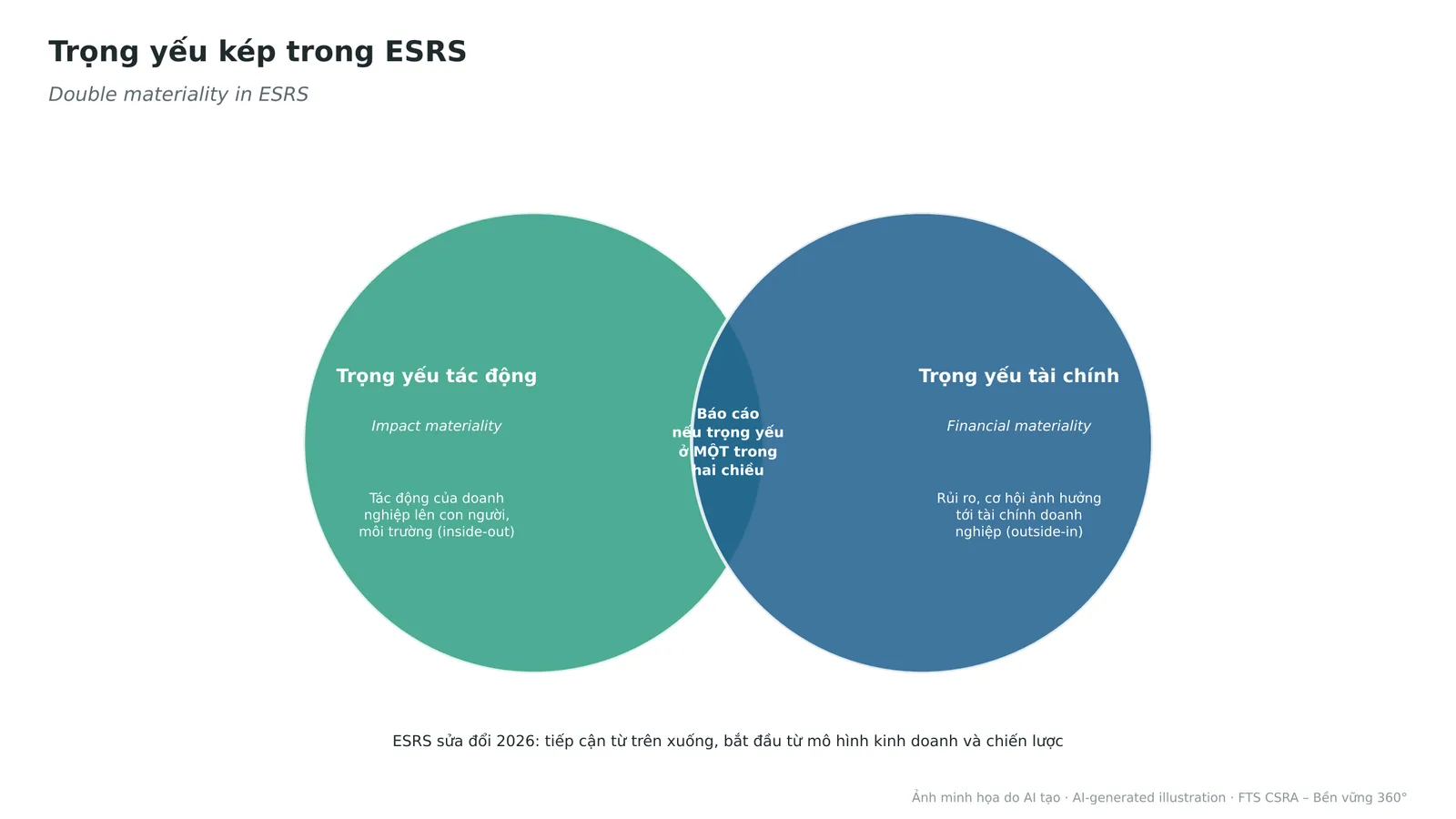
A topic is reported if it is material from at least one perspective: (1) impact materiality – the company has significant actual or potential, positive or negative impacts on people or the environment, assessed by scale, scope, irremediability and likelihood; (2) financial materiality – the sustainability matter creates risks or opportunities that significantly affect cash flows, performance, position or cost of capital. ESRS 2 is mandatory for all; topical standards apply only where material.
2.3. Main 2026 changes
| Area | Change |
|---|---|
| Mandatory datapoints | Down by more than 60%; total datapoints down by over 70%; compliance cost estimated down by over 30% |
| Double materiality assessment | Top-down, starting from business model and strategy; less item-by-item documentation |
| Fair presentation | Applies to the sustainability statement as a whole rather than each datapoint |
| Reliefs | Omission of seriously prejudicial information; undue cost or effort relief; value-chain cap based on VSME for smaller partners |
| Climate | GHG boundary by financial or operational control; incompatibility with 1.5°C must be disclosed |
| Phase-in | Mandatory from FY2027; optional early application for FY2026. Wave-one deferrals: E4, S2–S4 to FY2027; SVHC to FY2028; quantitative financial effects and E2-5 to FY2030 |
2.4. The VSME standard for smaller companies
The voluntary VSME standard has a Basic Module (B1–B11: basis for preparation, transition practices, energy and GHG, pollution, biodiversity, water, resources and waste, workforce characteristics, health and safety, remuneration and collective bargaining, training, corruption) and a Comprehensive Module (C1–C9). After Omnibus, VSME is the upper limit of information large companies may request from small value-chain partners – highly relevant for Vietnamese suppliers.
Users and how to apply it
Users in Vietnam: subsidiaries of EU groups; Vietnamese companies with EU subsidiaries or branches above the thresholds; suppliers to EU groups (indirectly, through value-chain data requests); banks with EU clients or shareholders.
- Determine whether the company is directly in scope (new Omnibus thresholds) or only a value-chain partner.
- If a supplier: prepare a data set following the VSME Basic Module (energy, Scope 1–2 GHG, water, waste, workforce, safety, corruption).
- If in scope: run a double materiality assessment and list impacts, risks and opportunities (IRO-1).
- Map disclosure requirements against available data; prioritise ESRS 2 and E1 (climate), usually material.
- Build internal controls over sustainability data to prepare for limited assurance.
Practical example
Hypothetical case: Furniture company G (Bình Định, 2,500 workers) exports 60% to the EU; its retail customer, in CSRD scope, requests data.
| Customer request | Data G provides | Reference |
|---|---|---|
| Product GHG emissions | Scopes 1, 2 under the GHG Protocol; intensity tCO₂e/m³ of timber | ESRS E1-6, VSME B3 |
| Timber origin, deforestation-free | Share of FSC timber, traceability documents, harvest coordinates | ESRS E4, EUDR |
| Working conditions | Hours, wages vs regional minimum wage, accidents | ESRS S2 (customer's), VSME B8–B10 |
| Anti-corruption | Policy, number of incidents | ESRS G1, VSME B11 |
Notes for use in Vietnam
- Not mandatory under Vietnamese law, but it reaches Vietnam through value chains and related rules such as CBAM, EUDR and CSDDD.
- Don't over-prepare: after Omnibus, EU customers may not request more than the VSME limit from small partners, except common sector information; suppliers can negotiate.
- Interaction with ISSB: ESRS and IFRS S1/S2 are highly interoperable on climate; one data set can serve both.
- Cross-check Circular 96/2020/TT-BTC: listed companies in Vietnam still disclose environmental and social information under domestic rules and can use ESRS to raise quality.
Method & scope
Content compiled and interpreted from FTS Impact Lab and documents of the issuing body; versions and sources should be verified before publication.
References
- Commission Delegated Regulation (EU) 2023/2772 – ESRS Set 1 ↗ (accessed 2026-10-25)
- EFRAG – 2026 revised ESRS and VSME (Knowledge Hub) ↗ (accessed 2026-10-25)
- European Commission – Corporate sustainability reporting (CSRD, Omnibus) ↗ (accessed 2026-10-25)
- Directive (EU) 2026/470 (Omnibus I) amending the CSRD and CSDDD (accessed 2026-10-25)