Contents
Overview and origin
| Item | Details |
|---|---|
| Vietnamese name | Khuyến nghị của Nhóm Công tác về Công bố thông tin tài chính liên quan đến thiên nhiên |
| English name | Recommendations of the Taskforce on Nature-related Financial Disclosures (TNFD) |
| Issuer/custodian | Taskforce on Nature-related Financial Disclosures – a global, market-led initiative launched in 2021 with support from UNDP, UNEP FI, WWF and Global Canopy; recommendations v1.0 published in September 2023. |
| Nature | Voluntary recommendations: 14 recommended disclosures under four pillars (mirroring TCFD), with the LEAP assessment approach and a set of core disclosure metrics. |
| Reference scope | Companies and financial institutions of all sizes; focuses on dependencies and impacts on nature (land, freshwater, ocean, atmosphere) and the financial risks and opportunities that follow. |
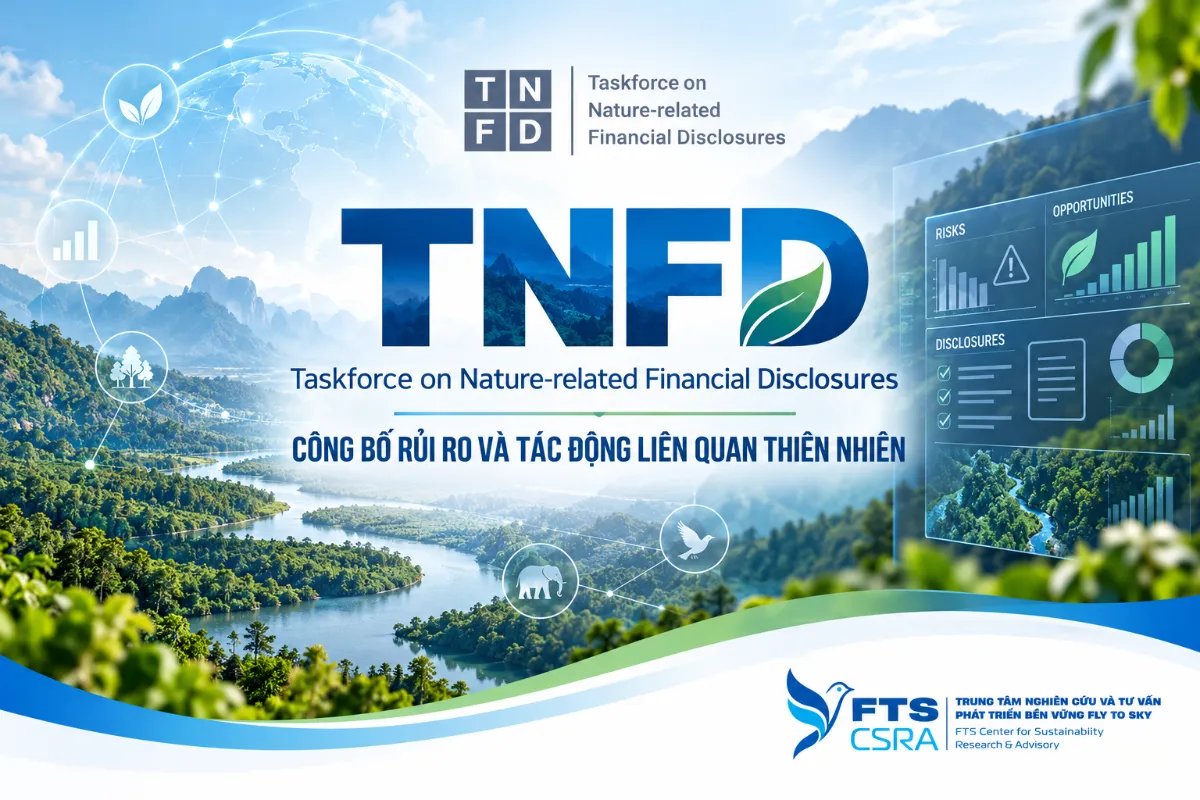
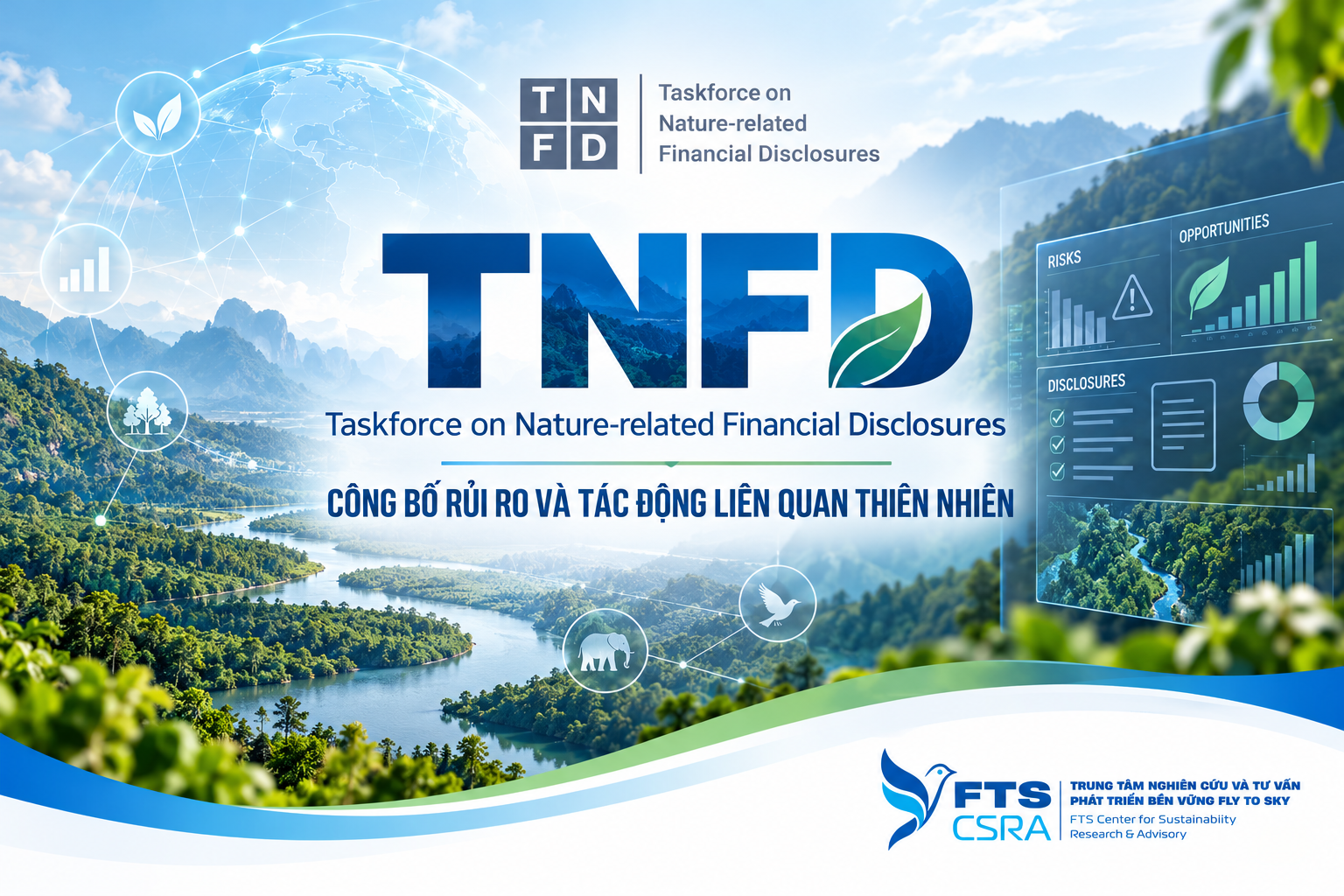
TNFD was developed alongside the Kunming-Montreal Global Biodiversity Framework (GBF), whose Target 15 asks large businesses and financial institutions to assess and disclose biodiversity risks, dependencies and impacts. By late 2025, more than 730 organisations had committed to TNFD adoption, including around 180 financial institutions with over USD 22 trillion in assets.
Key update: in November 2025 the ISSB decided to develop nature-related disclosure requirements building on the TNFD recommendations, aiming for an exposure draft around the CBD COP17 conference (October 2026). TNFD is completing its work in progress and expects to wind down technical work around 2027, handing standard-setting to the ISSB. Companies adopting TNFD now still gain an advantage, as the content will carry over.
Purpose and main structure
Purpose: help organisations identify, assess, manage and disclose nature-related issues so that capital shifts toward nature-positive outcomes. TNFD has six general requirements: approach to materiality (financial or double materiality allowed), scope of disclosures, location of nature-related issues, integration with other sustainability disclosures, time horizons, and engagement with Indigenous Peoples, local communities and affected stakeholders.
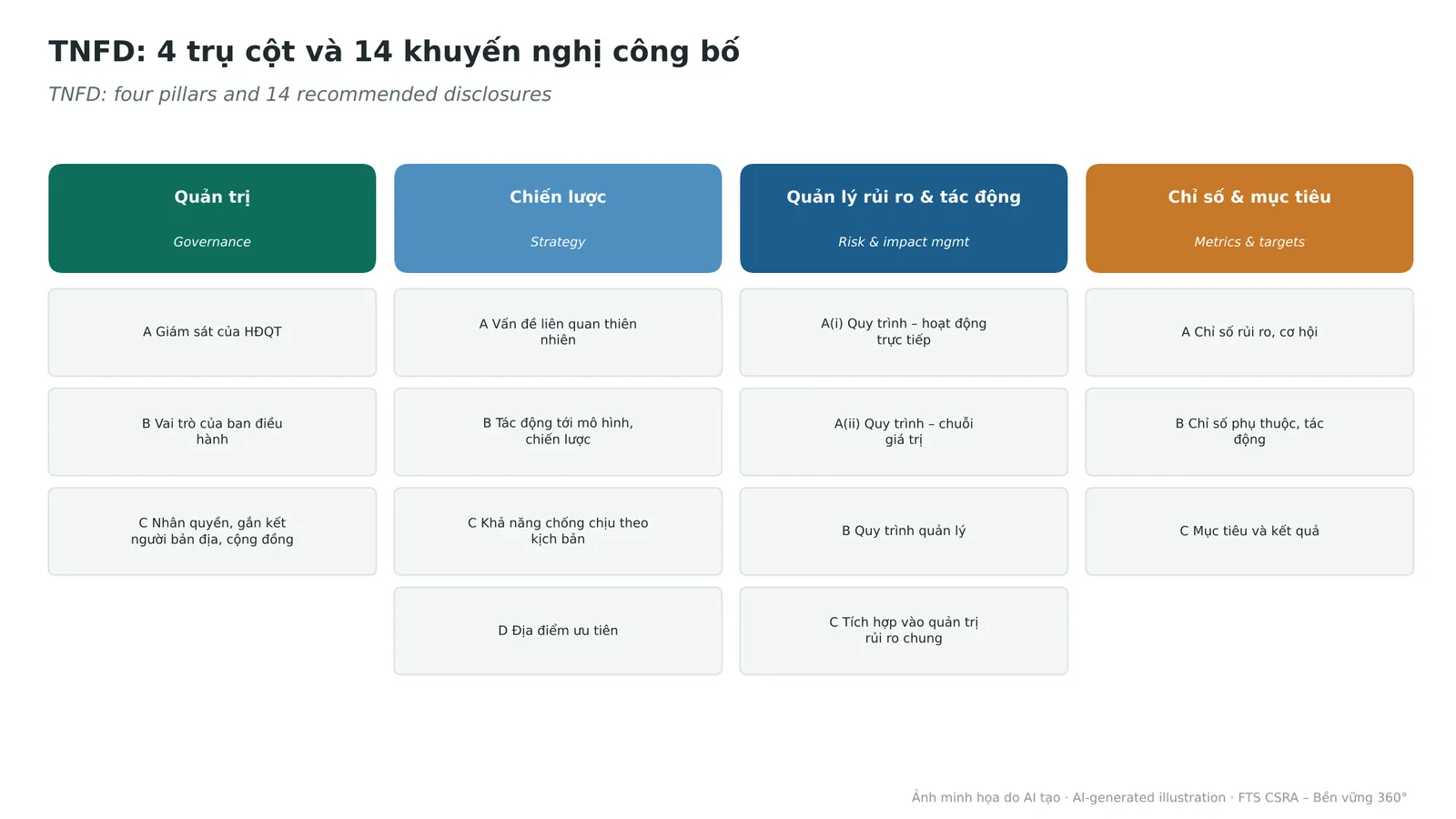
2.1. The 14 recommended disclosures
| Pillar | Code | Recommended disclosure |
|---|---|---|
| Governance | A | Describe the board's oversight of nature-related dependencies, impacts, risks and opportunities |
| Governance | B | Describe management's role in assessing and managing them |
| Governance | C | Describe human rights policies and engagement with Indigenous Peoples, local communities, affected and other stakeholders, and board/management oversight |
| Strategy | A | Describe the dependencies, impacts, risks and opportunities identified over the short, medium and long term |
| Strategy | B | Describe the effect on business model, value chain, strategy and financial planning, and any transition plans or analysis |
| Strategy | C | Describe the resilience of the strategy, taking into consideration different scenarios |
| Strategy | D | Disclose the locations of assets and activities in direct operations (and upstream/downstream where possible) that meet the criteria for priority locations |
| Risk & impact management | A(i) | Describe processes for identifying, assessing and prioritising them in direct operations |
| Risk & impact management | A(ii) | Describe these processes for the upstream and downstream value chain |
| Risk & impact management | B | Describe processes for managing them |
| Risk & impact management | C | Describe how these processes are integrated into overall risk management |
| Metrics & targets | A | Disclose the metrics used to assess and manage material risks and opportunities |
| Metrics & targets | B | Disclose the metrics used to assess and manage dependencies and impacts on nature |
| Metrics & targets | C | Describe the targets and goals used and performance against them |
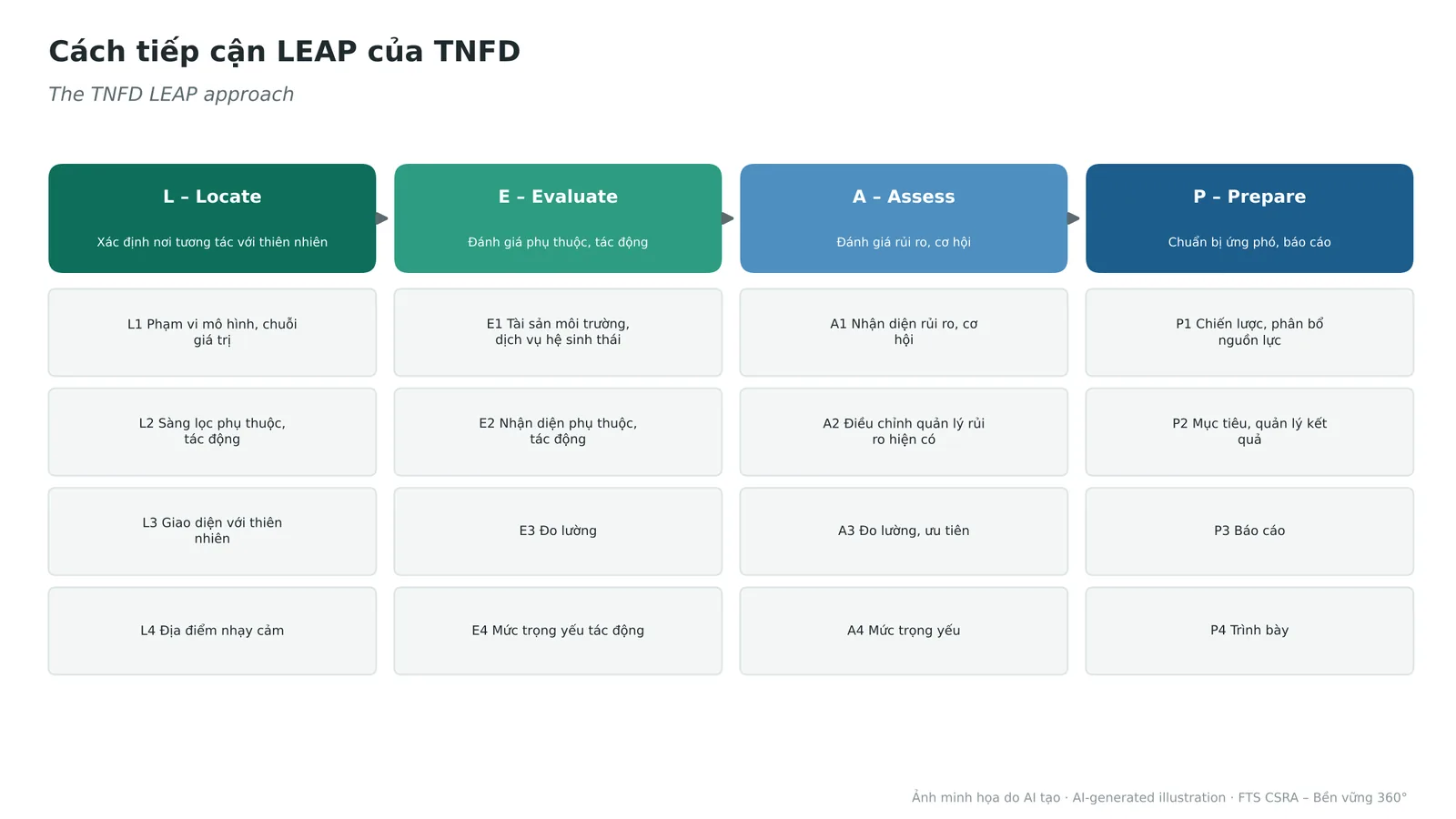
2.2. The LEAP approach: 16 components
| Component | What is assessed |
|---|---|
| L1 | Span of the business model and value chain |
| L2 | Dependency and impact screening (which sectors and value chains have moderate/high dependencies and impacts) |
| L3 | Interface with nature: which biomes and ecosystems, where |
| L4 | Interface with sensitive locations: biodiversity importance, high or rapidly declining integrity, water stress, importance to Indigenous Peoples |
| E1 | Identification of environmental assets, ecosystem services and impact drivers |
| E2 | Identification of dependencies and impacts |
| E3 | Dependency and impact measurement |
| E4 | Impact materiality assessment |
| A1 | Risk and opportunity identification |
| A2 | Adjustment of existing risk mitigation and management |
| A3 | Risk and opportunity measurement and prioritisation |
| A4 | Risk and opportunity materiality assessment |
| P1 | Strategy and resource allocation plans |
| P2 | Target setting and performance management |
| P3 | Reporting |
| P4 | Presentation |
2.3. Core global disclosure metrics
TNFD sets out core global metrics on a “comply or explain” basis, organised by the five IPBES drivers of nature change and a risk-and-opportunity group. Climate change is covered by referencing ISSB/GHG Protocol emissions metrics. There are also sector-specific and additional global metrics. Companies should consult Annex 1 of the TNFD recommendations for full definitions.
| Driver of nature change | Code | Core global disclosure metric |
|---|---|---|
| Land/freshwater/ocean-use change | Tổng diện tích dấu chân không gian (km²): tổng diện tích kiểm soát/quản lý, diện tích bị xáo trộn, diện tích đã phục hồi | undefined |
| Land/freshwater/ocean-use change | Mức thay đổi sử dụng đất, nước ngọt, biển (km²) theo loại hệ sinh thái và hoạt động kinh doanh | undefined |
| Pollution | Chất ô nhiễm thải ra đất (tấn), theo loại | undefined |
| Pollution | Nước thải xả ra (m³) và nồng độ chất ô nhiễm chính | undefined |
| Pollution | Chất thải phát sinh và xử lý (tấn): nguy hại, không nguy hại; tái sử dụng, tái chế, chôn lấp, đốt | undefined |
| Pollution | Ô nhiễm nhựa: khối lượng nhựa sử dụng hoặc bán (tấn), theo loại; tỷ lệ có thể tái chế | undefined |
| Pollution | Chất ô nhiễm không khí ngoài khí nhà kính (tấn): bụi PM2.5, NOx, SOx, VOC, NH₃ | undefined |
| Resource use/replenishment | Lượng nước khai thác và tiêu thụ (m³) từ khu vực khan hiếm nước | undefined |
| Resource use/replenishment | Khối lượng hàng hóa tự nhiên rủi ro cao (tấn) khai thác từ đất, biển, nước ngọt, kèm tỷ lệ được chứng nhận, truy xuất | undefined |
| Invasive alien species | Biện pháp ngăn ngừa du nhập ngoài ý muốn sinh vật ngoại lai xâm hại | undefined |
| State of nature | Chỉ số về tình trạng hệ sinh thái, mức độ toàn vẹn, quần thể loài (khuyến khích, tùy chọn) | undefined |
| Risks & opportunities | Giá trị tài sản, nợ phải trả, doanh thu, chi phí dễ tổn thương trước rủi ro chuyển đổi liên quan thiên nhiên | undefined |
| Risks & opportunities | Giá trị tài sản, nợ phải trả, doanh thu, chi phí dễ tổn thương trước rủi ro vật lý liên quan thiên nhiên | undefined |
| Risks & opportunities | Mô tả, giá trị các khoản phạt, bồi thường, kiện tụng đáng kể liên quan tác động lên thiên nhiên | undefined |
| Risks & opportunities | Chi đầu tư, tài trợ, đầu tư dành cho cơ hội liên quan thiên nhiên | undefined |
| Risks & opportunities | Mức tăng, tỷ trọng doanh thu từ sản phẩm, dịch vụ có tác động tích cực rõ ràng tới thiên nhiên | undefined |
2.4. Types of nature-related risks and opportunities
| Type | Examples |
|---|---|
| Physical risk – acute | Floods, droughts, crop disease linked to ecosystem degradation |
| Physical risk – chronic | Declining pollination, soil quality, groundwater and fish stocks |
| Transition risk – policy | EU Deforestation Regulation, extraction limits, discharge fees |
| Transition risk – market, technology, reputation, liability | Buyer traceability demands; pollution litigation; boycotts |
| Systemic risk | Ecosystem collapse, contagion across financial portfolios |
| Opportunities | Resource efficiency, nature-friendly products, biodiversity credits, ecosystem restoration |
Users and how to apply it
Users: nature-dependent companies (agriculture, coffee, rubber, seafood, timber, mining, hydropower, tourism), banks, investment funds, exporters to the EU and Japan.
- Use screening tools (ENCORE, IBAT, WRI Aqueduct) to identify high-dependency, high-impact sectors and locations (L1–L4).
- Identify priority locations: sourcing areas near natural forests, protected areas, water-scarce areas, mangroves.
- Measure dependencies and impacts with the relevant core metrics (E1–E4).
- Assess financial risks and opportunities and integrate them into enterprise risk management (A1–A4).
- Set targets and action plans and disclose against the 14 recommendations; starting with governance and strategy is acceptable (P1–P4).
Practical example
Hypothetical case: Coffee company C in the Central Highlands, exporting to the EU, applies LEAP to its sourcing base of 8,000 farming households.
| Phase | Findings | Actions and metrics |
|---|---|---|
| Locate | 15% of farms border natural forest; 2 districts face high water stress | GPS mapping of farms; 2 priority locations identified |
| Evaluate | Dependence on groundwater and pollination; impacts from fertiliser, pesticides, forest-encroachment risk | C1.1 land converted = 0 km² since 2020; C3.0 irrigation water in scarce areas |
| Assess | EUDR risk: loss of market without deforestation-free proof; drought risk to yields | C7.0: 40% of revenue depends on the EU market |
| Prepare | Targets: 20% less irrigation water, 100% farm-level traceability | C7.3: capex for efficient irrigation; reporting against the 14 recommendations |
Notes for use in Vietnam
- Not mandatory in Vietnam, but international buyers and banks already ask for this information; the EU Deforestation Regulation (coffee, rubber, timber, cocoa, soy, cattle, palm oil) is a direct driver.
- Cross-check with domestic law: the 2008 Biodiversity Law (as amended), the 2017 Forestry Law, the 2023 Water Resources Law, the 2020 Law on Environmental Protection and the national biodiversity conservation master plan.
- Local data gaps: combine global tools with local data (forest maps, land-use plans) and consultation with communities and ethnic minority groups.
- Watch the ISSB: its nature-related standard will build on TNFD; companies preparing for IFRS S1/S2 should integrate early.
Method & scope
Content compiled and interpreted from FTS Impact Lab and documents of the issuing body; versions and sources should be verified before publication.
References
- Recommendations of the Taskforce on Nature-related Financial Disclosures (September 2023) ↗ (accessed 2026-10-25)
- TNFD – Guidance on the identification and assessment of nature-related issues: the LEAP approach ↗ (accessed 2026-10-25)
- ISSB Update January 2026 – nature-related standard-setting ↗ (accessed 2026-10-25)
- Kunming-Montreal Global Biodiversity Framework – Target 15 ↗ (accessed 2026-10-25)