IFRS S1 and IFRS S2 are becoming the “common language” of investor-focused sustainability disclosure in more than 40 jurisdictions. On Sustainability 360° (Bền vững 360°), FTS CSRA experts set out the full requirements of the four pillars, eight general requirements, seven cross-industry climate metric categories, first-year reliefs, the December 2025 IFRS S2 amendments and how Vietnamese companies can prepare before any mandatory roadmap.
IFRS S1 – Yêu cầu chung về công bố thông tin tài chính liên quan đến bền vững; IFRS S2 – Công bố thông tin liên quan đến khí hậu
English name
IFRS S1 General Requirements for Disclosure of Sustainability-related Financial Information; IFRS S2 Climate-related Disclosures
Issuer/custodian
International Sustainability Standards Board (ISSB) of the IFRS Foundation – the body that also sets IFRS Accounting Standards. The ISSB was launched at COP26 (November 2021).
Nature
Sustainability-related financial disclosure standards using financial materiality and the four-pillar structure inherited from TCFD; effective for periods from 1 January 2024 where adopted by a jurisdiction.
Reference scope
Entities preparing financial statements under any accounting framework; focused on information for investors and lenders. More than 40 jurisdictions have adopted or are moving to adopt them.
The ISSB consolidated earlier initiatives: the Climate Disclosure Standards Board (CDSB) and the Value Reporting Foundation (SASB, Integrated Reporting Framework), and built on the TCFD recommendations (TCFD disbanded in 2023, handing monitoring to the ISSB). S1 and S2 were issued in June 2023. In December 2025 the ISSB issued amendments to IFRS S2, effective 1 January 2027 with early application permitted: Scope 3 Category 15 limited to financed emissions, classification systems other than GICS allowed, clarified relief where jurisdictions require methods other than the GHG Protocol, and relief on GWP values. The ISSB is also researching nature (building on TNFD) and human capital.
ISSB – IFRS S1 và IFRS S2 · Ảnh: FTS CSRA
Purpose and main structure
Purpose: require disclosure of sustainability risks and opportunities that could affect cash flows, access to finance or cost of capital over the short, medium and long term. IFRS S1 is the baseline for all sustainability topics; IFRS S2 applies specifically to climate.
2.1. Requirements by pillar
Pillar
IFRS S1 – General requirements
IFRS S2 – Climate
Governance
Body or individual overseeing sustainability risks and opportunities: terms of reference and mandates; skills and competencies; how and how often informed; consideration in strategy and major transactions; setting and monitoring targets, including links to remuneration. Management's role and delegated controls
As S1, applied to climate-related risks and opportunities
Strategy
Sustainability risks and opportunities that could affect prospects; current and anticipated effects on the business model and value chain (where concentrated); effects on strategy and decision-making; current and anticipated financial effects (position, performance, cash flows over short, medium, long term); resilience of strategy
Classify physical (acute, chronic) and transition risks; transition plan and climate targets; resourcing of mitigation and adaptation; climate scenario analysis commensurate with circumstances, including a scenario aligned with the latest international climate agreement
Risk management
Processes and policies to identify, assess, prioritise and monitor sustainability risks (inputs, use of scenarios, assessment of nature, likelihood and magnitude); processes for opportunities; integration into overall risk management
As S1 for climate risks and opportunities, including use of scenario analysis
Metrics and targets
Metrics required by IFRS Standards and entity-specific metrics (including from SASB); targets set by the entity or required by law: metric, quantitative target, period, base period, milestones, performance, revisions
Cross-industry metrics (see 2.2), industry-based metrics (SASB-derived guidance), climate targets (including gross or net GHG targets and planned use of carbon credits)
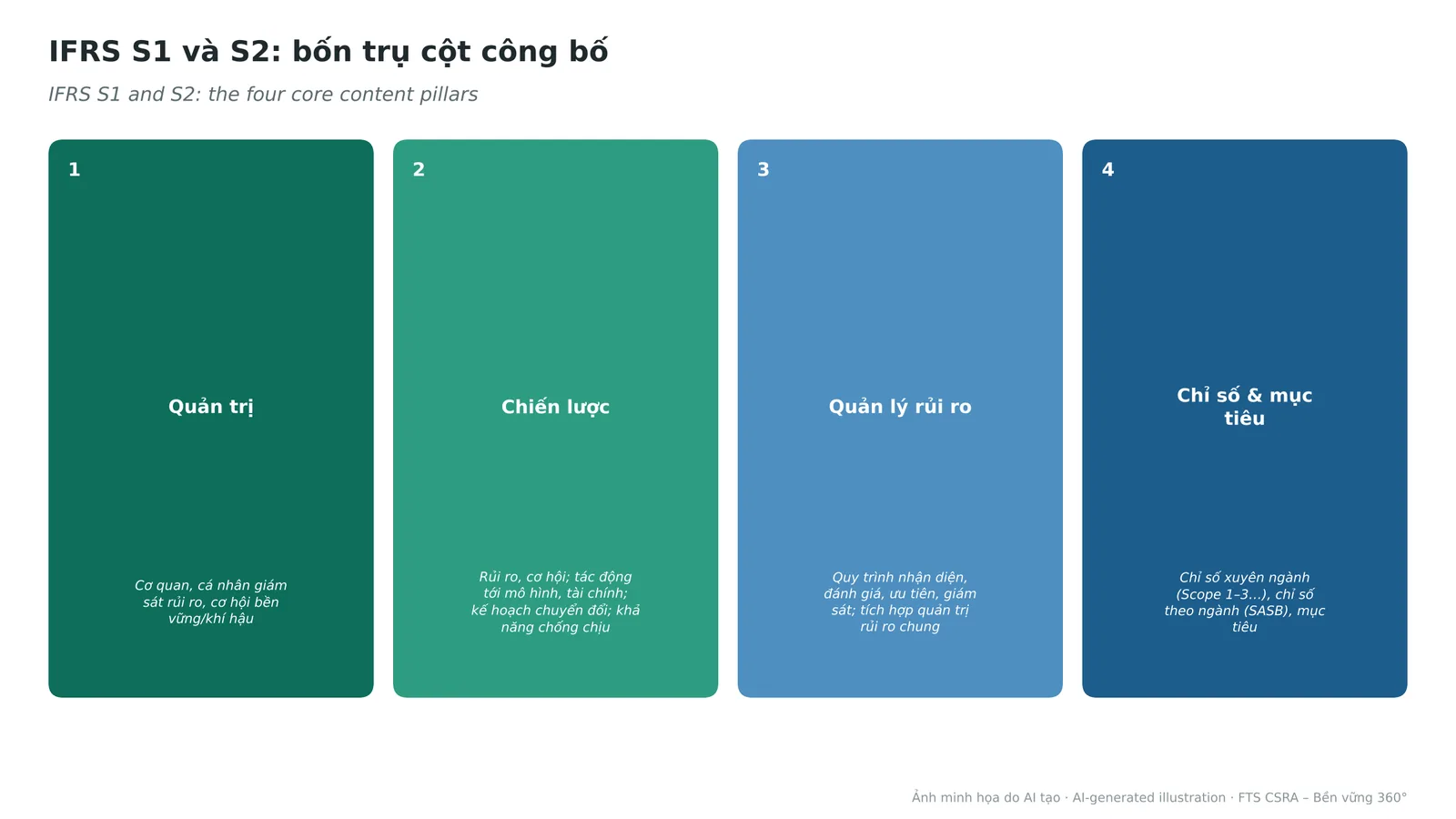
Figure 1. The four core content pillars of IFRS S1 and S2, carried over from TCFD. (AI-generated image) / Hình 1. The four core content pillars of IFRS S1 and S2, carried over from TCFD. (Ảnh do AI tạo)
Absolute gross Scope 1, 2, 3 (tCO₂e) measured under the GHG Protocol (2004) unless a jurisdiction requires otherwise; location-based Scope 2 plus contractual-instrument information; Scope 3 categories included; split by consolidated group and other investees; asset managers, banks and insurers disclose financed emissions
Transition risks
Amount and percentage of assets or business activities vulnerable to transition risks
Physical risks
Amount and percentage of assets or business activities vulnerable to physical risks
Climate-related opportunities
Amount and percentage of assets or business activities aligned with climate opportunities
Capital deployment
Capital expenditure, financing or investment deployed towards climate risks and opportunities
Internal carbon prices
Whether and how applied in decision-making; price per tonne CO₂e
Remuneration
How climate considerations factor into remuneration; % of executive remuneration recognised in the period linked to climate
2.3. Eight general requirements (IFRS S1)
Requirement
Content
Fair presentation
Complete, neutral and accurate depiction of risks and opportunities; additional information where needed
Materiality
Information is material if omitting, misstating or obscuring it could influence primary users' decisions
Reporting entity
Same reporting entity as the financial statements
Connected information
Links between risks, opportunities and the financial statements; consistent data and assumptions
Timing
Published at the same time and for the same period as the financial statements
Comparative information
Comparatives for all amounts disclosed
Statement of compliance
Explicit and unreserved statement only when all requirements are met
Sources of guidance
Shall consider SASB; may consider CDSB guidance and other frameworks such as GRI and ESRS if not conflicting
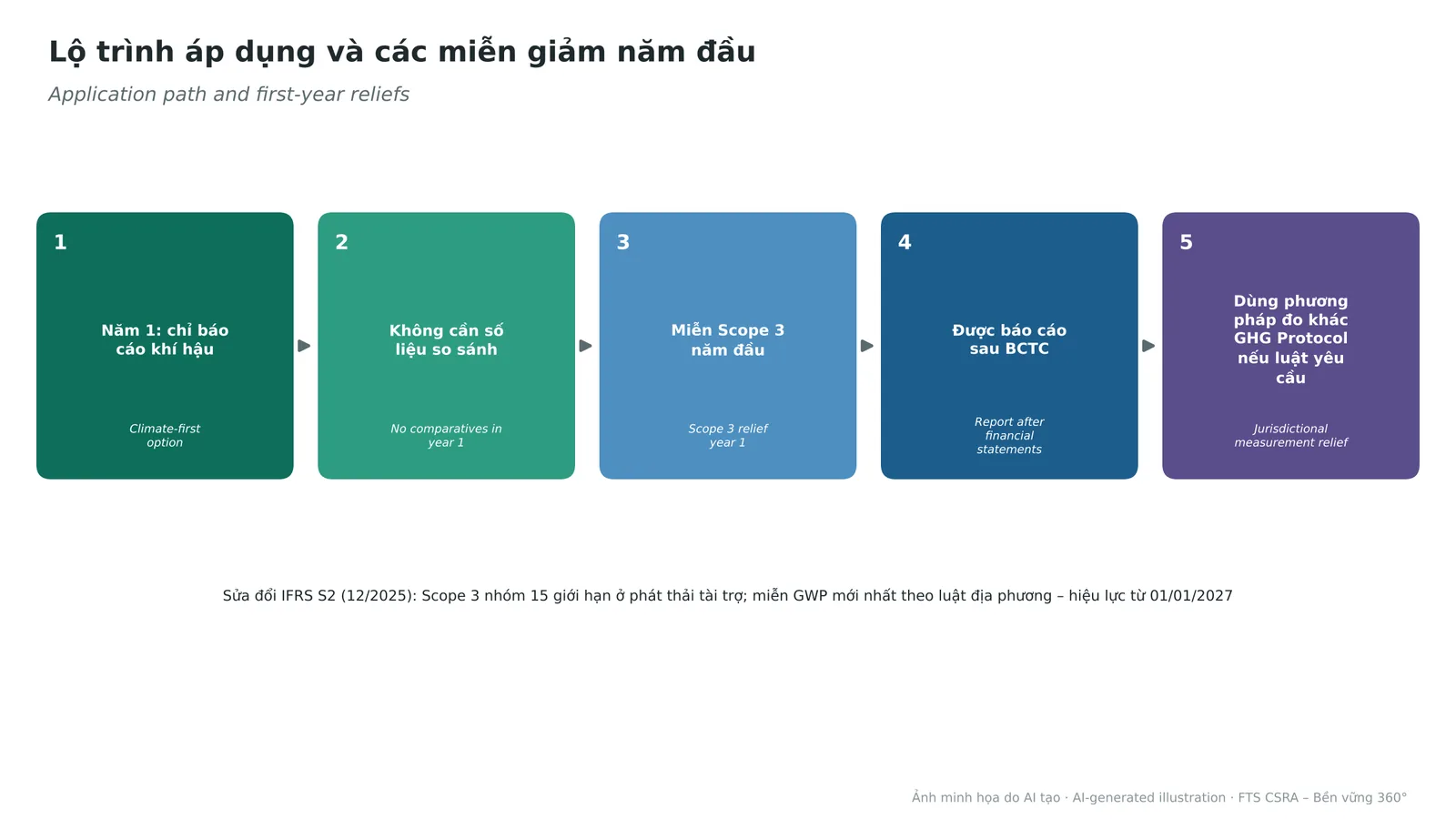
2.4. First-year transition reliefs
Relief
Content
Climate first
In year one, disclose only climate risks and opportunities under S2; in year two no comparatives are needed for other topics
No comparatives
Comparative information not required in year one
Scope 3
Scope 3 emissions (including financed emissions) not required in year one
Timing
In year one, disclosures may follow the financial statements (with the Q2 interim report or within nine months of period end)
Measurement
In year one, an entity may keep using a GHG measurement method other than the GHG Protocol if used immediately before
Figure 2. Application path and first-year reliefs under IFRS S1 and S2. (AI-generated image) / Hình 2. Application path and first-year reliefs under IFRS S1 and S2. (Ảnh do AI tạo)
Users and how to apply it
Users: listed companies, banks, insurers, issuers of international bonds, and subsidiaries of groups in ISSB-adopting jurisdictions (Australia, Singapore, Hong Kong, Japan, the UK, Malaysia, Brazil…).
Run a gap analysis between current reporting (Circular 96, GRI, TCFD) and S1/S2.
Set up a cross-functional team: finance, risk, sustainability, operations.
Identify material climate risks and opportunities, using the industry-based guidance (SASB).
Inventory Scope 1 and 2 GHG under the GHG Protocol; plan for Scope 3.
Start scenario analysis qualitatively and move to quantitative as resources allow.
Connect data with the financial statements (estimates, assumptions, impairment); prepare for independent assurance.
Practical example
Hypothetical case: Commercial bank B (listed, with foreign shareholders) prepares a voluntary IFRS S2 report for FY2026.
Pillar
Preparation
Metric
Governance
The Board Risk Committee oversees climate risk quarterly
% of executive pay linked to green credit targets
Strategy
Risks: loans to coal power and Mekong Delta agriculture exposed to saline intrusion; opportunity: renewable energy lending
Exposure to transition and physical risk (VND bn, %)
Risk management
Climate risk built into the credit risk framework and stress tests
Number of clients with environmental and social ratings
Metrics, targets
Scopes 1 and 2; PCAF financed emissions next year (using the year-one relief)
tCO₂e; green lending +25% per year
Notes for use in Vietnam
No mandatory roadmap yet: Vietnam has not issued an official roadmap for ISSB Standards; listed companies still disclose environmental and social information under Circular 96/2020/TT-BTC.
Link to the IFRS roadmap: the financial reporting scheme (Decision 345/QĐ-BTC, 2020) introduced voluntary IFRS application for certain groups; companies already on IFRS will find S1/S2 easier, as the reporting entity and timing are the same.
Banks: the State Bank of Vietnam already regulates environmental risk management in lending (Circular 17/2022/TT-NHNN); this data is a good input for S2.
Capital-market pressure: foreign funds and market upgrade efforts are raising demand for ISSB-aligned reporting.
Avoid mechanical translation: “financial materiality” differs from GRI's “impact materiality”; use GRI alongside for impacts.
Method & scope
Content compiled and interpreted from FTS Impact Lab and documents of the issuing body; versions and sources should be verified before publication.
European and Japanese buyers increasingly ask Vietnamese companies one question: “Have you carried out due diligence on your supply chain?” On Sustainability 360° (Bền vững 360°), FTS CSRA experts break down the OECD Due Diligence Guidance: the six steps and their specific actions, the eight characteristics of due diligence, the cause–contribute–linked logic and how Vietnamese suppliers can apply it.
ISO 14001:2026 has formally replaced the 2015 edition, placing climate change, biodiversity and a life-cycle perspective at the heart of environmental management. On Sustainability 360° (Bền vững 360°), FTS CSRA experts walk through clauses 4–10, highlight what is new, list the mandatory documented information, suggest environmental indicators and set out a transition path for Vietnamese companies.
After climate, nature is the next “asset” investors want companies to measure. On Sustainability 360° (Bền vững 360°), FTS CSRA experts explain the TNFD recommendations: 14 recommended disclosures, the 16 components of the LEAP approach, the core global disclosure metrics and how Vietnamese agriculture, seafood and extractive companies can get started.
Every “tonne of CO₂ equivalent” in a sustainability report needs a common method, and that method is the GHG Protocol. On Sustainability 360° (Bền vững 360°), FTS CSRA experts present the five accounting principles, the three emission scopes, all 15 Scope 3 categories, the mandatory reporting elements, the status of the standards revision and how it links to Vietnam's GHG inventory obligations.
In 2026 Europe narrowed the scope of the CSRD and adopted a leaner revised ESRS, yet EU groups still need data from Vietnamese suppliers. On Sustainability 360° (Bền vững 360°), FTS CSRA experts present the 12-standard ESRS architecture, every disclosure requirement by code, double materiality, the Omnibus and 2026 revision changes and how Vietnamese companies can prepare.
A bank does not need to report wastewater like a dye house, and SASB is the standard that answers “what should my industry disclose?”. On Sustainability 360° (Bền vững 360°), FTS CSRA experts list all 77 industries across 11 sectors, the 26 general issue categories, how to read metric codes and the full metric sets for two industries key to Vietnam: apparel and footwear, and commercial banks.
B Corp certification has changed the rules: no more scoring 80 points on a questionnaire; companies must now meet mandatory requirements in each impact topic. On Sustainability 360° (Bền vững 360°), FTS CSRA experts analyse B Lab Standards V2: the Foundation Requirements, seven Impact Topics with specific requirements, the Year 0 – Year 3 – Year 5 pathway and what Vietnamese companies and social enterprises should know before applying.
Every supply chain due diligence rule today, from the OECD to Germany's Supply Chain Act and the EU CSDDD, traces back to 31 concise UN principles. On Sustainability 360° (Bền vững 360°), FTS CSRA experts present all 31 Guiding Principles on Business and Human Rights under the three “Protect, Respect and Remedy” pillars, the eight effectiveness criteria for grievance mechanisms and how Vietnamese companies can apply them.