Contents
##
Overview and origin
| Item | Details |
|---|---|
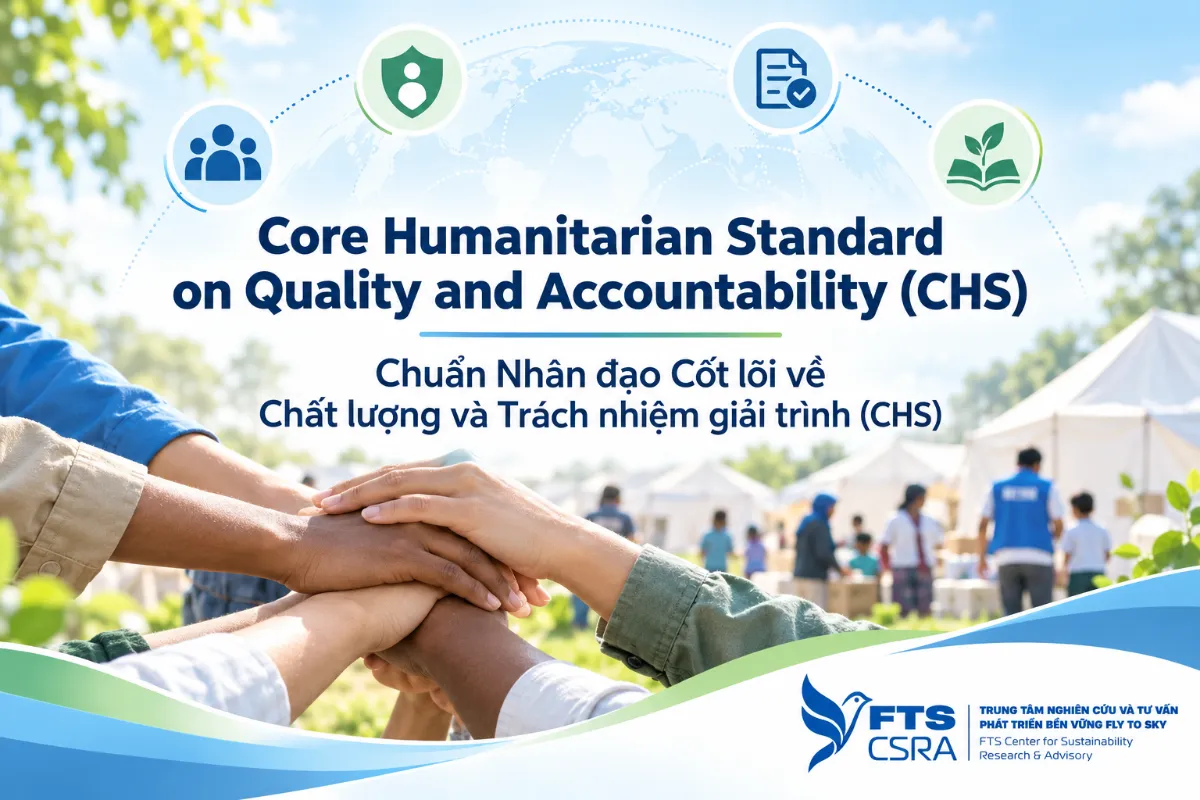
| Vietnamese name | Chuẩn Nhân đạo Cốt lõi về Chất lượng và Trách nhiệm giải trình (CHS) |
| English name | Core Humanitarian Standard on Quality and Accountability (CHS) – 2024 Edition |
| Issuer / administrator | Jointly owned by the CHS Alliance, Sphere and Groupe URD. Developed through broad consultation with thousands of organizations, individuals and crisis-affected people. |
| Nature | A voluntary standard with nine commitments and 50 requirements, usable for self-assessment, peer review, independent verification or certification. |
| Reference scope | Humanitarian, development, protection and peacebuilding work; for international and local organizations, public bodies, companies and community groups working directly or through partners. |
The CHS was launched in 2014, merging earlier standards (HAP 2010, the People In Aid Code, the Sphere Core Standards). The second edition, CHS 2024, frames every commitment from the perspective of “People and communities…”, extends beyond the humanitarian sector, and strengthens prevention of sexual exploitation and abuse, environmental protection and the role of local actors. The CHS is the foundation standard of the Sphere Handbook.
Purpose and main structure
Purpose: to improve the quality, effectiveness and accountability of support to people affected by crisis and vulnerability. Each commitment has numbered requirements (e.g., 1.1–1.6) describing what the organization must do; most end with a requirement for a coherent organizational approach (policies, systems, resources).
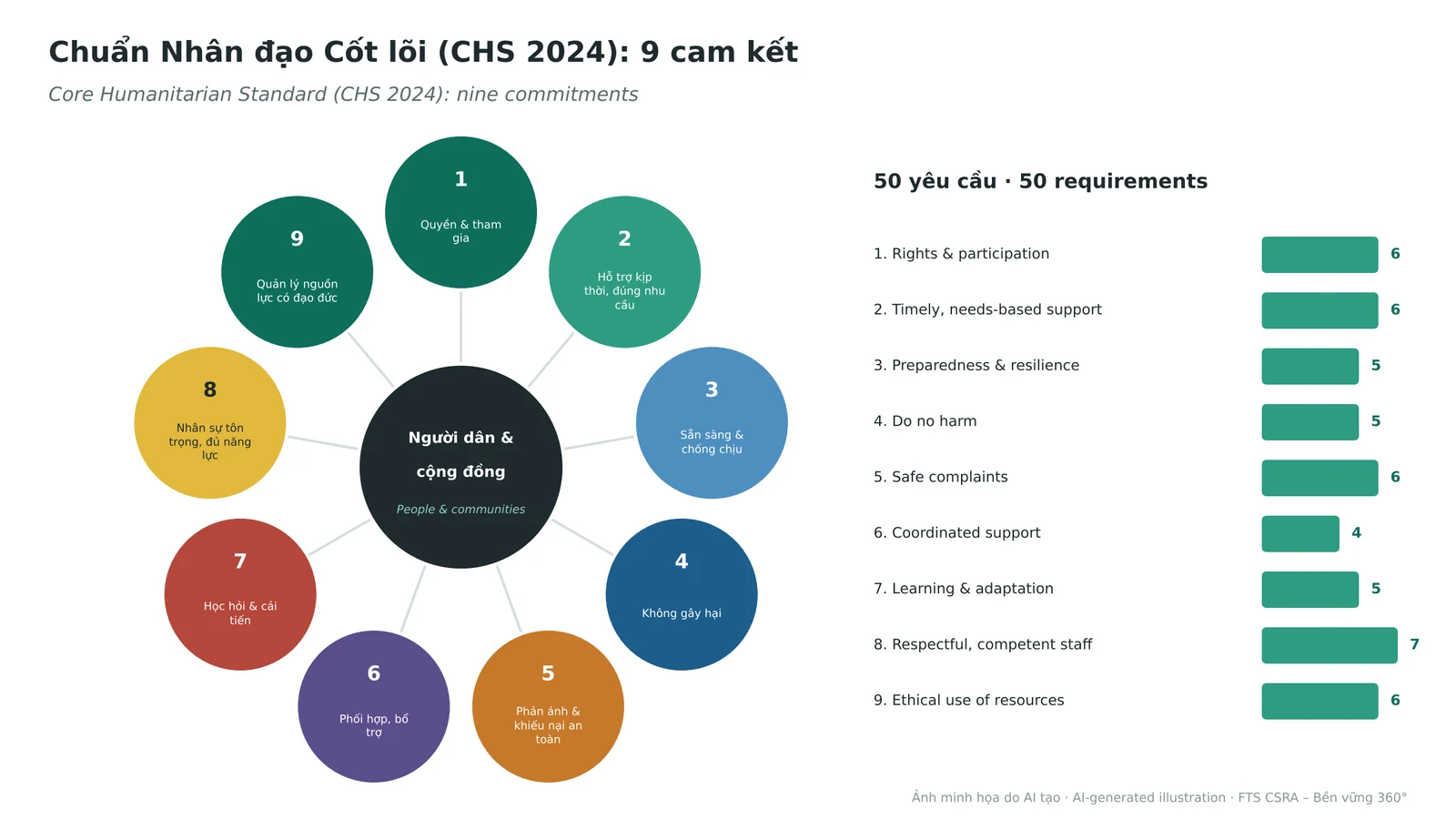
2.1. The nine commitments and 50 requirements
| # | Commitment | Reqs | Main content of the requirements |
|---|---|---|---|
| 1 | People and communities can exercise their rights and participate in actions and decisions that affect them. | 6 | Accessible information; meaningful consultation and participation; attention to excluded groups (women, persons with disabilities, older people, children) |
| 2 | People and communities access timely and effective support in accordance with their specific needs and priorities. | 6 | Disaggregated needs assessment; context-based design; timely delivery; adjustment as needs change |
| 3 | People and communities are better prepared and more resilient to potential crises. | 5 | Build on local capacity; disaster risk reduction; transition and exit planning; links to longer-term development |
| 4 | People and communities access support that does not cause harm to people or the environment. | 5 | Analyse risks of harm; prevention of sexual exploitation, abuse and harassment (PSEAH); data protection; reduced environmental impact |
| 5 | People and communities can safely report concerns and complaints and get them addressed. | 6 | Community-designed complaints mechanisms; confidential and safe; timely handling; referral of sensitive cases |
| 6 | People and communities access coordinated and complementary support. | 4 | Join coordination mechanisms; share information; avoid duplication and gaps; respect roles of authorities and local actors |
| 7 | People and communities access support that is continually adapted and improved based on feedback and learning. | 5 | Monitoring and evaluation; use feedback to adapt; share learning; innovation |
| 8 | People and communities interact with staff and volunteers that are respectful, competent, and well-managed. | 7 | Code of conduct; safe recruitment; training; staff safety and wellbeing; performance management |
| 9 | People and communities can expect that resources are managed ethically and responsibly. | 6 | Use resources as intended; anti-fraud and anti-corruption; transparent financial management; responsible procurement |
2.2. Suggested tracking indicators per commitment
The CHS sets no mandatory quantitative indicators. FTS CSRA proposes this minimum set, best combined with surveys of affected people:
| Commitment | Suggested tracking indicators |
|---|---|
| 1 | % of people surveyed who know their entitlements and took part in decisions |
| 2 | Days from needs assessment to delivery; % of support reaching priority groups |
| 3 | % of projects with transition/exit plans; local partners strengthened |
| 4 | % of staff and partners trained on PSEAH; harm incidents recorded and handled |
| 5 | Complaints received; % answered on time; % of people who know how to complain |
| 6 | Coordination meetings attended; % of activities reported to joint coordination systems |
| 7 | Programme adjustments made based on community feedback |
| 8 | % of staff who signed the code of conduct; % completing mandatory training |
| 9 | Fraud/corruption cases detected and handled; % of spending audited |
Who uses it and how
Users: NGOs, social funds, volunteer groups, corporate social responsibility programmes and public agencies involved in relief.
- Self-assess against the 50 requirements using CHS Alliance tools; identify gaps.
- Prioritise Commitment 4 (do no harm, PSEAH) and Commitment 5 (complaints mechanisms) – the basis of community trust.
- Build CHS requirements into the project cycle: needs assessment, design, delivery, monitoring, closure.
- Collect feedback from people regularly and show how the organization adapted.
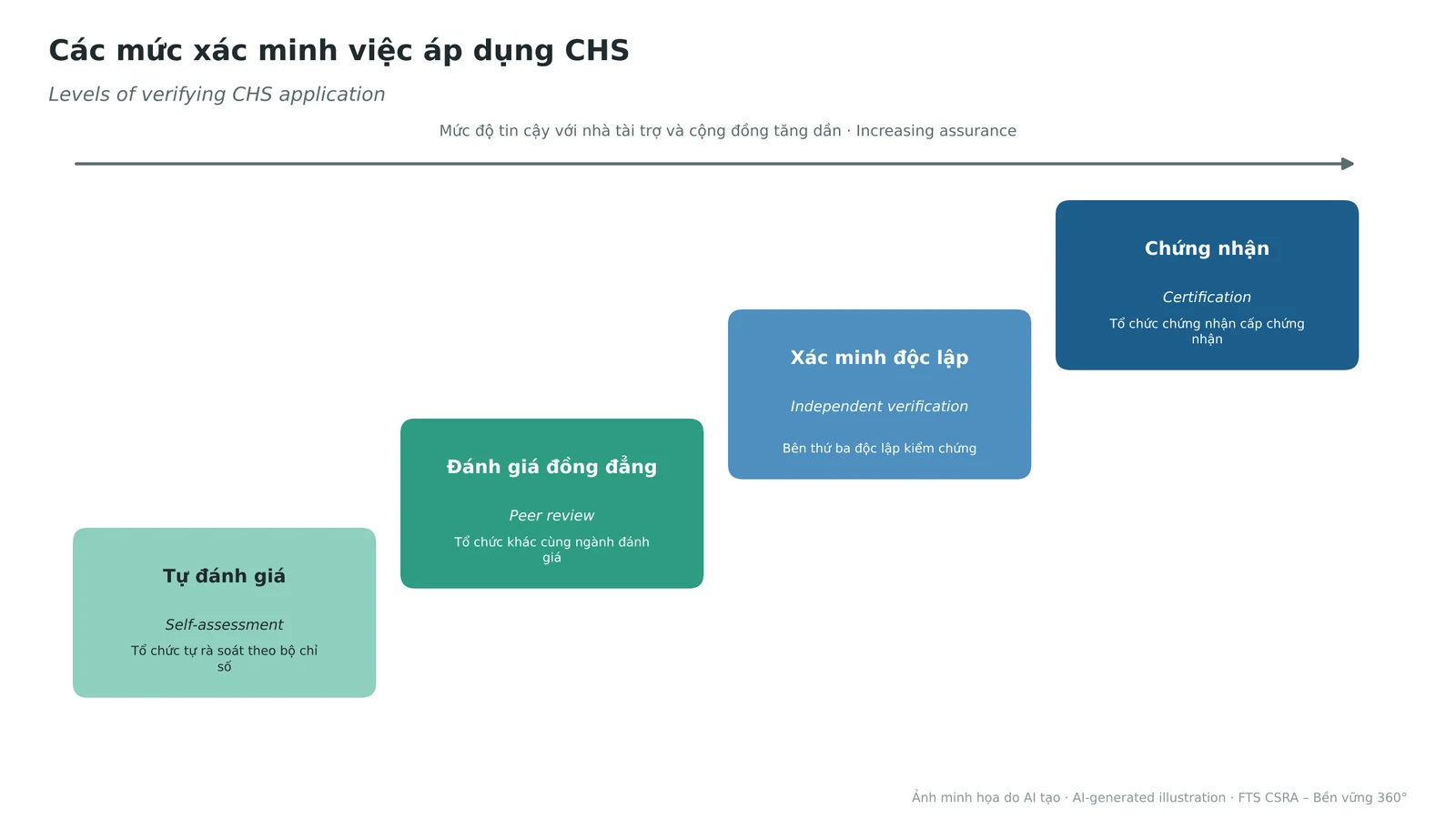
- Choose a verification level: self-assessment, peer review, independent verification or certification.
Practical example
Hypothetical case: Charity Fund K supports 2,000 flood-affected households in central Vietnam with cash and essential items.
| Commitment | Before applying CHS | After applying CHS |
|---|---|---|
| 2 – Needs-based support | Identical gift bags for every household | Rapid survey; 60% of households receive cash to choose for themselves, priority for households with persons with disabilities |
| 4 – Do no harm | No PSEAH rules for volunteers | 100% of volunteers sign the code of conduct and are trained |
| 5 – Safe complaints | No feedback channel | Hotline, drop box, Zalo; 46 reports, 100% answered within 7 days |
| 9 – Transparent resources | Aggregate income/expense report | Recipient lists by village, bank statements and independent audit published |
Notes for use in Vietnam
- Law on fundraising and relief: organizations and individuals raising donations must follow Decree 93/2021/ND-CP on mobilizing, receiving, distributing and using voluntary contributions; the CHS helps meet its transparency requirements.
- Financial transparency: publishing bank statements and recipient lists (with personal data protection under current rules) is a context-appropriate way to deliver Commitment 9.
- Coordination with local authorities (Commitment 6): work through the Fatherland Front Committees and commune authorities to avoid duplication and gaps.
- Protecting children and vulnerable groups: take care with photos and social media – images of recipients need consent and must not cause harm.
- Companies doing CSR: use the CHS as quality criteria for relief programmes, combined with GRI 413 (local communities) reporting.
Method & scope
Content compiled and interpreted from FTS Impact Lab and documents of the issuing body; versions and sources should be verified before publication.
References
- The Core Humanitarian Standard on Quality and Accountability – 2024 Edition (CHS Alliance, Groupe URD, Sphere) ↗ (accessed 2026-10-24)
- CHS Alliance – Core Humanitarian Standard ↗ (accessed 2026-10-24)
- Sphere – Introduction to the Core Humanitarian Standard 2024 ↗ (accessed 2026-10-24)
- Vietnam: Decree 93/2021/ND-CP on mobilizing, receiving, distributing and using voluntary contributions (accessed 2026-10-24)