CSR – Business or Charity?
Do businesses engage in CSR for the benefit of the community, or for their own interests?
When people think of CSR – Corporate Social Responsibility, they often associate it with familiar initiatives: companies providing scholarships, donating gifts to disadvantaged children, building schools, delivering disaster relief, planting trees, or organizing community-focused programs.

CSR – Business or Charity?
But then a question arises: If a company undertakes these activities to build its brand, earn customers' goodwill, and ultimately increase sales, is that still social responsibility, or simply a form of marketing?
Conversely, if a company spends money on charitable activities without generating any business value, can that truly be considered CSR? The answer is not simply yes or no.
Research conducted over the past two decades suggests that CSR lies at the intersection of responsibility, society, and business value. This relationship becomes even more apparent in Vietnam.
CSR Is Not Simply About Giving Back
One common interpretation of CSR is that businesses earn money from the market and then give back a portion to society. This is not entirely wrong, but it is limited.
Modern CSR extends beyond charitable donations. It concerns how businesses treat employees, customers, suppliers, communities, and the environment.
A company that pays fair wages, ensures occupational safety, provides safe products, reduces environmental impacts, is transparent with customers, or develops a responsible supply chain is also fulfilling its social responsibilities.
If a company pollutes the environment, violates workers' rights, or sells substandard products and then organizes a major gift-giving campaign, it is difficult to characterize its overall conduct as socially responsible.
Charity cannot automatically erase the negative impacts of business operations. Traditional approaches to CSR often overlook this point.
So, Is CSR a Business Activity?
CSR can generate business value. But describing it solely as a tool for making money is an oversimplification.
A widely cited study by Orlitzky, Schmidt, and Rynes (2003) analyzed 52 studies with 33,878 observations and found a generally positive relationship between corporate social and environmental performance and financial performance. CSR reputation was particularly associated with financial outcomes.
Friede, Busch, and Bassen (2015) synthesized evidence from more than 2,000 empirical studies on ESG and financial performance. Most findings indicated a positive relationship, although the magnitude varied by context and measurement method.
A 2025 meta-analysis of 223 studies across countries similarly identified a generally positive relationship between CSR and financial performance, with substantial variation across contexts and methods.
CSR can therefore generate business benefits, but it does not automatically convert spending into profit.
How Does CSR Create Business Value?
CSR value does not usually appear immediately as a simple return on spending. It can arise indirectly through several mechanisms.
1. Building Trust
Consumers buy more than products: they place trust in the businesses behind them. Responsible companies can build stronger reputations, reduce reputational risks, and establish long-term customer relationships.
Research involving more than 1,000 Vietnamese automotive customers found that perceptions of CSR and customer trust influenced purchase intentions.
CSR may not directly generate sales, but it can create conditions that encourage purchasing.
2. Attracting and Retaining Talent
Responsible businesses may appeal to employees as well as customers. As workers increasingly value meaningful work, workplace conditions, organizational culture, and social impact, CSR can become part of an employee value proposition.
This is why CSR is increasingly discussed alongside corporate culture, employer branding, and sustainable development.
3. Reducing Risks
Effective management of environmental, labor, ethical, and supply-chain issues can reduce potentially costly risks.
A product scandal, environmental incident, labor dispute, supply-chain problem, or communications campaign that backfires can impose costs exceeding the initial investment in responsible business practices.
CSR can therefore be considered an investment in business resilience, not merely a community expense.
However, CSR does not always produce financial benefits.
Promotional narratives often imply a straightforward chain: CSR leads to a stronger brand, greater customer preference, and increased revenue. Reality is more complex.
A study of Vietnamese listed companies from 2012 to 2017 found that CSR disclosure had an overall negative effect on corporate performance. Environmental responsibility had a notably negative effect, social responsibility a weak positive effect, and the economic dimension no significant effect.
This does not mean CSR necessarily causes losses. CSR has costs, and its benefits may not arise immediately or equally for every company.
Waste-treatment investments, better wages, and environmentally friendly materials may increase short-term costs but generate longer-term benefits in compliance, reputation, market access, employee relations, and continuity.
The better question is not whether CSR makes money, but how businesses create social and economic value, over what time horizon, and for which stakeholders.
What About CSR in Vietnam?
Vietnam is a particularly interesting case. CSR has existed for years, but it was long associated mainly with sponsorship, charity, and community programs.
As early as 2004, World Bank research in Vietnam raised the business case for sustainable development, positioning social responsibility within sustainable business rather than charity alone.
A study of 130 Vietnamese enterprises from 2012 to 2017 found a statistically significant positive relationship between CSR and financial performance.
A 2024 study of 29 listed Vietnamese commercial banks over 2016–2022 found positive effects of CSR on return on assets (ROA) and return on equity (ROE), but no significantly positive relationship with Tobin's Q.
These findings need not contradict the previously mentioned 2022 study. CSR outcomes depend on the company, industry, implementation, measurement, and time period. No single company's results can prescribe the same CSR approach for every business.
Do Vietnamese Consumers Really Care About CSR?
Yes, but its influence should not be exaggerated.
Research on Vietnamese consumers in urban and rural areas, based on Carroll's four dimensions of CSR, established the relevance of CSR perceptions to business and marketing research.
A 2025 study of 312 Vietnamese Generation Z consumers found that perceived CSR significantly affected brand attitudes, but not purchase intentions directly. Its effect on purchase intentions operated indirectly through brand attitudes.
Thus CSR does not necessarily make people buy immediately. It may influence perception, trust or attitudes, and subsequently behavior.
Is Charitable Giving Considered CSR?
It can be, but charity and CSR are not synonymous.
Giving 1,000 gifts to disadvantaged children can create real social value. Yet a company's social responsibility strategy cannot mature if it consists only of distributing gifts, taking photographs, and publishing posts.
Mature CSR asks: What social issue is being addressed? How does it relate to the business? Who benefits? How is impact measured? How long does the program last? What happens when funding ends? Has the company changed its operations to reduce harm?
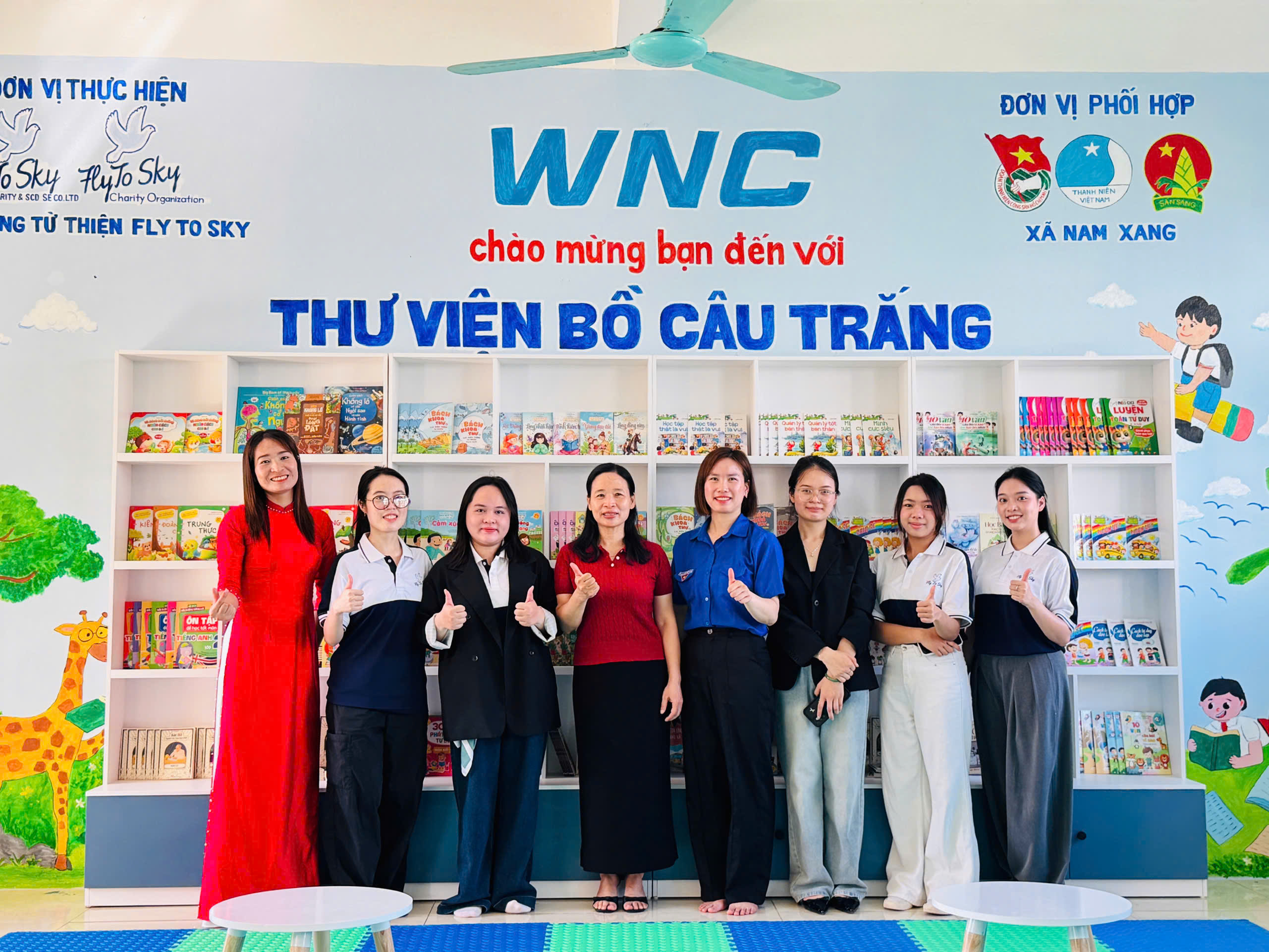
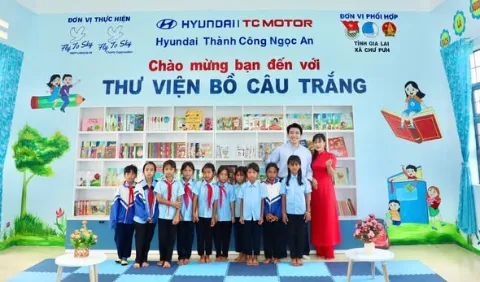
A sponsored school library may have little lasting impact if it has no new books, dedicated personnel, reading activities, or maintenance system, despite a large initial budget.
Modern CSR therefore shifts attention from how much is given to what impact is created.
The Most Effective CSR Lies at the Intersection of Social Needs and Business Strategy
Michael Porter and Mark Kramer introduced Creating Shared Value, emphasizing that economic and social benefits need not be mutually exclusive. Addressing social problems can create opportunities for economic value.
A food company might distribute free meals to children as a community initiative. It could also invest in school nutrition, health education, improved ingredients, support for local farmers, sustainable supply chains, and affordable nutritious products.
Here, social needs and business operations intersect. The company earns revenue while people and communities benefit. This is the logic of shared value.
Effective CSR Does Not Necessarily Require Large Donations
A VND 10 billion CSR budget does not automatically create more social impact than a VND 1 billion budget. Program design matters more.
VND 1 billion spent on a short-term, unmeasured initiative without a maintenance mechanism may create less impact than VND 500 million invested in a model that operates for years.
Businesses should shift from asking how much they will sponsor this year to what social impact they will create. This brings CSR closer to ESG, impact measurement, and sustainable development.
Is CSR Motivated by Business Interests Insincere?
Not necessarily. If a company genuinely cares about education and develops a community education program that also improves its reputation, the business benefit does not cancel out the social value.
Communities and businesses can both benefit. The key question is whether business value is created by delivering additional value or by concealing harmful impacts.
A polluting company using a tree-planting campaign to present itself as green is problematic. A company that actually reduces emissions, changes production processes, publishes data, and communicates those changes is different.
CSR need not be entirely selfless. It must be genuine, responsible, and capable of producing verifiable impact.
So, Is CSR Business or Charity?
CSR should not be forced into either category. Charity focuses on giving, and business on economic value. CSR concerns taking responsibility for the social and environmental impacts of business operations while seeking lasting value for stakeholders.
Mature CSR may involve charity, business benefits, stronger brands, greater trust, reduced risks, or new markets. None of these alone guarantees good CSR.
The essential questions are what impact a business creates, whether it is real and measurable, and whether it is produced responsibly.
From Doing Charity to Creating Impact
The biggest change in CSR may not be greater spending on communities, but better answers to three questions: What problem is the business solving? What impact does its solution create? Why is the business better placed than other actors to solve it?
When companies can answer these questions, CSR becomes part of how they understand their role in society, rather than simply a charity budget.
Well-designed CSR is not about whether businesses give to society or society gives to businesses. It is about creating economic value without separating it from social value.
This is a more difficult challenge, and one worth pursuing for Vietnamese businesses in their next stage of development.
Research References
- Orlitzky, M., Schmidt, F. L., & Rynes, S. L. (2003). Corporate Social and Financial Performance: A Meta-Analysis. Organization Studies, 24(3), 403–441.
- Friede, G., Busch, T., & Bassen, A. (2015). ESG and financial performance: aggregated evidence from more than 2000 empirical studies. Journal of Sustainable Finance & Investment, 5(4), 210–233.
- Porter, M. E., & Kramer, M. R. (2011). Creating Shared Value. Harvard Business Review.
- Huang, Y-F., Do, M-H., & Kumar, V. (2019). Consumers' perception on corporate social responsibility: Evidence from Vietnam. Corporate Social Responsibility and Environmental Management, 26, 1272–1284.
- Nguyen, H. N. & Pham, L. X. (2018). The relationship between country-of-origin image, corporate reputation, corporate social responsibility, trust and customers' purchase intention: Evidence from Vietnam. Journal of Applied Economic Sciences, 13(2), 498–509.
- Ho, T. V. A. & Pham, T. A. (2020). Corporate Social Responsibilities and Corporate Financial Performance in Vietnam Context. Journal of Science and Technology – IUH.
- Corporate Social Responsibility and Financial Performance: The Case in Vietnam (2022). Cogent Economics & Finance.
- The Impact of Corporate Social Responsibility on Brand Attitude and Purchase Intention of Vietnamese Generation Z Consumers (2025). Journal of Finance – Marketing Research.
Corporate Social Responsibility and Corporate Financial Performance of Commercial Banks: Evidence from Vietnam (2024). Journal of Development and Integration.
Fly To Sky's Comprehensive Community Impact Solutions
As CSR and sustainable development increasingly become part of business strategies, effective CSR/ESG programs require more than a community budget. They require appropriate implementation models, clearly defined beneficiaries, trusted local partners, coordinated resources, and measurable, documented results.
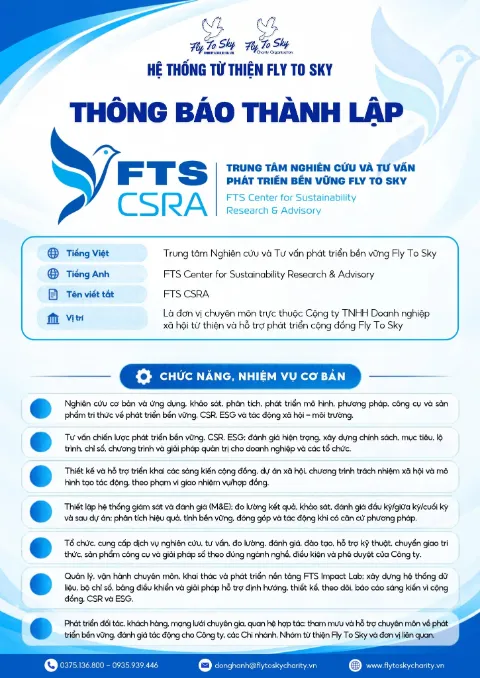
Fly To Sky aims to partner with businesses to turn CSR/ESG objectives into concrete community programs through consulting, design, needs assessment, local partnerships, resource mobilization, activity organization, product supply, and impact reporting.
Fly To Sky is a charitable network operating on a not-for-profit basis, established on September 2, 2018, in Gia Lai Province, Vietnam. It comprises Fly To Sky Charity and Community Development Support Social Enterprise Co., Ltd. and The Fly To Sky Charity Organization, which participates in the National Volunteer Networks affiliated with the Vietnam National Volunteer Center under the Central Committee of the Ho Chi Minh Communist Youth Union.
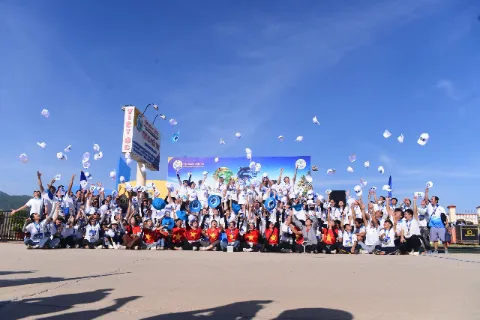
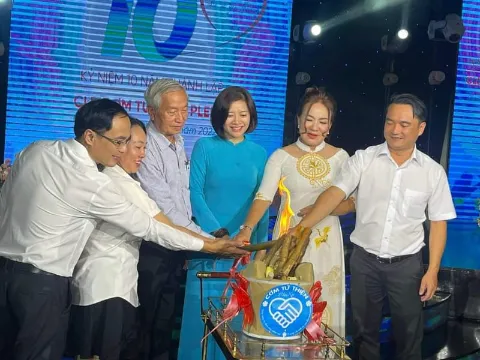
Operating nationwide, Fly To Sky has received six national awards and one international award for volunteering and community service and has been nationally recognized by the Central Youth Union for seven consecutive years.
Over eight years, Fly To Sky has developed more than 200 community programs and 30 projects across various fields. It has also worked with more than 200 businesses, companies, and organizations on social responsibility, community initiatives, volunteering, and CSR/ESG and sustainable development activities in Vietnam.
Building on this experience, Fly To Sky has developed its Comprehensive Community Impact Solutions model to act as a consultant, implementing organization, service provider, product supplier, or long-term partner according to each client's needs.
COMPREHENSIVE COMMUNITY IMPACT SOLUTIONS
1. STRATEGIC CONSULTING & SUSTAINABLE DEVELOPMENT
Consulting on community development, CSR, ESG, and sustainable development strategies and programs aligned with each partner's direction and values.
2. PROGRAM DESIGN & IMPLEMENTATION
Designing, organizing, constructing, and operating community initiatives, charity and CSR programs, internal corporate activities, experiential programs, volunteer tourism, events, talk shows, and workshops for businesses, organizations, and individuals nationwide.
3. RESOURCE MOBILIZATION & PARTNERSHIP DEVELOPMENT
Connecting, mobilizing, receiving, and managing financial resources, in-kind contributions, products, personnel, and expertise from domestic and international individuals, businesses, and organizations, directing them toward community needs and impactful projects.
4. FUNDRAISING CAMPAIGNS & SOCIAL IMPACT BUSINESS INITIATIVES
Developing fundraising campaigns, social-impact business initiatives, trade promotion, and sustainable livelihood support models to expand opportunities for communities and disadvantaged groups.
5. TRAINING, WORKSHOPS & CAPACITY BUILDING
Designing and delivering training, workshops, and experiential activities to strengthen community management, coordination, life skills, leadership, volunteering, and initiative development among young people, organizations, and businesses.
6. CUSTOMIZED GIFTS, GOODS & PRODUCTS
Supplying gifts, souvenirs, essential goods, and community program materials; designing, producing, and printing uniforms, backpacks, tote bags, event merchandise, gift sets, and communications materials.
Fly To Sky can provide end-to-end supply through one contact point, from product consultation, design, production and printing, quantity control, and packaging to transport and delivery.
7. EMPLOYMENT & SUSTAINABLE LIVELIHOODS FOR DISADVANTAGED GROUPS
Connecting disadvantaged groups with employment, livelihood resources, and markets; supporting product development, trade promotion, and sustainable livelihood opportunities.
8. SOCIAL IMPACT MEASUREMENT & ENHANCEMENT
Monitoring and evaluating program results, developing impact indicators, reports, and documentation to help partners understand social value and expand lasting initiatives.
Fly To Sky can conduct field surveys, collect local data, document beneficiaries and activities, and gather photographs and field information for evaluation, reporting, and impact records.
FLY TO SKY – YOUR CSR/ESG IMPLEMENTATION PARTNER IN VIETNAM
Fly To Sky has the legal status and foundation to mobilize, receive, and manage domestic and international resources and sponsorships, and to provide comprehensive community development and CSR solutions in Vietnam.
Its Comprehensive Community Impact Solutions model supports partners from strategic planning and design to implementation and impact measurement. Fly To Sky can assess local needs, coordinate with authorities, schools, healthcare facilities, and social organizations, mobilize volunteers and corporate personnel, organize main and supporting activities, and handle logistics, field operations, products, gifts, and materials.
Through a single point of contact, Fly To Sky can deliver a complete program or individual components, allowing partners to focus on objectives and impact while Fly To Sky manages coordination and implementation.
As a social enterprise, Fly To Sky's services and products create value for partners while helping generate resources to sustain, reinvest in, and expand community initiatives in accordance with applicable law. Corporate resources can thus become tangible programs, products, and benefits for communities.
For businesses operating multiple CSR programs or working across several locations, Fly To Sky can act as a central implementation and supply partner, reducing the need to coordinate many separate vendors.
Fly To Sky does not apply the same model to every business. Each program is tailored to CSR/ESG objectives, budgets, beneficiary groups, locations, personnel, and brand direction.
We believe combining corporate resources and CSR/ESG priorities with Fly To Sky's practical experience, local networks, volunteers, and supply capabilities can produce programs that benefit communities and businesses alike.
Fly To Sky welcomes opportunities to meet with businesses, introduce its capabilities, program ecosystem, networks, and representative projects, and discuss potential CSR/ESG and community partnerships.
References
- Website Fly To Sky Charity ↗ (accessed 2026-10-26)